


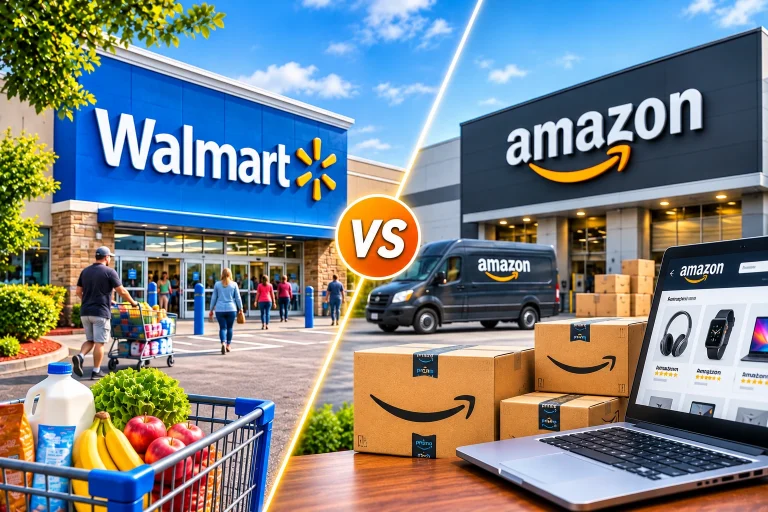
Amazon is now bigger than Walmart by sales, but Walmart is bigger by stores and staff. Amazon earned $716.9 billion in 2025, edging past Walmart’s $713.2 billion. On price, a 2026 study found Amazon slightly cheaper online, but only by about 4% on identical items. For groceries and in-store shopping, Walmart still has the edge.
The right choice depends on what you are comparing: company size, prices, memberships, delivery or jobs. Below, I compare Walmart and Amazon on each, using company filings and 2026 price studies.
Key Takeaways
- Size: Amazon passed Walmart in yearly sales in 2026, $716.9 billion to $713.2 billion. Over the 12 months to September 2026, Amazon’s sales reached $797.5 billion.
- Prices: Profitero’s study of about 10,300 items found Amazon cheaper in all 16 categories, but only 4% cheaper than Walmart on identical products.
- Membership: Walmart+ costs $98 a year, while Amazon Prime costs $139 a year.
- Groceries: Walmart holds more than 30% of US online grocery sales, against more than 20% for Amazon, according to eMarketer data cited by Darden.
- Profit: Amazon earns far more, thanks to AWS, its cloud business, which grew 39% in Q3 2026.
Walmart vs Amazon at a Glance
| Factor | Walmart | Amazon |
|---|---|---|
| Latest full-year revenue | $713.2B (FY2026, to Jan 2026) | $716.9B (2025) |
| Latest quarter | $187.9B, +5.9% (to July 2026) | $201.9B, +12% (to Sept 2026) |
| Employees | About 2.1 million | About 1.58 million |
| Stores | More than 10,900 in 19 countries | Mostly online |
| Paid membership | Walmart+: $12.95/month or $98/year | Prime: $14.99/month or $139/year |
| Biggest profit driver | Retail, plus fast-growing ads | AWS cloud computing |
| Largest owner | Walton family, about 44% | Widely held public company |
| Stock ticker | WMT (Nasdaq) | AMZN (Nasdaq) |
For the details on Walmart’s owners, see our guide on who owns Walmart.
Which Is Bigger, Walmart or Amazon?
Amazon is bigger by revenue. On February 19, 2026, NPR reported that Walmart posted lower yearly sales than Amazon for the first time. Amazon made $716.9 billion in 2025. Walmart made $713.2 billion in the fiscal year that ended in January 2026.
The gap has widened since then. Amazon’s sales grew 12% to $201.9 billion in the quarter ended September 2026, and reached $797.5 billion over the past 12 months, according to its Q3 2026 earnings release. Walmart’s sales grew 5.9% to $187.9 billion in its quarter ended July 2026.
But Walmart is bigger in physical size. It has more than 10,900 stores and about 2.1 million associates. Amazon had about 1.58 million employees at the end of 2025.
Where does each company’s money come from?
| Amazon segment (Q3 2026) | Sales | Growth |
|---|---|---|
| North America (retail) | $112.9B | +6% |
| International (retail) | $43.1B | +5% |
| AWS (cloud) | $46.0B | +39% |
Amazon’s online stores bring in most of its sales, but AWS brings in most of its profit. Walmart, by contrast, earns mainly from stores and online retail, with advertising and memberships growing fast. Walmart’s global ad business grew 46% to nearly $6.4 billion in fiscal 2026.
How did Amazon catch up?
The change happened over about two years:
| When | What happened |
|---|---|
| Prior fiscal years | Walmart’s revenue ($681 billion) was still ahead of Amazon’s ($638 billion), as Darden reported in 2025 |
| 2025 | Amazon passed Walmart in quarterly sales for the first time, according to Darden |
| February 2026 | Amazon passed Walmart in full-year sales, $716.9 billion to $713.2 billion |
| Q3 2026 | Amazon’s sales grew 12% in a quarter, about twice Walmart’s latest rate of 5.9% |
Will Walmart take the top spot back? Not soon on current growth rates. Amazon’s cloud business is growing much faster than retail, and that pushes its total sales up even when its stores grow slowly.
How Do Walmart and Amazon Make Money Differently?
The two companies look similar from the shopper’s side, but their business models are very different.
| Walmart segment (FY2026) | Net sales | Share |
|---|---|---|
| Walmart U.S. | $483.0B | 68% |
| Walmart International | $130.4B | 19% |
| Sam’s Club U.S. | $93.0B | 13% |
| Amazon segment (first 9 months of 2026) | Net sales | Growth |
|---|---|---|
| North America | $333.2B | +11% |
| International | $125.1B | +13% |
| AWS | $125.8B | +35% |
Walmart is almost entirely a retailer. Most of its money comes from selling goods in US stores and online. Amazon is a retailer plus a cloud company. AWS made up about a fifth of Amazon’s sales in the first nine months of 2026, but it earns much higher margins than retail.
For me, this is the most important difference between them. Walmart has to win on price every day. Amazon can afford thinner retail margins because AWS funds much of the business.
Is Amazon Cheaper Than Walmart?
Slightly, online. Profitero’s annual Price Wars study compared the online prices of about 10,300 items across 16 categories. It found Amazon had the lowest prices in all 16 categories, according to Kiplinger, updated in October 2026.
But the gap with Walmart was small:
- Amazon’s prices averaged 14% lower than competitors overall.
- Against Walmart on identical items, the gap was only about 4%.
- Amazon and Walmart had identical prices 75% of the time.
- Walmart usually came second.
Amazon had the lowest prices in video games, appliances, fashion, and sports and outdoors, with a narrow lead in beauty and toys.
What about groceries? The study did not include groceries. Kiplinger notes that Walmart’s grocery prices are generally lower than at Whole Foods Market, which Amazon owns. Walmart’s whole model is built on everyday low pricing, and that matters most in the grocery aisle.
For me, the takeaway is simple: for one-off online purchases, check both, because they match on price three times out of four. For a weekly grocery shop, Walmart is usually the safer bet on price.
Walmart+ vs Amazon Prime: Which Membership Is Better?
| Feature | Walmart+ | Amazon Prime |
|---|---|---|
| Monthly price | $12.95 | $14.99 |
| Yearly price | $98 | $139 |
| Free grocery delivery | On orders of $35 or more | Free Amazon Grocery same-day delivery over $25; Amazon Fresh over $100 |
| Streaming included | Choice of Paramount+ Essential or Peacock Premium | Prime Video (with ads) |
| Ad-free video | Depends on chosen service | Prime Video Ultra add-on, $4.99/month from April 2026 |
| Extras | Gas discounts | Shopping perks across Amazon services |
Prices come from Kiplinger and Amazon’s March 2026 announcement. Walmart+ streaming details come from a July 2026 review by agoodmovietowatch.
New in October 2026: Walmart launched a combined Walmart+ and Sam’s Club Plus membership for $120 a year. It includes free delivery from both stores, a choice of Peacock or Paramount+, gas discounts and 2% Sam’s Cash, according to The National Desk.
Which membership should you pick? Walmart+ is $41 a year cheaper and better if you buy groceries often and live near a Walmart. Prime is better if you shop a wide range of products online and use its video service.
Who Wins in Online Shopping?
Amazon is still the online leader, but Walmart is growing faster online. Walmart’s global eCommerce sales grew 23% in its quarter ended July 2026. Amazon’s North America segment, which includes its US online store, grew 6% in the quarter ended September 2026.
Together, they dominate. eMarketer forecasts Amazon and Walmart will capture over half of US retail ecommerce sales in 2026.
In online groceries, Walmart leads. According to eMarketer data cited by the Darden School of Business, Walmart has more than 30% of US digital grocery sales, while Amazon has more than 20%.
Why is Walmart growing faster online? Its stores. Darden notes that Walmart has about 4,600 US stores within 10 miles of 90% of the population, and can deliver most of its 120,000 products to 93% of US households the same day, citing The Wall Street Journal.
How Do Walmart and Amazon Compete in India?
The rivalry is not only in the US. In India, Walmart owns Flipkart, an Indian online marketplace, and its main rival there is Amazon’s Indian business. Walmart bought a 77% stake in Flipkart in 2018 for about $16 billion. That makes India a second front where the two companies fight for the same online shoppers.
Who Delivers Faster?
Both companies are racing on speed. Amazon built a huge network of warehouses and delivery stations. Walmart uses its stores as local hubs instead.
Walmart is also expanding drone delivery with Wing. It plans to reach 270 US stores by the end of 2027, covering more than 40 million Americans, according to CBS News in January 2026.
Which is faster for you? It depends on where you live. In cities, both offer same-day options. In smaller towns near a Walmart, Walmart’s store network often gives it an edge.
Which Company Is More Profitable?
Amazon, by a wide margin. Amazon’s operating income was $28.1 billion in Q3 2026, a 13.9% margin. Its AWS cloud business alone earned $17.8 billion of that.
Walmart runs on thinner margins because it sells many low-priced groceries and basics. Its fastest-growing profit sources are advertising, up 38% in its latest quarter, and membership fees, up 17%. You can see how these strengths and risks fit together in our Walmart SWOT analysis and Amazon SWOT analysis.
Who Pays Workers More, Walmart or Amazon?
Based on the latest public figures, Amazon pays more per hour:
| Walmart | Amazon | |
|---|---|---|
| Average hourly pay | About $18.25 (US hourly associates) | Nearly $24 (US full-time core operations) |
| Starting pay | Not given in the source | $20 per hour (US full-time core operations, from Sept 2026) |
| Source | Fortune, January 2026 | AP, September 2026 |
These figures cover different groups of workers, so they are not a perfect match. Amazon’s numbers are for full-time warehouse and shipping roles, while Walmart’s are for all US hourly associates.
Who Will Win the Retail War?
Researchers at the University of Virginia’s Darden School studied this question in a 2025 case. Professor Young Hou said tariffs would be “the most important deciding factor in the near term,” with private-label products mattering more over the long term.
Hou’s view was that Walmart is the safer bet for steady profits, while Amazon is the higher-risk, higher-reward bet. In 2026, both views are holding up: Amazon passed Walmart in sales and earns far more profit, while Walmart is growing faster online and winning higher-income shoppers.
For me, neither company is “winning” outright. Amazon wins on total size, online reach and profit. Walmart wins on stores, groceries and membership price. The real battle is now about delivery speed and AI shopping, where both are investing heavily. To see the outside forces behind this race, read our PESTLE analysis of Walmart.
Should You Shop at Walmart or Amazon?
| If you want | Better choice | Why |
|---|---|---|
| Cheapest weekly groceries | Walmart | Strong grocery pricing and lower membership fee |
| The widest online selection | Amazon | Larger online catalog and marketplace |
| Lowest online price on a specific item | Check both | Prices matched 75% of the time |
| A cheaper membership | Walmart+ | $98 a year vs $139 for Prime |
| Streaming with your membership | Either | Prime Video vs Paramount+ or Peacock |
| Same-day pickup from a store | Walmart | Thousands of nearby stores |
How Can You Use This Comparison?
- For a class or case study: Use the at-a-glance table, then explain why Amazon’s profit comes from AWS while Walmart’s comes from retail.
- For a business plan: Study how Walmart turns stores into delivery hubs. Local businesses can copy this with click-and-collect.
- For a competitor study: Compare both with other rivals in our lists of Walmart competitors and Amazon competitors.
- Update it each quarter: Revenue, growth and membership prices change often, so always check the latest earnings releases.
Bottom Line
Amazon is now the bigger company by sales and far more profitable, thanks to AWS. Walmart is still the bigger employer, has far more stores, and wins on groceries and membership price. For shoppers, the price gap online is small, about 4% on identical items, so the better choice depends on what you buy and where you live. For me, the most important trend is Walmart’s online growth: 23% a quarter is closing the gap faster than many expected. For another close rivalry, see Walmart vs Target.
Frequently Asked Questions
No. They are separate public companies. Walmart is controlled by the Walton family, which owns about 44% of its shares. Amazon is a separate company listed on Nasdaq as AMZN, with no shared ownership with Walmart.
Walmart+ is worth it if you buy groceries often and live near a Walmart. It costs $98 a year, $41 less than Prime, and includes free delivery on orders of $35 or more plus Paramount+ or Peacock.
Walmart has more. It had about 2.1 million associates at the start of 2026, while Amazon had about 1.58 million employees at the end of 2025. Walmart is the larger employer because it runs thousands of stores.
Yes. Amazon’s operating income was $28.1 billion in Q3 2026 alone, with AWS earning $17.8 billion of it. Walmart runs on thinner retail margins, though its ad and membership income is growing fast.
Walmart leads US online grocery, with more than 30% of digital grocery sales against more than 20% for Amazon, according to eMarketer data. Walmart+ also offers free delivery on ordeIs Walmart+ worth it compared with Prime?rs of $35 or more.

