


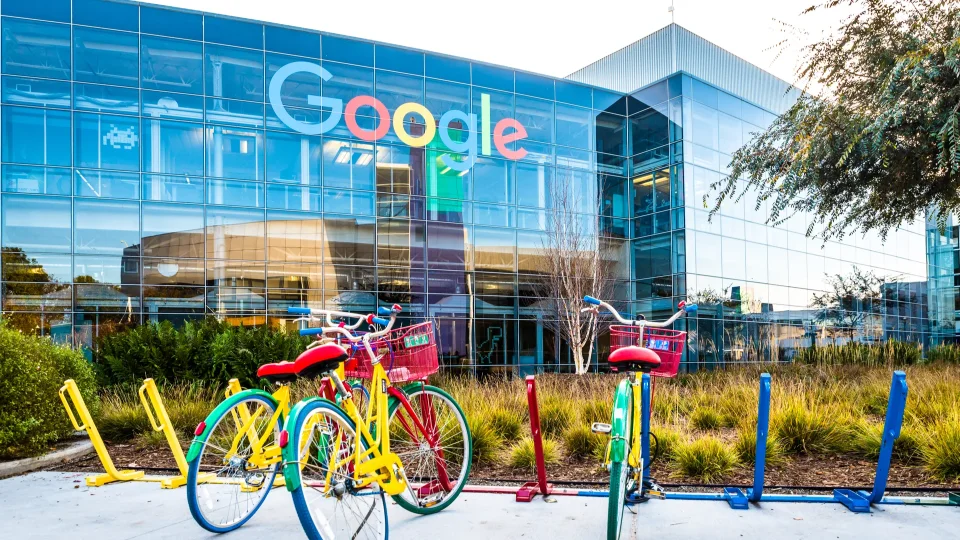
Google is owned by Alphabet Inc., a public company traded on the Nasdaq. Alphabet’s shareholders own it, but Google’s co-founders, Larry Page and Sergey Brin, control about 52.7% of the votes through special Class B shares. Investment firm BlackRock is the largest outside shareholder listed in Alphabet’s 2026 proxy statement.
So the short answer has three layers: Alphabet owns Google, public shareholders own Alphabet, and the founders control the votes. Below, I break down each layer using Alphabet’s own SEC filings, not estimates.
Key Takeaways
- Google LLC is a subsidiary of Alphabet Inc., created in a 2015 restructuring.
- Alphabet trades on the Nasdaq as GOOGL (Class A) and GOOG (Class C).
- Larry Page holds 27.4% of Alphabet’s voting power and Sergey Brin holds 25.3%, according to the 2026 proxy statement.
- BlackRock owns 6.1% of Class A shares, which equals 2.5% of the voting power.
- Berkshire Hathaway bought $10 billion of new Alphabet stock in June 2026.
- Sundar Pichai is the CEO of both Google and Alphabet.
Who Owns Google?
Alphabet Inc. owns Google. In 2015, Google reorganized and created Alphabet as a holding company. The restructuring was completed on October 2, 2015, and Google stock was converted into Alphabet stock.
Here is how the ownership chain works:
| Level | Who | Role |
|---|---|---|
| 1 | Shareholders | Own Alphabet through its public stock |
| 2 | Alphabet Inc. | Parent company that owns Google and other businesses |
| 3 | Runs Search, YouTube, Android, Gmail, Google Cloud, and more |
Who owns Google now? The same structure is in place in 2026. No other company owns Google. Alphabet owns it, and Alphabet is owned by its shareholders.
Who Are Google’s Largest Shareholders?
Alphabet’s 2026 proxy statement lists every person or firm that owns more than 5% of a voting share class. As of the April 6, 2026, record date, these were the main holders:
| Shareholder | Shares held | Share of class | Voting power |
|---|---|---|---|
| Larry Page | 389.1 million Class B | 46.5% of Class B | 27.4% |
| Sergey Brin | 358.9 million Class B | 42.9% of Class B | 25.3% |
| BlackRock | 356.9 million Class A | 6.1% of Class A | 2.5% |
| Sundar Pichai (CEO) | 227,560 Class A | Under 1% | Under 1% |
Source: Alphabet 2026 proxy statement. BlackRock’s figures come from a filing made in February 2024.
What about Vanguard? Vanguard used to be listed with about 493.8 million Class A shares. In March 2026, it filed an update saying it no longer counts as the beneficial owner of those shares as of January 12, 2026. Alphabet says it does not know whether any single Vanguard unit holds more than 5%, so the 2026 proxy does not list Vanguard.
All 14 of Alphabet’s executive officers and directors together hold 54.3% of the voting power.
Who Controls Google?
Larry Page and Sergey Brin control Google. Together, they hold about 52.7% of Alphabet’s voting power. That is enough to control most shareholder votes, even though they own only part of the company’s stock.
This is possible because Alphabet has three share classes:
| Share class | Ticker | Votes per share | Shares outstanding (Sept 30, 2026) |
|---|---|---|---|
| Class A | GOOGL | 1 | 5,888 million |
| Class B | Not traded | 10 | 828 million |
| Class C | GOOG | 0 | 5,578 million |
Sources: votes per share from Alphabet’s 10-K for fiscal 2025; share counts from Alphabet’s Q3 2026 earnings release.
Class B shares make up only about 6.7% of all Alphabet shares, but each one carries 10 votes. Page and Brin owned about 89.3% of the Class B stock at the end of 2025. That is how two people control a company with about 12.3 billion shares.
Why do websites show different numbers for the founders? Figures online vary, often because voting power and ownership get mixed up. Alphabet’s filings report the founders’ voting power, 52.7%, not their share of total stock. The proxy table also leaves out Class C shares because they carry no vote. I use the filed numbers here.
What does this mean for regular shareholders? If you buy GOOGL, you get one vote per share. If you buy GOOG, you get none. For me, this is the trade-off every Alphabet investor accepts: you share in the profits, but the founders set the direction.
Who Sits on Alphabet’s Board?
Alphabet’s board has 10 director nominees in the 2026 proxy. John L. Hennessy, the former president of Stanford University, is the independent Chair. The proxy notes that this role is separate from the CEO role.
| Director | Role | On board since |
|---|---|---|
| Larry Page | Co-founder | 1998 |
| Sergey Brin | Co-founder | 1998 |
| K. Ram Shriram | Director | 1998 |
| L. John Doerr | Director | 1999 |
| John L. Hennessy | Chair | 2004 |
| Roger W. Ferguson Jr. | Director | 2016 |
| Sundar Pichai | CEO of Alphabet and Google | 2017 |
| Frances H. Arnold | Director | 2019 |
| Robin L. Washington | Director | 2019 |
| R. Martin “Marty” Chávez | Director | 2022 |
Three directors have been on the board since 1998, the year Google was founded. Since the founders hold most of the votes, shareholders who disagree with a board choice have limited power to change it.
Who Owns Alphabet Inc.?
Alphabet is owned by its shareholders. Anyone can buy Class A (GOOGL) or Class C (GOOG) shares on the Nasdaq. Class B shares do not trade on the market and are mostly held by the founders. If you want to see how this fits among other business structures, our guide to types of companies explains public and private firms.
So the owners of Alphabet include:
- The founders, Larry Page and Sergey Brin, who hold most Class B shares
- Investment firms like BlackRock
- Berkshire Hathaway, which added to its stake in 2026
- Individual investors and funds that buy GOOGL and GOOG shares
Does Berkshire Hathaway Own Google?
Yes, Berkshire Hathaway owns part of Google through Alphabet stock. On June 1, 2026, Alphabet announced an $80 billion equity capital raise. As part of it, Berkshire agreed to buy $10 billion of new shares in a private placement:
| Part of the raise | Amount |
|---|---|
| Underwritten offerings (preferred and common stock) | $30 billion |
| At-the-market share sales, starting Q3 2026 | $40 billion |
| Berkshire Hathaway private placement | $10 billion |
Berkshire paid $351.81 per Class A share and $348.20 per Class C share, $5 billion of each. The Motley Fool reported that Berkshire first bought Alphabet in the third quarter of 2025 and roughly tripled its stake with this deal. Alphabet said it would use the money for general purposes, including spending to scale its AI infrastructure and computing power.
Does this change who controls Google? No. Berkshire is not listed as a 5% holder, and half of its new shares are Class C, which carry no votes. The founders still hold the majority of votes.
What does it mean for other owners? New shares mean each existing share owns a slightly smaller slice of the company. Alphabet also sold mandatory convertible preferred stock that turns into Class A and Class C shares around May 15, 2029. For me, this shows how hungry the AI race is for money. Even a company with $127.6 billion in quarterly revenue chose to sell new stock to keep up. You can see who Alphabet is racing against for AI chips in our list of Nvidia competitors.
How Does Alphabet Pay Its Owners?
Alphabet pays shareholders through dividends and, in past years, share buybacks.
| Action | What happened |
|---|---|
| First dividend | $0.20 per share, approved April 25, 2024, paid June 17, 2024 |
| Buyback plan | Up to $70 billion more, approved April 25, 2024 |
| Latest dividend | $0.22 per share, declared October 2026, payable December 14, 2026 |
| Dividends paid, first nine months of 2026 | About $8.2 billion (common and preferred stock) |
| Buybacks, first nine months of 2026 | $0, compared with $39.8 billion a year earlier |
Sources: Alphabet’s April 2024 8-K filing and its Q3 2026 earnings release.
Why did buybacks stop? Alphabet did not buy back any stock in the first nine months of 2026, based on its Q3 release. In the same year, it raised money by selling new shares. Buybacks shrink the share count, while new stock grows it. A company doing both at once would be working against itself. For me, the message is clear: in 2026, Alphabet put AI spending ahead of returning cash through buybacks. The dividend, though, kept going and grew.
Who Made Google?
Google was founded in 1998 by American computer scientists Larry Page and Sergey Brin. When they stepped back in December 2019, Page and Brin stayed on as board members and shareholders, as Engadget reported. They remain Alphabet’s controlling shareholders today.
How Has Google’s Ownership Changed Over Time?
| Year | Event |
|---|---|
| 1998 | Larry Page and Sergey Brin found Google |
| 2004 | Google goes public on the Nasdaq on August 19 at $85 per share |
| 2006 | Google agrees to buy YouTube for $1.65 billion in stock |
| 2014 | Google creates non-voting Class C shares |
| 2015 | Google creates Alphabet as its parent company (completed October 2) |
| 2019 | Page steps down as Alphabet CEO, Brin gives up the president role, and Sundar Pichai becomes Alphabet’s CEO |
| 2022 | 20-for-1 stock split for all share classes, paid July 15 |
| 2024 | Alphabet pays its first dividend |
| 2026 | $80 billion equity raise, including $10 billion from Berkshire Hathaway |
Why does the 2014 Class C step matter? Class C shares let Google issue new stock without giving away votes. That move is a big reason the founders still hold a majority of votes years later.
Who Is the CEO of Google?
Sundar Pichai is the CEO of Google and Alphabet. He has led Google since before the 2019 change and became Alphabet’s CEO in December 2019, when the founders stepped back.
Pichai owns 227,560 Class A shares, less than 1% of the company. As CEO, he runs the business day to day, while Page and Brin hold the voting control.
Who Owns YouTube?
Google owns YouTube, and Alphabet owns Google. Google agreed to buy YouTube on October 9, 2006, for $1.65 billion in a stock-for-stock deal. YouTube now sits inside the Google Services segment.
That deal looks very different today. In Q3 2026 alone, YouTube ads brought in $11.2 billion, up 9% from a year earlier. For me, it is one of the best examples of a company buying the right asset early. YouTube now competes with streaming giants for viewing time, which we cover in our list of Netflix competitors.
How Big Is Google?
Here are Alphabet’s latest numbers:
| Measure | Figure |
|---|---|
| Revenue, Q3 2026 | $127.6 billion (up 25%) |
| Google Cloud revenue, Q3 2026 | $30.7 billion (up 103%) |
| YouTube ads revenue, Q3 2026 | $11.2 billion (up 9%) |
| Employees (Dec 31, 2025) | 190,820 |
| Shares outstanding (Sept 30, 2026) | About 12.3 billion |
Alphabet reported its third-quarter results on October 28, 2026. Google Cloud revenue more than doubled from a year earlier.
What Does Alphabet Own?
Alphabet’s annual report splits its businesses into three groups:
| Segment | Main businesses |
|---|---|
| Google Services | Search, YouTube, Android, Chrome, Gmail, Google Maps, Google Play, Google Photos, Google Drive, Gemini, devices, and ads |
| Google Cloud | Google Cloud Platform and Google Workspace |
| Other Bets | Waymo (self-driving rides), X (the “moonshot factory”), and other early-stage businesses |
Other Alphabet companies include Verily, Calico, Wing, Isomorphic Labs, Google Fiber, GV, and CapitalG.
Who owns Gmail? Gmail is part of Google Services, so Google runs it and Alphabet owns it. Waymo is a separate Alphabet company. Learn more in our guide on who owns Waymo and our list of Waymo competitors.
To see who Google competes with, read our list of Google competitors. For a full business review, see our Google SWOT analysis and PESTLE analysis of Google.
Could the Government Force Google to Sell Parts of Its Business?
Regulators have tried. In two US cases, the government asked courts to break off parts of Google. So far, judges have said no, but they ordered strict new rules instead.
| Case | Ruling | Result |
|---|---|---|
| US search case | Remedies ruling, September 2, 2025 | No forced sale of Chrome or Android; no exclusive search or Gemini deals; must share some search data with qualified rivals; six years |
| US ad tech case | Remedies opinion unsealed September 16, 2026 | No forced sale of the AdX ad exchange; ban on tying its ad tools together; outside monitor; six years, worldwide |
| European Union | €2.95 billion fine, September 2025 | For favoring its own ad exchange since at least 2014; Google said it would appeal |
In the search case, Judge Mehta wrote that the plaintiffs “overreached in seeking forced divesture” of Chrome, as Fortune reported. In the ad tech case, the court found a breakup “neither realistic nor needed,” according to the National Law Review.
Why does this matter for ownership? A forced sale would have changed what Alphabet owns. Chrome or AdX could have become separate companies with new owners. For now, Alphabet keeps all of them. For me, the bigger risk is the data-sharing rule. It gives qualified rivals some of Google’s own search index and user-interaction data. For a search rival such as Microsoft’s Bing, that data could help close the gap; see our list of Microsoft competitors. Data is a core part of Google’s competitive advantage, and these rules chip at it.
Bottom Line
Google is owned by Alphabet, Alphabet is owned by its shareholders, and two founders hold the votes. For me, Google is the clearest example of the gap between owning a company and controlling it. Page and Brin left their executive jobs in 2019, yet their Class B shares still give them about 52.7% of the vote. Big names like BlackRock and Berkshire Hathaway can buy billions in stock, but they cannot outvote the founders. Compare it with how Apple’s ownership works in our guide on who owns Apple.
Frequently Asked Questions
No. Microsoft does not own Google. Google is owned by Alphabet Inc. Alphabet’s 2026 proxy statement lists only Larry Page, Sergey Brin, and BlackRock as holders of more than 5% of a voting share class.
Yes. Google was founded in 1998 by American computer scientists Larry Page and Sergey Brin. Its parent company, Alphabet, is headquartered at 1600 Amphitheatre Parkway in Mountain View, California, and trades on the Nasdaq.
No. Google is a subsidiary of Alphabet Inc., which is a public company. Anyone can buy Alphabet’s Class A shares (GOOGL) or Class C shares (GOOG) on the Nasdaq stock market through a brokerage account.
BlackRock owns part of Google through Alphabet stock. It reported 356.9 million Class A shares, 6.1% of that class and about 2.5% of Alphabet’s total voting power. That makes it the largest outside holder listed in the 2026 proxy.
They no longer run the company day to day. Page stepped down as Alphabet CEO in December 2019, and Brin gave up his president title. Both remain employees, board members, and Alphabet’s controlling shareholders.

