


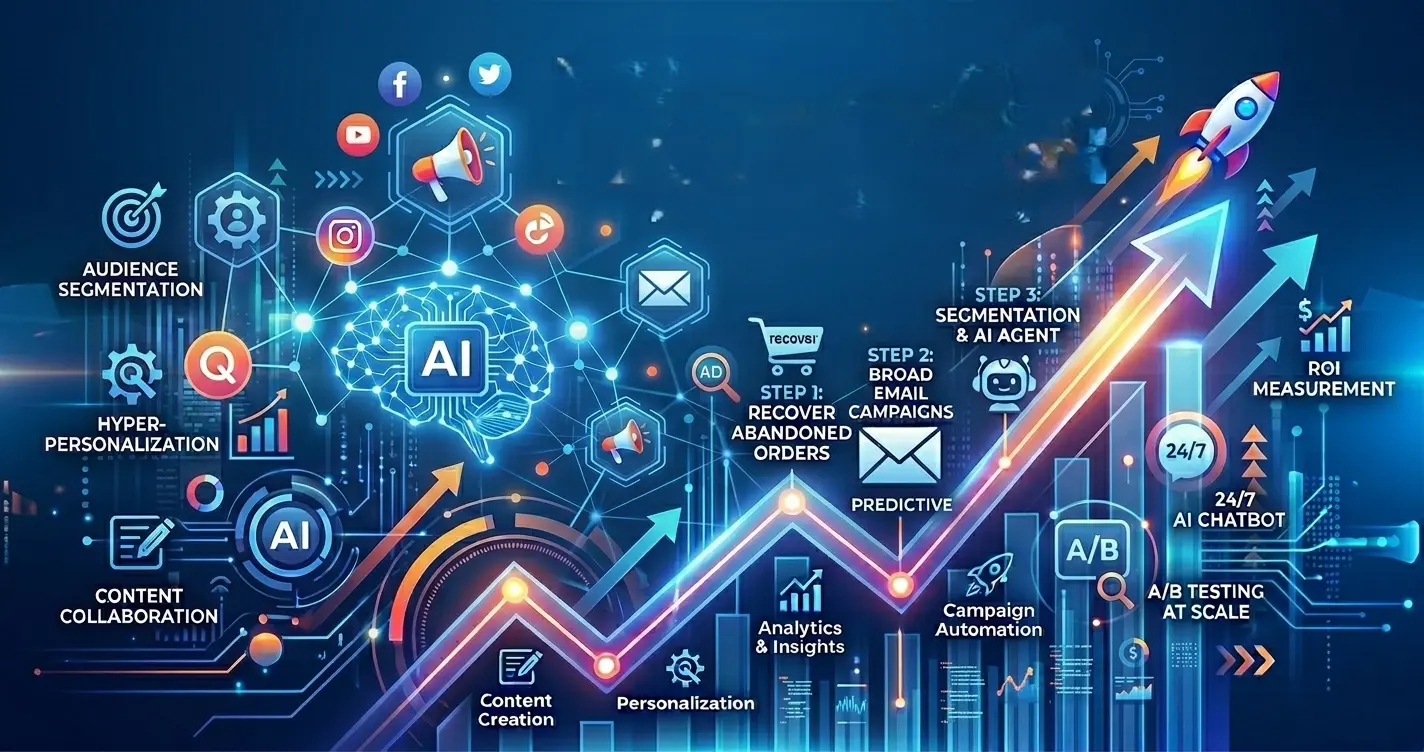
Here is a problem most growing businesses face. Your marketing worked well when you were small. You sent emails manually. You wrote the content yourself and managed your social media one post at a time.
Then your business started growing. Suddenly, your product/service demand increases, resulting in more data, channels and customer complaints every day. Traditional marketing tactics cannot keep up with that kind of growth.
That is exactly where AI comes in. Marketing teams are required to manage increasing volumes of customer data, adapt to rapidly shifting market trends, and deliver measurable results in real time. Traditional marketing strategies are struggling to keep up.
AI solves that problem. It helps you do things efficiently. reach more people, spend less time on repetitive tasks and grow your business faster than ever before.
In this guide, I will walk you through exactly how to scale your marketing with AI.
What Does Scaling Marketing with AI Actually Mean?
Scaling your marketing does not mean just publishing more content or running more ads. It means doing more – without proportionally increasing your time, budget, or team size.
AI-driven marketing uses machine learning, natural language processing, and data analytics to automate, optimize, and personalize your marketing efforts. Unlike traditional marketing automation, AI systems learn from data and improve gradually – making them increasingly effective at predicting customer behavior and delivering relevant experiences.
When you combine machine learning, predictive analytics, and natural language processing, AI helps your business to move from reactive to proactive decision-making. The result is not just better marketing performance but a more scalable and sustainable approach to business growth.
Why Most Businesses Struggle to Scale Without AI
When customer expectations are high and competition becomes more intense, marketers will have to navigate through fragmented data, market trends, and increasing pressure for quantifiable ROI.
Below are the top three obstacles when it comes to business scaling.
- Data fragmentation. Your customer data lives in ten different places. Your email tool. Your CRM. Your social media. Your website analytics. Without AI, it is almost impossible to connect all of this and make sense of it quickly.
- Content demand. Customers expect fresh, relevant content across every channel every single day. No human team can produce that volume consistently without burning out.
- Personalization at scale. Customers expect brands to know them personally. Delivering that level of personalization to thousands of customers manually is simply not possible.
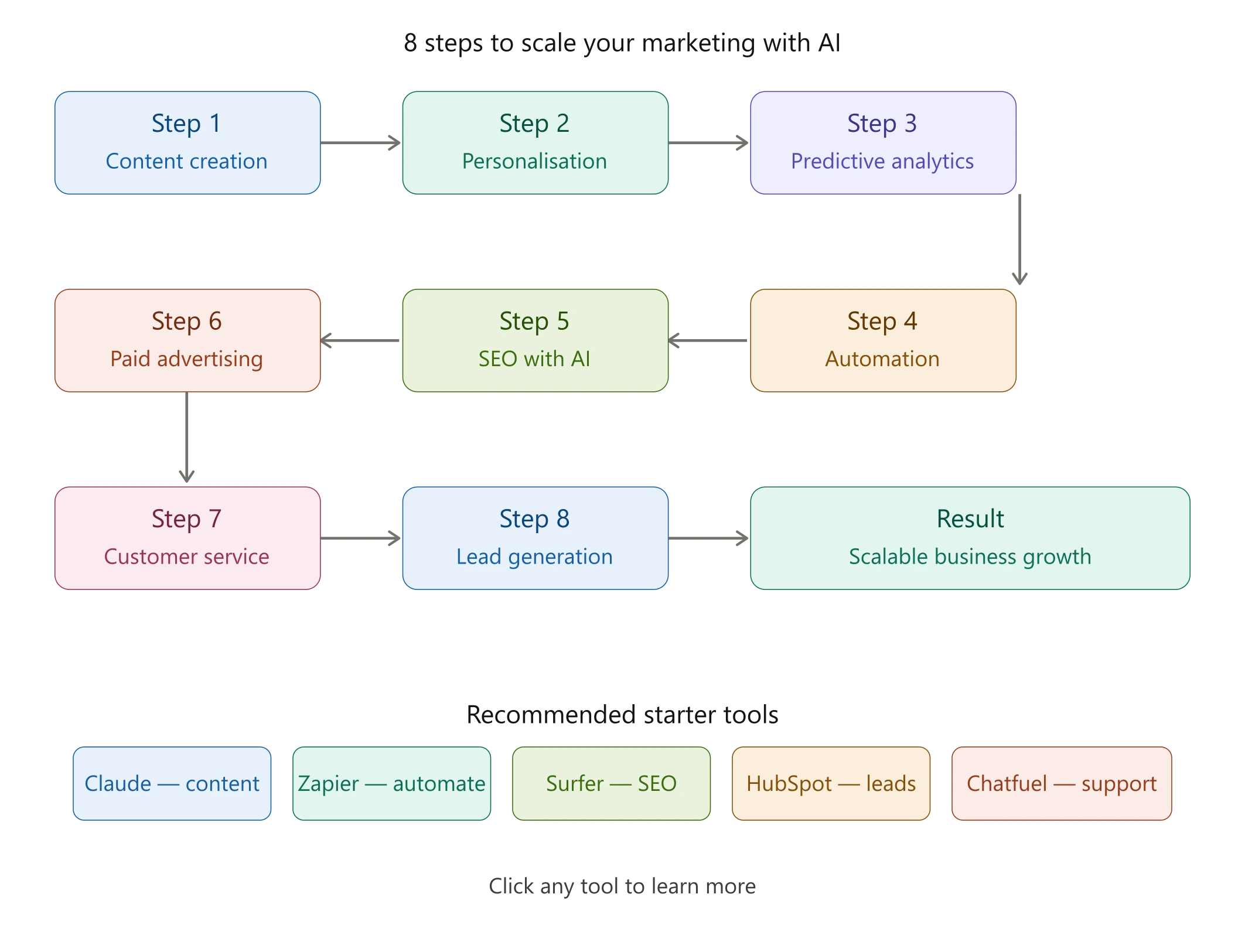
AI helps you solve all three problems. Let me show you how in the following guide.
Step-by-Step: How to Scale Marketing with AI
Step 1. Scale Your Content Creation With AI
Content is still the foundation of every marketing strategy. But the truth is that great content does not magically pop up overnight. No, it takes time to write, research, edit, publish, promote, and then repeat.
Today AI tools can help you:
- Provide ideas based on what your customer is actually searching for
- Write a draft blog posts, emails, and social media captions
- Optimize your blog headlines for maximum clicks
- Repurpose one piece of content across multiple platforms
The keyword here is first drafts. AI gives you a strong starting point. You then add your personal experience, real examples, and unique voice.
That combination, AI speed plus human insight, is what produces content that actually ranks and resonates.
Tools to use: Claude, Jasper AI, Brandwell
Real-world result: Adidas used AI-powered marketing tools to boost average order value from new users by 259% in just one month and drive a 50.3% increase in mobile conversion rates.
Step 2. Personalize Your Marketing at Scale
In the past few years, customers no longer just appreciate personalization; they expect it. They want emails that feel like they were written specifically for them. Customers want product recommendations that actually make sense. They want content that speaks to their exact situation right now.
Delivering that manually to hundreds or thousands of customers is impossible. AI makes it scalable. AI-powered personalization engines analyze individual user behavior across touchpoints and deliver customized content, offers, and recommendations in real time.
Here is a simple real-world example
A marketing manager uses AI to send push notifications to the store’s most loyal customers at optimal times. AI helps serve up notifications that are both personalized and relevant – making for a better customer experience. The more the customer interacts, the more tailored the experience becomes thanks to AI.
This level of personalization used to be reserved for big brands with massive budgets. Today, any business can do it with the right AI tools.
What AI personalization can do for your business:
- Send the right email to the right customer at the right time
- Show personalized product recommendations on your website
- Deliver targeted ads based on real browsing and purchase behavior
- Adjust customer journey paths based on individual interactions
Tools to use: HubSpot AI, Salesforce Marketing Cloud, Klaviyo
Step 3. Use Predictive Analytics to Make Smarter Decisions
Most marketing decisions used to be based on gut feeling. You looked at last month’s numbers. You made your best guess. And you hoped for the right result. Predictive analytics changes that completely.
AI uses predictive analytics and modelling to anticipate customer behavior, forecast market demand, and optimize pricing strategies. These data driven insights empower businesses to make proactive decisions rather than reactive adjustments.
In practical terms, this means you can:
- Identify which customers are most likely to buy before they even show interest
- Predict which products will be in high demand next month
- Know which marketing channels will deliver the best ROI before you spend a penny
- Spot customers who are about to leave and stop them before they do
Predictive models offer sharper insights for forecasting sales, planning inventory, anticipating customer churn, or identifying new market opportunities. The value is in proactive rather than reactive planning.
This is one of the most powerful ways AI helps businesses scale. Because when you stop guessing and start predicting, every marketing decision becomes smarter.
Step 4. Automate Your Marketing Workflows
Time is your most valuable asset when scaling a business. Most marketing teams waste enormous amounts of it on repetitive manual tasks. Sending follow-up emails and scheduling social posts. Tagging leads. Routing enquiries. Updating spreadsheets.
AI-powered marketing automation handles all of that for you. It can determine the best times to reach out to customers. It optimizes send time, frequency of messages, and adjusts customer journey paths based on recommendations, everything automatically.
Here are the key workflows you should automate first:
- Email marketing sequences. Set up automated welcome emails, follow-ups, and re-engagement campaigns. Once built, they run on their own – personalizing to each customer automatically.
- Lead nurturing. When someone shows interest in your product, AI can automatically send them the right content at the right time to move them closer to buying.
- Social media scheduling. Plan your content calendar once. AI tools automatically schedule and publish across all platforms.
- Reporting and analytics. Instead of manually pulling reports every week, AI delivers real-time dashboards with the insights you actually need.
Tools to use: Zapier, Gumloop, HubSpot, Marketo
The result? Manual processes create bottlenecks. As your business grows, the volume of customer interactions, content demands, and data points multiplies. AI removes those bottlenecks and keeps everything running smoothly at any scale.
Step 5. Scale Your SEO with AI
SEO is still the most cost-effective long-term growth strategy for any business. It has completely transformed how you approach it.
AI-powered SEO tools can analyze search intent at scale, identify high-value keyword opportunities, monitor competitor strategies, and even predict algorithm changes before they impact your rankings.
For content-heavy businesses, this is a game-changer.
Instead of manually researching keywords one by one, AI can scan thousands of search queries and identify exactly what your audience is looking for. It tells you which topics to write about. Which gaps are your competitors missing? And which existing pages need updating?
Here is what AI-powered SEO looks like in practice:
- Keyword research. AI identifies high-value, low-competition keywords in minutes
- Content audits. AI scans all your existing pages and flags what needs improving
- Competitor analysis. AI monitors what your competitors are ranking for and where the gaps are
- Content optimization. AI scores your content in real time and tells you exactly what to fix
Tools to use: Surfer SEO, ContentShake AI, Semrush
The businesses winning on Google in 2026 are not the ones publishing the most content. They are the ones using AI to publish the right content consistently.
Step 6. Improve Your Paid Advertising With AI
Running ad campaigns without AI is not a wise decision. You are willing to spend money, but you are not sure whether it will work or not.
Manually optimized campaigns do not work anymore. Ai continuously learns from performance data and selects the right creatives, bidding, and targeting. This means less budget wasted, better targeting and higher returns.
Here is what AI does for your paid advertising:
- Audience targeting. AI identifies the exact people most likely to buy from you
- Bid optimization. AI manages your bids in real time to maximize results within your budget
- Creative testing. AI automatically tests different ad creatives and scales the winners
- Performance prediction. AI tells you which campaigns are likely to perform best before you spend
AI enables dynamic pricing models that adjust in real time based on demand, competitor pricing, customer behavior, and stock levels. It is a powerful way to optimize revenue without increasing costs.
Real result: Harley Davidson used AI-powered ad optimization and saw a 2930% increase in leads per month. That is not a typo.
Tools to use: Albert.ai, Google Performance Max, Meta Advantage Plus
Step 7. Scale Customer Service With AI
Here is something most marketers overlook. Customer service is marketing. Every interaction your customer has with your support team shapes how they feel about your brand. And as you scale, those interactions multiply fast.
AI-powered chatbots give you 24/7 customer support, resulting in greater customer satisfaction while reducing operational costs. Chatbots have the capability to handle complex tasks and queries, recommend products, process returns, and even escalate issues to human agents when needed.
But here is the part most businesses miss completely.
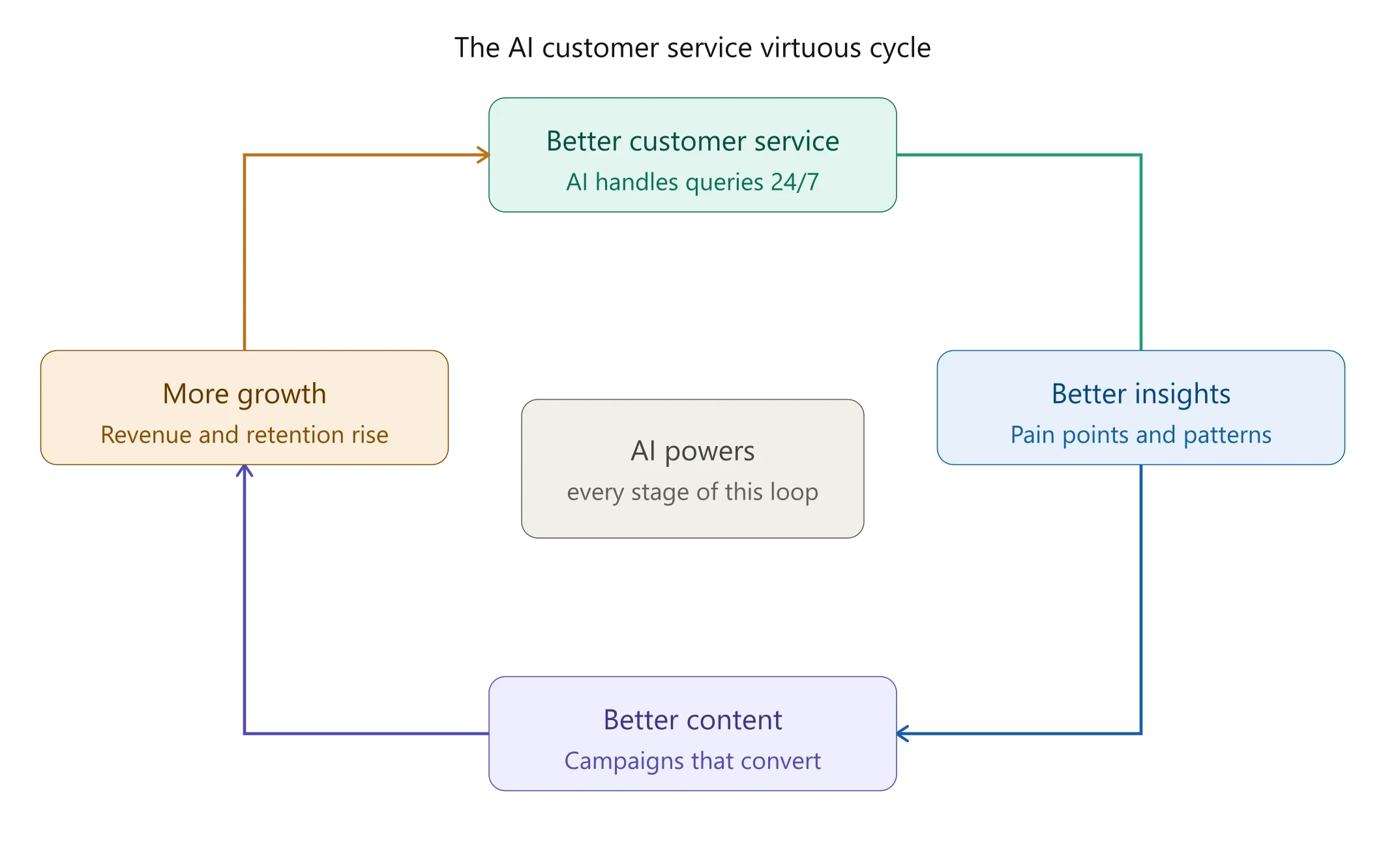
The data generated by customer service interactions is equally valuable. AI customer service tools capture insights about common pain points, frequently asked questions, and product feedback that can directly inform your marketing messaging and product development strategy.
This creates a virtuous cycle.
Tools to use: Chatfuel, Tidio, Intercom, Freshdesk
Step 8. Use AI for Lead Generation and Nurturing
Growing your business means constantly finding new customers. Meanwhile, AI has transformed lead generation completely.
AI prospecting tools help businesses identify potential customers by analyzing online signals such as website performance, advertising activity, social media engagement, and SEO rankings to identify companies or individuals with growth opportunities.
Once leads are identified, AI automates the entire nurturing process.
- Personalized emails are sent at the right time automatically
- Follow-up sequences triggered by specific customer actions
- Lead scoring that identifies your hottest prospects instantly
- Chatbots that qualify website visitors 24 hours a day
AI chatbots interact with visitors in real time, answer questions, collect contact information, and qualify prospects by asking targeted questions about their needs. They work 24/7 ensuring businesses never miss potential opportunities.
The result is a lead generation system that runs almost on autopilot – bringing in qualified leads consistently without manual effort.
Tools to use: Reply.io, HubSpot AI, Paradigm AI, Chatfuel
Common Mistakes to Avoid When Scaling With AI
I have seen businesses make these mistakes over and over. Do not repeat them.
- Mistake 1. Adding too many tools at once. Start with one or two tools. Master them completely. Then expand. Jumping between different AI platforms creates confusion and wastes time.
- Mistake 2. Removing the human layer entirely. AI is powerful. But it is not perfect. Always have a human review AI-generated content, campaigns, and customer communications before they go live. Your brand reputation depends on it.
- Mistake 3. No clear strategy before adding AI. Scaling your marketing with AI is not simply about adopting the latest tools. It requires a strategic approach that aligns technology with your brand goals, audience expectations, and long-term vision.
- Mistake 4. Ignoring data quality. AI is only as good as the data it learns from. If your customer data is messy, incomplete, or outdated, your AI results will reflect that. Clean your data first.
- Mistake 5. Expecting instant results. AI gets smarter over time. The longer you use it, the better it performs. Give it time to learn and improve before judging its effectiveness.
Your Simple Action Plan (Start Scaling Today)
You do not need a huge budget or a technical team to start. Here is a practical five step plan to get started right now:
- Pick one problem to solve first. Is it content creation? Email marketing? Lead generation? Pick the biggest bottleneck in your marketing right now.
- Choose one AI tool that solves that problem. Do not overwhelm yourself. One tool. One problem. Start there.
- Set it up and test it for 30 days. Give it enough time to learn and show results. Track your key metrics before and after.
- Measure the results honestly. Did it save time? Did it improve results? Is it worth the cost? Answer those questions honestly before moving forward.
- Expand gradually. Once you have mastered one tool add the next. Build your AI marketing stack layer by layer.
My personal recommendation for beginners:
| Priority | Tool | Purpose |
| 1st | Claude | Content creation |
| 2nd | Zapier | Marketing automation |
| 3rd | Surfer SEO | Content optimization |
| 4th | Chatfuel | Customer service chatbot |
| 5th | HubSpot AI | Email and lead nurturing |
Start with free plans. Upgrade only when you see results.
Conclusion
AI is the great equalizer in marketing. It used to be that only big companies with massive budgets could personalize at scale, optimize campaigns in real time, and make data-driven decisions. Small businesses simply could not compete.
Now that has shifted completely and the future of marketing will be defined by how well organizations operate in an AI-focused world. The winner will be whoever can learn faster, individualize at scale, optimize across the entire funnel, and design experiences for not only humans but also for the AI system that guides them.
The marketers who win in 2026 will not be the ones who work the hardest. They will be the ones who work the smartest. They are using AI as a powerful partner in every task they do.
Frequently Asked Questions
It just means doing more without burning yourself out. You use AI tools to write content, send emails and run ads. Stuff like that used to take hours. Your reach grows. Your workload doesn’t. That’s really the whole idea.
Honestly? It saves you from doing things you hate doing. Checking data. Tweaking ads. Following up with leads. AI handles that stuff quietly in the background. You focus on your actual business. Results improve without you working more hours.
Yes. You don’t need a marketing team or a big budget. Claude is free. Zapier is free. HubSpot has a free version too. Regular people running small shops use these tools every single day. You can figure it out in an afternoon.
Depends on your headache. If you want to write, go for Claude or Jasper. Zapier can help you connect your apps. Getting found on Google uses Surfer SEO. Growing your email list using HubSpot. Pick the one that solves your current problem. Don’t overthink it.
Nobody wants to feel like they got a mass email. AI makes your message feel personal. It studies what each person clicks and buys, then adjusts what you show them. People respond to that. Sales go up. It really is that straightforward.
Your old data knows things. AI analytics digs through it and spots patterns you’d never notice yourself. Then it tells you what’s probably coming next. Who’s close to buying. Which campaign might flop. You spend smarter because you already know what’s likely to work.
Start free. Seriously, don’t pay anything yet. Test Claude, Zapier, Grammarly, HubSpot, all these apps offer a free plan. If you upgrade later, most plans are $10 to $50 a month. One good marketing campaign result pays for six months of that. Worth it.

)