



A competitive advantage is anything that lets a business beat its rivals, such as lower costs, a stronger brand, or a product others cannot easily copy. It shows up as more customers, higher prices, or bigger profits than competitors earn.
Michael Porter set out the idea in his 1985 book Competitive Advantage. In this guide, I explain the three types, where an advantage comes from, and how to test whether it will last. I also cover real company examples with their latest numbers.
Key Takeaways
- A competitive advantage is what makes customers choose you over a rival.
- Michael Porter named three generic strategies: cost leadership, differentiation, and focus.
- An advantage is only sustainable if rivals cannot easily copy it.
- The VRIO test checks whether a resource is valuable, rare, hard to imitate, and well organized.
- Advantages can fade. Lululemon’s US sales fell in 2026 as Alo Yoga and Vuori grew.
What Is Competitive Advantage?
Competitive advantage is the edge that lets a company perform better than its competitors. According to Porter, it grows out of the value a company creates for its buyers, and that value must be more than it costs the company to create.
In simple terms, a business has a competitive advantage when customers have a clear reason to pick it. That reason might be a lower price, a better product, a trusted brand, or a better location.
What is competitive advantage in business? It is any strength a company can use to win sales, keep customers, or earn more profit than rivals. It must matter to customers. A strength customers do not care about is not an advantage.
Why Does Competitive Advantage Matter?
Without a competitive advantage, a business has to compete on price alone. That squeezes profits for everyone.
A real advantage gives a business three things:
- Pricing power: Customers pay more for something they value and cannot get elsewhere.
- Loyal customers: People keep coming back when they have a reason to choose you.
- Money to reinvest: Higher profits pay for new products, stores, and marketing.
What Are the 3 Types of Competitive Advantage?
Porter identified two main sources of advantage: lower cost and differentiation. He combined them with the size of the market a company targets, broad or narrow. That gives three generic strategies.
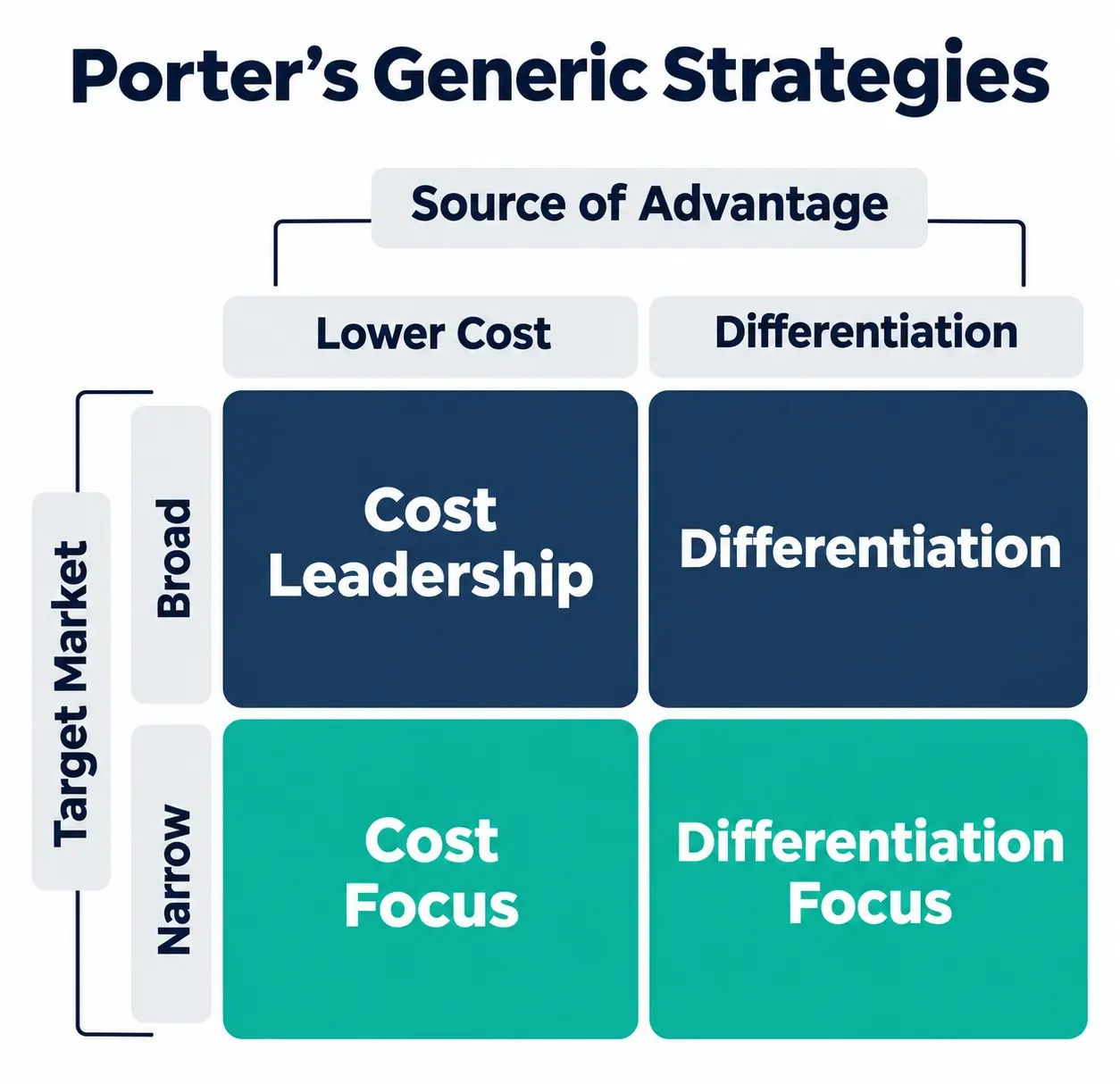
| Strategy | How it wins | Target market | Example |
|---|---|---|---|
| Cost leadership | Lowest costs, so it can charge lower prices | Broad | Walmart, Costco |
| Differentiation | A product customers see as unique or better | Broad | Apple, Lululemon |
| Focus | Serves one narrow group better than anyone | Narrow | A local niche shop |
1. Cost leadership
A cost leader produces or sells at a lower cost than its rivals. It can then charge lower prices and still make a profit. Walmart and Costco both use this strategy. Read more in our guide to cost leadership.
2. Differentiation
A differentiator offers something customers see as unique, so they will pay more for it. That could be design, quality, brand, or service. Apple is a classic example. Learn more in our guide to differentiation strategy.
3. Focus
A focused business targets one narrow market and serves it better than larger rivals. Porter split it into two forms: cost focus and differentiation focus. For example, a bakery that only makes gluten-free bread uses a differentiation focus. See our full guide to focus strategy.
Where Does Competitive Advantage Come From?
Porter’s three strategies explain how a company competes. The table below shows the specific sources that create an advantage in practice.
| Source | What it means | Real example |
|---|---|---|
| Scale | Buying and selling in huge volumes lowers costs | Walmart’s supplier pricing reflects its volume |
| Simple operations | Fewer products and lower running costs | Costco carries fewer than 4,000 items per warehouse |
| Brand and design | Customers pay more for a name they trust | Apple |
| Ecosystem | Products and tools work best together | Nvidia’s CUDA software |
| Loyalty programs | Rewards bring customers back more often | Starbucks Rewards |
| Own technology | Products rivals cannot easily copy | Lululemon’s proprietary fabrics |
Competitive Advantage Examples
These examples show each type in action, with numbers from each company’s own reports.
1. Costco: cost leadership through membership
Costco charges members a yearly fee, $65 in the US, and keeps prices low. Its annual report says, “We do not focus in the short-term on maximizing prices charged.”
The model works. In fiscal 2026, Costco had 84.1 million paid members and earned $5.9 billion in membership fees. Its renewal rate was 92.3% in the US and Canada, according to its annual report. It also keeps costs down by carrying fewer than 4,000 products per warehouse.
2. Walmart: cost leadership through scale
Walmart made $713.2 billion in revenue in fiscal 2026 and serves about 280 million customers each week. It runs more than 10,900 stores in 19 countries, according to its annual report.
Walmart pairs “everyday low price” with “everyday low cost,” which it describes as controlling expenses so it can pass savings to customers. Its report also says its supplier pricing reflects the volume it buys. That is a scale advantage few rivals can match. See how it compares in our Walmart vs Target breakdown.
3. Apple: differentiation through its ecosystem
Apple’s advantage is a family of devices and services that work together. In early 2026, CEO Tim Cook said Apple had a record installed base of more than 2.5 billion active devices, up from 2.35 billion a year earlier. For me, that base is the advantage: every active device is a customer already inside Apple’s system.
4. Nvidia: differentiation through software
Nvidia sells AI chips, but its advantage goes beyond the chips. Its annual report says over 7.5 million developers use CUDA and its other software tools, and CUDA runs on all Nvidia GPUs. Developers who build on CUDA have a reason to keep buying Nvidia.
Its sales show how strong that position is. Nvidia’s revenue grew 65% to $215.9 billion in fiscal 2026, and $193.7 billion came from its data center business, according to its fiscal 2026 results. Read more about its rivals in our list of Nvidia competitors.
5. Starbucks: differentiation through loyalty
Starbucks Rewards had 35.8 million active US members in the quarter ending June 28, 2026. Members made up 59% of spending at Starbucks’ US company-operated stores, and mobile orders made up 33% of transactions, according to its investor dashboard.
6. Lululemon: differentiation, and a warning
Lululemon’s annual report says it develops proprietary fabrics and uses community-based marketing. Its stores sold $1,426 per square foot in 2025.
But this example also shows that an advantage can fade. Sales per square foot fell from $1,574 in 2024. Americas comparable sales fell 12% in the quarter ended August 2, 2026, while rivals Alo Yoga and Vuori kept opening stores. Read the full story in our Lululemon SWOT analysis.
What Is a Sustainable Competitive Advantage?
A sustainable competitive advantage is one that lasts, even when rivals try to copy it or come up with something new. Most advantages are temporary. A new feature or a low price can be matched quickly.
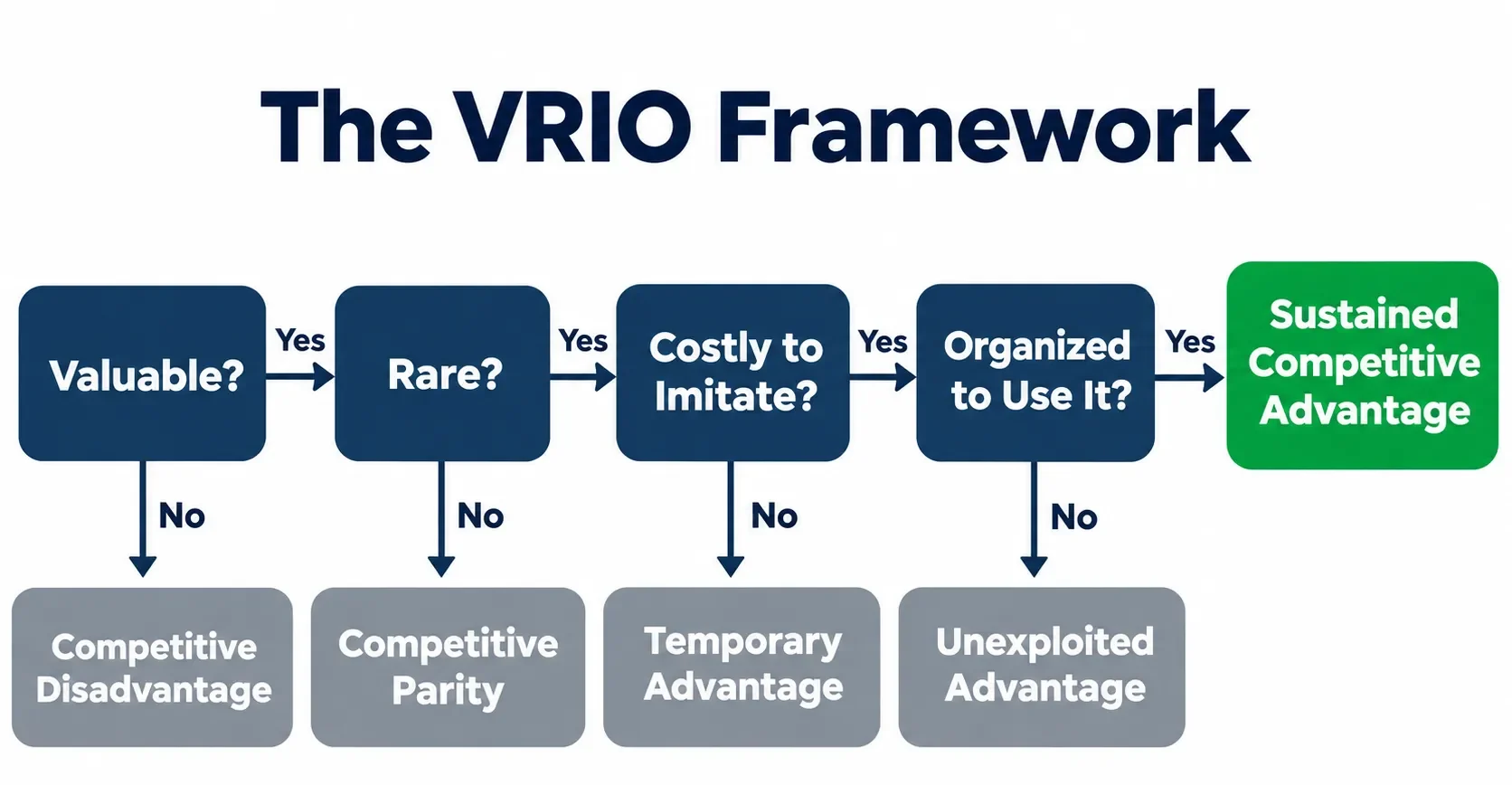
The best-known test is VRIO, created by Jay Barney. He first set out the idea in a 1991 paper, “Firm Resources and Sustained Competitive Advantage.” VRIO asks four questions about a resource:
| Question | If the answer is “no” |
|---|---|
| Valuable: Does it help customers or cut costs? | Competitive disadvantage |
| Rare: Do few competitors have it? | Competitive parity |
| Imitable (costly to imitate): Is it hard to copy? | Temporary advantage |
| Organized: Is the company set up to use it? | Unexploited advantage |
Only a resource that passes all four gives a sustained competitive advantage.
Which examples pass the VRIO test? For me, Nvidia’s CUDA platform is a strong case. It is valuable, and a developer base of over 7.5 million is hard for a rival to copy quickly. Costco’s 92.3% renewal rate also suggests an advantage that is hard to copy quickly.
Competitive Advantage vs Comparative Advantage
These two terms sound alike, but they come from different fields.
| Competitive advantage | Comparative advantage | |
|---|---|---|
| Field | Business strategy | Economics and trade |
| Main idea | What lets a firm beat its rivals | Why people, firms, and countries gain from trade |
| Key thinker | Michael Porter (1985) | David Ricardo (1817) |
| Example | Costco’s low prices and loyal members | Two countries both gaining by trading with each other |
Comparative advantage explains why trade benefits both sides, even when one side is more productive at everything. Competitive advantage explains why one company wins customers over another.
How Do You Find Your Competitive Advantage?
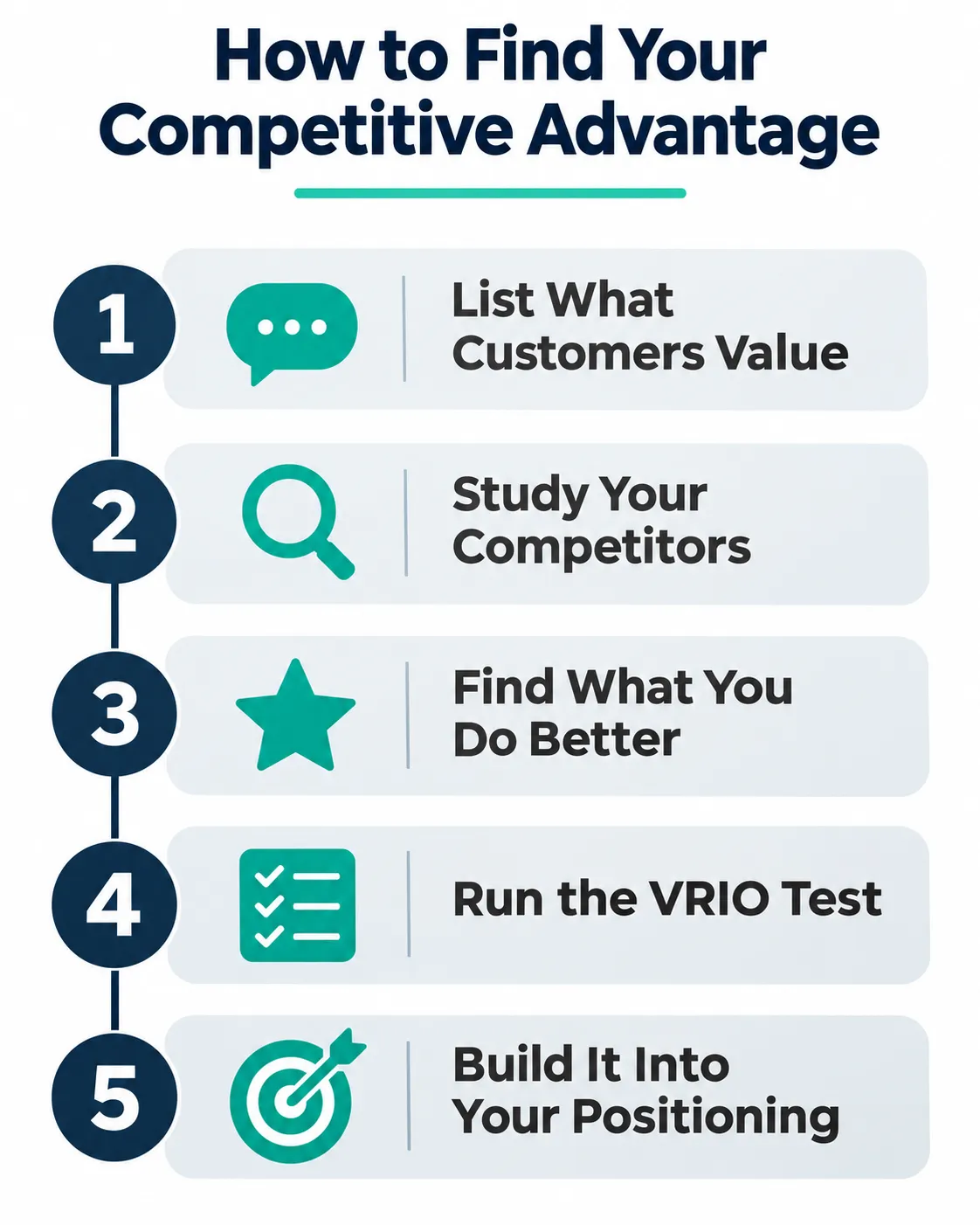
Use these five steps to find your own advantage, whether you run a small business or study a large company:
- List what customers value. Ask your best customers why they buy from you. Their answers matter more than your opinion.
- Study your competitors. Compare prices, products, service, and reviews. Look for gaps they leave open.
- Find what you do better. Match your strengths to what customers value. A SWOT analysis helps here.
- Run the VRIO test. Check whether each strength is valuable, rare, hard to copy, and supported by your business.
- Build it into your positioning. Make your advantage the center of your marketing. Our guide to market positioning shows how.
A small business rarely wins on cost against Walmart. A focus strategy is usually the better path: pick a narrow group of customers and serve them better than anyone else.
Bottom Line
For me, the most useful question about competitive advantage is not “do we have one?” but “will it last?” Costco, Walmart, and Nvidia show advantages that rivals struggle to copy. Lululemon shows the other side: even a strong brand can lose ground when competitors offer something new. Find what customers truly value, test it with VRIO, and keep investing in it.
Frequently Asked Questions
Michael Porter is best known for the theory. His 1985 book, Competitive Advantage: Creating and Sustaining Superior Performance, introduced the three generic strategies of cost leadership, differentiation, and focus. Later, Jay Barney created the VRIO test for judging whether an advantage can last.
Yes. Any advantage can wear down as rivals copy it or offer something new. Lululemon is a recent example: its Americas comparable sales fell 12% in mid-2026 while newer brands like Alo Yoga and Vuori expanded.
Yes. Small businesses rarely win on cost, but they can win through focus. Serving one narrow customer group, offering expert service, or owning a strong local reputation can all give a small business an edge over bigger rivals.
It can be, if rivals cannot easily copy it. Starbucks Rewards had 35.8 million active US members in mid-2026, and they made up 59% of spending at its US company-operated stores. That scale is hard to match.
Cost leadership wins by having the lowest costs, so a company can charge lower prices, like Walmart. Differentiation wins by offering something customers see as unique, so they will pay more, like Apple. Both target a broad market, while a focus strategy targets a narrow one.

