


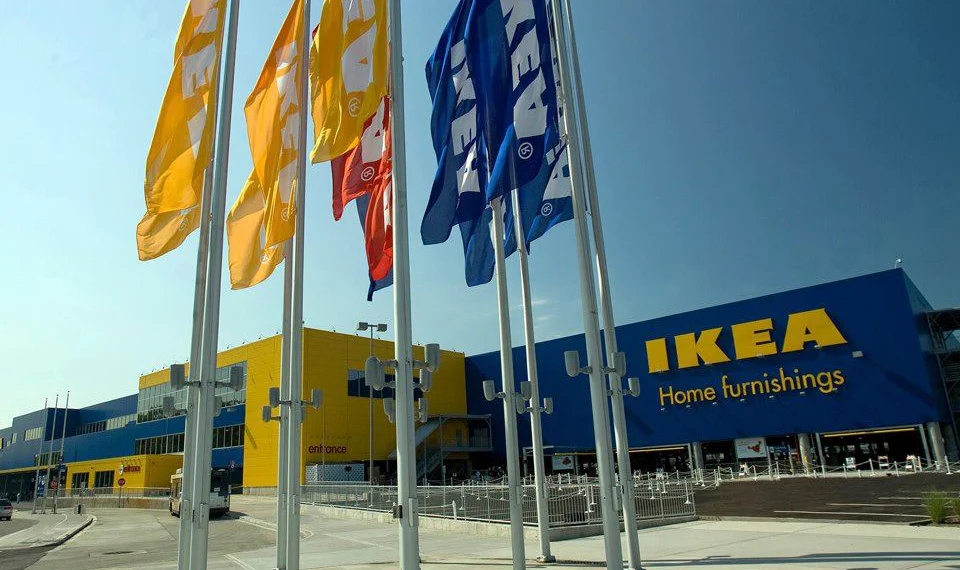
IKEA sells to people furnishing a home on a budget: renters setting up a first apartment, young couples moving in together, and families who need storage that works. Young adults matter most in the US, where 18- to 34-year-olds make up 41% of people who would consider IKEA for their next home purchase.
That focus comes from IKEA’s own vision: “To create a better everyday life for the many people.” The IKEA target market is broad by design, but its products, prices, and stores are built around value-conscious households with limited space. Below, each segment is broken down with IKEA’s latest US and global data.
Key Takeaways
- IKEA made $5.3 billion in US sales in fiscal 2025, and $1.9 billion of that came from online orders.
- Young adults lead IKEA’s US growth: 18- to 34-year-olds are 41% of people considering IKEA, versus 29% of all US adults, according to YouGov.
- IKEA Family members bring in 56% of IKEA’s US sales, and the program has 25 million US members.
- IKEA cut prices by about 10% over two years, and its number of customers rose 3% in fiscal 2025.
- IKEA wins back shoppers who don’t want to build furniture through TaskRabbit, the assembly service owned by its largest franchisee.
How Big Is IKEA in 2026?
| IKEA Fact | Global (FY2025) | United States (FY2025) |
|---|---|---|
| Sales | €44.6 billion | $5.3 billion |
| Online share | 28% of sales | $1.9 billion online |
| Store visits | 915 million | About 61 million |
| Locations | 523 stores in 64 markets | 61 locations |
| Loyalty members | n/a | 25 million IKEA Family members |
Sources: IKEA FY25 results and IKEA US FY25 annual summary. IKEA’s fiscal year ends August 31.
Who owns IKEA? Inter IKEA owns the IKEA brand and concept and franchises it to retail companies. Ingka Group, the largest franchisee, runs IKEA’s US stores and makes 87% of IKEA’s global sales.
Who Shops at IKEA?
IKEA groups customers by life stage, meaning the point a person has reached in life, such as leaving home, marrying, or having kids. Each stage needs different furniture:
- First-apartment renters: students and young workers who need a bed, desk, and storage for the first time, at low cost and in small spaces.
- Young couples: people moving in together who want a full home that looks good without a big budget.
- Families with children: parents who need storage, durable kids’ furniture, and room to grow.
- Small businesses: offices, cafés, and shops that use the IKEA Business Network for 5% off in store and design services from $299 per room.
Life-stage targeting is a form of lifestyle segmentation, and it explains why IKEA showrooms are set up as complete rooms rather than rows of products.
What Age Group Shops at IKEA the Most?
Young adults. A March 2026 YouGov analysis found that 18- to 34-year-olds make up 41% of Americans who would consider IKEA, compared with 29% of the US adult population. Their interest in IKEA rose from the mid-30s in 2021 to nearly 50 on YouGov’s scale.
IKEA also reaches higher earners. High-income households were 11% of IKEA’s US consideration group, slightly above their 9% share of the population, and IKEA ranked first for value in both groups. Learn more about this approach in our demographic segmentation guide.
Where Are IKEA’s Customers?
The US is one of IKEA’s most important markets. It accounts for 12.6% of Ingka Group’s retail sales, second only to Germany.
IKEA’s US growth now targets city dwellers and smaller markets, not only suburban big-box shoppers:
- City-center stores: IKEA plans 10 new US stores in 2026, including its first US city-center store in Culver City, California.
- Small formats: IKEA opened 14 US locations in fiscal 2025, including smaller stores and Plan & Order Points with pickup in cities like Charlotte and Roseville.
- New regions: 2026 openings include Tulsa, Fort Collins, and Huntsville, cities that were far from an IKEA before.
Globally, IKEA is entering new countries in Latin America, including Panama and Costa Rica. This mix of big stores and small formats is a clear example of geographic segmentation.
What Do IKEA Customers Value?
IKEA customers want good design at a low price. IKEA calls this Democratic Design, built on five principles: form, function, quality, sustainability, and low price.
IKEA’s own research shows what its customers worry about. The IKEA Life at Home Report 2026 surveyed 31,689 adults in 31 countries and found:
| Life at Home 2026 Finding | Share |
|---|---|
| Top worry: household finances | 37% |
| Say comfort at home matters | 86% |
| Often feel comfortable at home | 66% |
| A tidy, organized home makes it comfortable | 43% |
| Would do more for the climate to save money | 54% |
These numbers explain IKEA’s product mix. Money worries support low prices, and the gap between wanting comfort and feeling it supports storage, lighting, and textiles that make a small space feel better. Read more in our psychographic segmentation guide.
How Do IKEA Customers Buy?
IKEA customers buy in four main ways:
- As loyalty members: IKEA Family has 25 million US members, and they bring in 56% of US sales.
- Online and in store: 28% of IKEA’s global sales are online, but stores still drew 915 million visits in fiscal 2025.
- Do it yourself, or not: flat-pack furniture keeps prices low for buyers who assemble it themselves. Buyers who don’t want to can book TaskRabbit assembly, now offered in more than 200 IKEA stores.
- Sell it back: the US Buyback & Resell program pays store credit for more than 2,800 eligible used IKEA products.
Why does IKEA cut prices? Value is IKEA’s main selling point, and YouGov ranks it first on value perception among young US adults. After lowering prices by about 10% over two years, IKEA’s customer numbers rose 3% in fiscal 2025. See how brands use buying patterns like these in our behavioral segmentation guide.
What Is IKEA’s Segmentation, Targeting, and Positioning (STP)?
| STP Step | What IKEA Does |
|---|---|
| Segmentation | Splits customers by life stage, budget, home size, and region |
| Targeting | Aims at “the many people,” with extra focus on young adults and families furnishing on a budget |
| Positioning | Well-designed, functional furniture at prices low enough for most people to afford |
IKEA uses a broad, mass-market target but positions itself clearly on value plus design. That is what separates it from discount stores, which compete on price, and premium brands, which compete on design. Our guide to segmentation, targeting, and positioning explains each step.
What Do IKEA’s Customer Personas Look Like?
These five personas are built from the data above.
| Persona | Who They Are | What They Buy | Why They Choose IKEA |
|---|---|---|---|
| First-apartment renter | Student or new worker | Bed, desk, storage, kitchen basics | Low price, fits small spaces |
| Young couple | Partners moving in together | Sofa, dining set, wardrobes | Full rooms that look good on a budget |
| Growing family | Parents with young kids | Storage, kids’ furniture, beds | Durable, easy to change as kids grow |
| Busy professional | Higher income, short on time | Kitchens, planned rooms, assembly | Design services, TaskRabbit, delivery |
| Small business owner | Café, shop, or office | Desks, chairs, shelving | Business Network discount, design help |
Who Does IKEA Lose, and How Does It Win Them Back?
IKEA’s model loses some shoppers. Here is how it responds:
- Premium buyers: shoppers who want custom or heirloom furniture often choose brands like Pottery Barn instead. See our Pottery Barn competitors guide for that market.
- People who don’t want to build furniture: IKEA added TaskRabbit assembly to the booking flow, and 50% more customers added assembly after the change.
- People far from a store: small formats, pickup points, and online orders reach shoppers who would not drive to a big-box IKEA.
- Price shoppers when costs rise: US tariffs pushed some sofa prices up by nearly $50 and bedroom sets by nearly $100 in late 2025. To limit increases, IKEA plans to buy more US-made products; about 15% of products sold in US stores are made in the US.
How Does IKEA’s Target Market Compare With Rivals?
| Retailer | 2025 US Furniture and Bedding Sales (est.) | Who It Targets |
|---|---|---|
| Ashley | $6.26 billion | Traditional furniture buyers, large showrooms |
| Wayfair | $5.96 billion | Online shoppers who want a wide selection |
| Amazon | $5.70 billion | Convenience and fast delivery |
| Walmart | $3.52 billion | Low-price family shoppers |
| IKEA | $2.81 billion | Design-minded, value-conscious households |
| Target | $1.68 billion | Style-focused shoppers buying décor and small furniture |
Source: Home News Now estimates of 2025 US furniture and bedding sales. IKEA’s $5.3 billion total US sales include kitchens, décor, food, and other categories.
IKEA is smaller than Ashley, Wayfair, and Amazon in US furniture alone, but few rivals combine its low prices, in-house design, and room-by-room showrooms. Our full list of IKEA competitors covers each rival in more detail.
Bottom Line
IKEA’s target market is people furnishing a home with more taste than money. In the US, that means young adults first, which is why IKEA is opening city-center and small-format stores closer to where they live. For me, the smartest move is IKEA’s price cuts: they turned rising money worries into more customers. The risk is tariffs: IKEA’s core shoppers are budget-focused, so every price increase tests their loyalty. For a full view of IKEA’s strengths and risks, read our IKEA SWOT analysis and IKEA PESTLE analysis.
Frequently Asked Questions
In the US, IKEA’s biggest competitors are Ashley, Wayfair, and Amazon, which each sold more furniture and bedding than IKEA in 2025, based on Home News Now estimates. Walmart and Target compete on low prices and home décor, while Pottery Barn competes for premium buyers.
IKEA’s main goal is its vision: “To create a better everyday life for the many people.” It does this by selling well-designed, functional home furnishings at prices low enough that as many people as possible can afford them.
Inter IKEA owns the IKEA brand and concept and franchises it to retail companies. Ingka Group, IKEA’s largest franchisee, runs the US stores and makes 87% of global IKEA sales. Ingvar Kamprad founded IKEA in Älmhult, Sweden, in 1943, when he was 17.
IKEA had 61 US locations in fiscal 2025, including full stores, smaller stores, and Plan & Order Points. It plans 10 new US stores in 2026, including its first city-center store in Culver City, California.
Often, yes. IKEA designs and sells its own low-cost, flat-pack products, while Wayfair sells thousands of brands across a wide price range. Wayfair’s average order was $312 in 2025. Compare the same item on both sites, because prices vary by product.

