


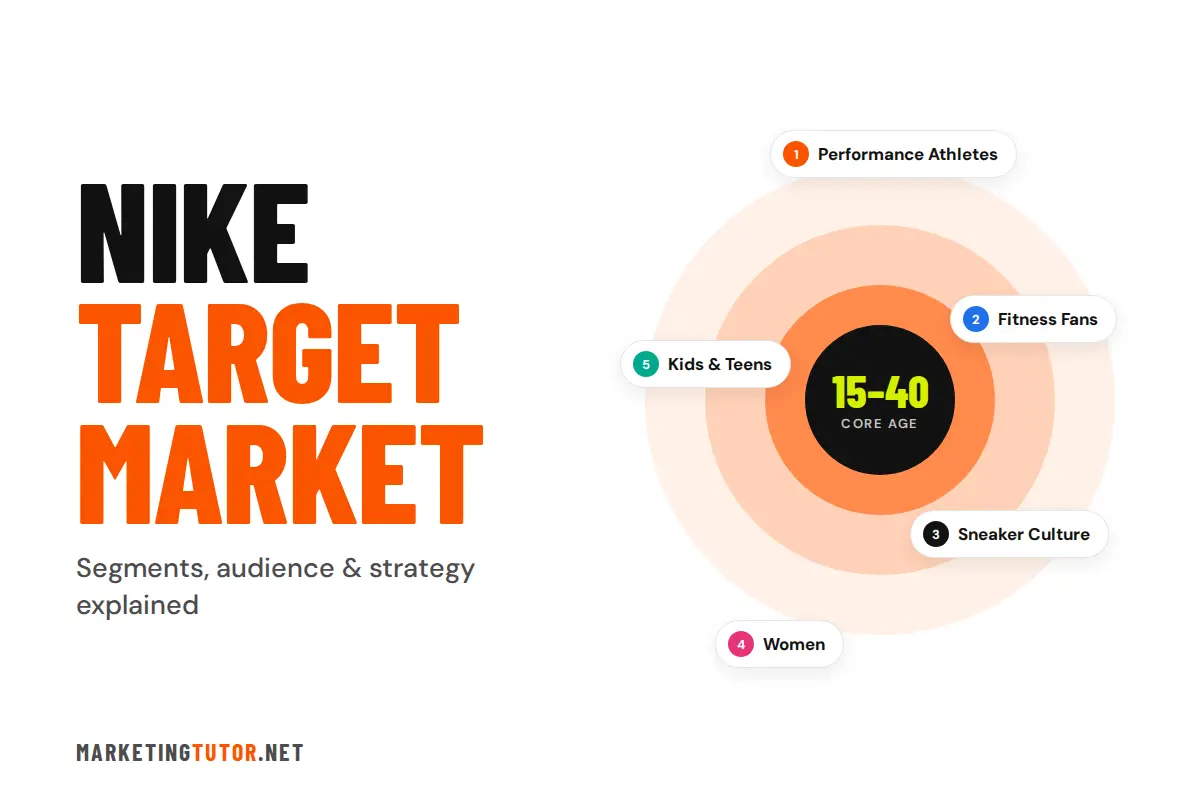
Nike’s target market is athletes and active, style-conscious consumers, mainly people aged roughly 15 to 40 who value performance, innovation, and brand image. Nike defines that market broadly through its mission: “If you have a body, you are an athlete.“
That simple line explains how a running shoe company from Oregon became the world’s largest sportswear brand. Nike sells to elite athletes, weekend joggers, sneaker collectors, and teenagers who never set foot on a track, and it uses different products, prices, and messages for each group.
Below, you will see how Nike segments its market, its main customer groups, how it positions and reaches them, how its target market is changing, and how you can apply the same approach to your own business.
Key Takeaways
- Nike’s core target market is active consumers aged about 15 to 40, across both men and women, with middle to high incomes.
- Nike segments its market using all four bases: demographic, geographic, psychographic, and behavioral segmentation.
- Its main customer groups are performance athletes, everyday fitness consumers, sneaker and streetwear fans, women, and kids.
- Nike targets these groups through athlete endorsements, digital apps, its membership program, and selected retail partners.
- North America is Nike’s largest region, and under CEO Elliott Hill, the company is refocusing on sport and young consumers.
What Is Nike’s Target Market?
A target market is the specific group of customers a company chooses to serve with its products and marketing. Nike’s target market is wide, but it is not “everyone.” It focuses on people who see sport or an active lifestyle as part of who they are.
Nike, Inc. was founded in 1964 as Blue Ribbon Sports by track coach Bill Bowerman and runner Phil Knight. It launched the Nike brand in 1971 and is headquartered in Beaverton, Oregon. Today, it also owns the Jordan Brand and Converse, which let it reach more customer groups under separate names.
| Nike at a Glance | Details |
|---|---|
| Founded | 1964 (as Blue Ribbon Sports) |
| Headquarters | Beaverton, Oregon |
| CEO | Elliott Hill (since October 2024) |
| Fiscal 2026 revenue | $46.4 billion |
| Wholesale revenue (FY2026) | $27.5 billion |
| Nike Direct revenue (FY2026) | $17.7 billion |
| Brands | Nike, Jordan Brand, Converse |
Market segmentation means dividing a large market into smaller groups with similar needs. Nike uses all four classic bases of segmentation. You can learn more about each in our guide to market segmentation examples.
| Segmentation Base | How Nike Segments | Nike Example |
|---|---|---|
| Demographic | Age (core 15 to 40), gender, income (middle to high) | Nike Kids lines, women’s training collections, premium Jordan releases |
| Geographic | Regions, climate, local sports culture | Soccer focus in Europe and Latin America, basketball focus in the US |
| Psychographic | Lifestyle, values, personality (competitive, fitness-driven, style-focused) | “Just Do It” messaging aimed at people who push themselves |
| Behavioral | Benefits sought, usage rate, loyalty, purchase occasion | Performance running shoes vs. lifestyle sneakers, member-only drops |
How Does Nike Use Demographic Segmentation?
Analysts commonly describe Nike’s core customer as roughly 15 to 40 years old. Nike designs separate collections for men, women, and kids, and its premium pricing targets middle to upper-middle-income buyers. For more on this approach, see demographic segmentation.
Why does Nike target teenagers? Teenagers set trends for their friends and share products on social media. A teen who falls in love with Nike at 15 can stay a customer for decades, so winning this age group early builds long-term loyalty.
Teenagers are especially important to Nike. In Piper Sandler’s Fall 2025 “Taking Stock With Teens” survey, Nike again ranked as the number one clothing and footwear brand among US teens. Adidas, New Balance, On, and Hoka followed in footwear, showing that newer running brands are gaining ground.
How Does Nike Use Geographic Segmentation?
Nike sells worldwide, but it adapts to each region. In the US, basketball and running lead its marketing. In Europe and Latin America, soccer takes center stage. North America is Nike’s largest region by revenue, and it was the region that grew in fiscal 2026 while Greater China and Europe declined.
What is Nike’s largest market? North America is Nike’s largest market. It brought in $20.5 billion in fiscal 2026, about 44% of total revenue, and it was the only major region that grew.
| Region | FY2026 revenue | Share of total | Change vs. FY2025* |
|---|---|---|---|
| North America | $20.5 billion | 44% | Up 5% |
| Europe, Middle East & Africa (EMEA) | $12.6 billion | 27% | Down 3% |
| Asia Pacific & Latin America | $6.2 billion | 13% | Down 1% |
| Greater China | $5.8 billion | 13% | Down 13% |
| Converse (all regions) | $1.2 billion | 3% | Down 32% |
*Currency-neutral change. Source: Nike fiscal 2026 annual report (Form 10-K), year ended May 31, 2026.
How Does Nike Use Psychographic Segmentation?
Nike targets people by mindset more than by sport. Its ads speak to determination, competition, and self-improvement. Campaigns like “Just Do It,” launched in 1988, sell an attitude, not just a shoe. See psychographic segmentation for how this works.
How Does Nike Use Behavioral Segmentation?
Nike separates buyers by what they want from a product. A marathon runner wants cushioning data and race performance, while a sneaker collector wants scarcity and design. Nike serves the first group with performance lines and the second with limited releases on its SNKRS app.
Who are Nike’s most loyal customers? Nike’s most loyal customers are its app members, sneaker collectors, and Jordan Brand fans. Members get early access to drops and personalized offers, collectors chase limited releases on SNKRS, and Jordan fans buy into a brand that has lasted for decades. These buyers come back again and again, and they often pay full price.
Does Nike Use Technographic Segmentation?
Yes, as a fifth layer. Technographic segmentation groups customers by the technology they use. Nike targets digitally active, app-first shoppers through the Nike app, SNKRS, and its fitness apps, which reward members with early access and personalized offers.
Who Are Nike’s Main Customer Segments?
1. Performance Athletes
Serious athletes, from high school players to professionals, want gear that improves results. Nike reaches them with performance running shoes, team uniforms, and endorsement deals with stars such as LeBron James and Caitlin Clark.
2. Everyday Fitness Consumers
This is Nike’s largest group: people who run, train at the gym, or walk for health. Nike keeps them engaged with free apps such as Nike Run Club and Nike Training Club.
3. Sneaker and Streetwear Fans
Sneaker collectors, or “sneakerheads,” buy shoes for style and status. The Air Jordan line, first released in 1985, and limited drops on SNKRS target this group. Many of these buyers never play the sport the shoe was designed for.
4. Women
Nike has expanded women’s apparel, sports bras, and training lines, and it sponsors top female athletes. Women’s sport is one of the fastest-growing areas of the athletic market.
5. Kids and Teens
Nike targets young customers early, building loyalty that can last decades. Kids’ sizes of popular adult shoes let children wear the same styles as their sports heroes.
Who Is Not Nike’s Target Market?
Nike does not target price-first shoppers who want the cheapest option. It sells some lower-priced products through Nike Factory Stores, but its brand strategy relies on premium pricing and an aspirational image.
How Does Nike Position Itself to Its Target Market?
Positioning is the place a brand holds in customers’ minds. Nike positions itself as the brand for athletes who want to win, combining performance innovation with cultural “cool.” Learn more in our guide to market positioning.
| Brand | Main Positioning | Core Customer |
|---|---|---|
| Nike | Performance plus culture, “every body is an athlete” | Active 15 to 40 year olds, athletes, sneaker fans |
| Adidas | Sport plus street style, strong in soccer | Soccer fans, lifestyle buyers, Europe-focused |
| Under Armour | Performance gear for serious training | Athletes and gym-goers |
| New Balance | Comfort and quality, “made in USA” lines | Runners, older buyers, rising style appeal |
| Hoka and On | Premium running comfort and technology | Runners and wellness-focused adults |
| Lululemon | Premium athleisure and yoga | Affluent women, now expanding to men |
For a closer look at Nike’s rivals, see our list of Nike competitors.
How Does Nike Reach Its Target Market?
Nike uses several channels, each matched to a segment:
- Athlete endorsements: Michael Jordan in 1984, then Tiger Woods, Serena Williams, LeBron James, and Caitlin Clark. Endorsements give each segment a hero to follow.
- Emotional advertising: campaigns built on stories and values, such as the 2018 “Dream Crazy” ad featuring Colin Kaepernick for the 30th anniversary of “Just Do It.”
- Digital apps and membership: the Nike app, SNKRS, Nike Run Club, and Nike Training Club collect customer data and reward loyal members with early access.
- Retail partners and Nike stores: after pushing direct-to-consumer sales for several years, Nike has rebuilt ties with retailers such as Foot Locker and Dick’s Sporting Goods to reach more shoppers.
- Customization: Nike By You lets customers design their own shoes, which appeals to buyers who want to express their style.
How Has Nike’s Target Market Changed in 2026?
Nike’s target market has widened over time. It began with serious runners in the 1970s, added basketball fans with Air Jordan in the 1980s, then grew into lifestyle and streetwear buyers.
Recent challenges have pushed Nike to refocus. Revenue was $46.4 billion in fiscal 2026, flat compared with the year before, as newer running brands won over some customers. Elliott Hill, who became CEO in October 2024, is leading what Nike calls its “Sport Offense,” a shift back toward sport, running, and young consumers.
The results show the change in channels too. In fiscal 2026, wholesale revenue rose 6% to $27.5 billion, while Nike Direct fell 6% to $17.7 billion, as Nike leaned on retail partners to reach more shoppers again.
Women are a bigger priority too. In September 2025, Nike launched NikeSKIMS, a new activewear brand built with SKIMS, the company co-founded by Kim Kardashian. It targets women who want gear for both workouts and everyday style, a space where Lululemon and Alo have grown fast.
Nike is also resetting in Greater China, where sales fell 13% in fiscal 2026. Hill says the company is returning to sport and innovation there and taking a more local approach to product design.
How Can You Define Your Target Market Like Nike?
Nike’s approach works for small businesses too. Use these five steps to define your own target market:
- Start with a mission that defines your customer. Nike’s “every body is an athlete” tells employees exactly who they serve. Write one sentence describing who your business exists for.
- Segment using all four bases. List your customers’ age and income, location, lifestyle, and buying behavior. Patterns will show you two or three distinct groups.
- Pick a core segment, then expand. Nike started with serious runners before reaching everyone else. Win one group first.
- Match products and messages to each segment. A performance buyer and a style buyer want different things, even from the same brand.
- Measure and adjust. Track who buys, how often, and why. Nike’s apps give it this data; for a small business, a simple customer survey or sales report can do the same job.
Bottom Line
In 14 years of blogging about marketing, I have used Nike as an example more than almost any other brand, and the reason is simple. Nike never tries to sell to “everyone.” It defines a clear identity, the athlete, and then stretches that identity to fit millions of people. If your business can describe its customer in one sentence the way Nike does, your marketing becomes far easier to plan and far harder for competitors to copy.
Frequently Asked Questions
Nike’s target audience is active, sport-minded consumers, mainly aged about 15 to 40, who value performance, innovation, and style. It includes serious athletes, everyday fitness consumers, sneaker collectors, women, and kids. Nike reaches this audience with athlete endorsements, emotional advertising, and digital apps, and it adjusts its products and messages for each group rather than marketing to everyone the same way.
Nike’s core age group is roughly 15 to 40, with special focus on teenagers and young adults, who set trends and can stay loyal for decades. Nike also sells kids’ lines to build loyalty early and offers comfort and walking products for older adults. Its marketing, apps, and social media are designed mainly to reach younger, digitally active consumers.
Nike targets both. Historically, its marketing leaned toward men’s sports such as basketball and football, but Nike has expanded its women’s training, running, and lifestyle lines and sponsors leading female athletes. Women’s sport is a major growth area for the whole athletic industry, and brands such as Lululemon compete strongly for female customers.
Nike is a premium brand, not a luxury brand. Its prices are higher than budget sportswear but far below luxury fashion labels. Some limited sneaker releases and designer collaborations resell for luxury-level prices, which adds to Nike’s status image. This premium position lets Nike earn strong margins while still reaching a mass market of middle-income consumers.
Adidas is Nike’s biggest global competitor, especially in soccer and lifestyle sneakers. In the US, Nike also competes with Under Armour, New Balance, Puma, and fast-growing running brands such as Hoka and On, while Lululemon competes for premium athleisure customers. Each rival targets a slightly different segment, which forces Nike to defend several markets at once.
Segmentation lets Nike create the right product, price, and message for each group of customers. A marathon runner, a sneaker collector, and a parent buying kids’ shoes want very different things. By dividing its market into segments, Nike avoids generic marketing, spends its budget where it gets the best return, and builds stronger loyalty within each group.

