


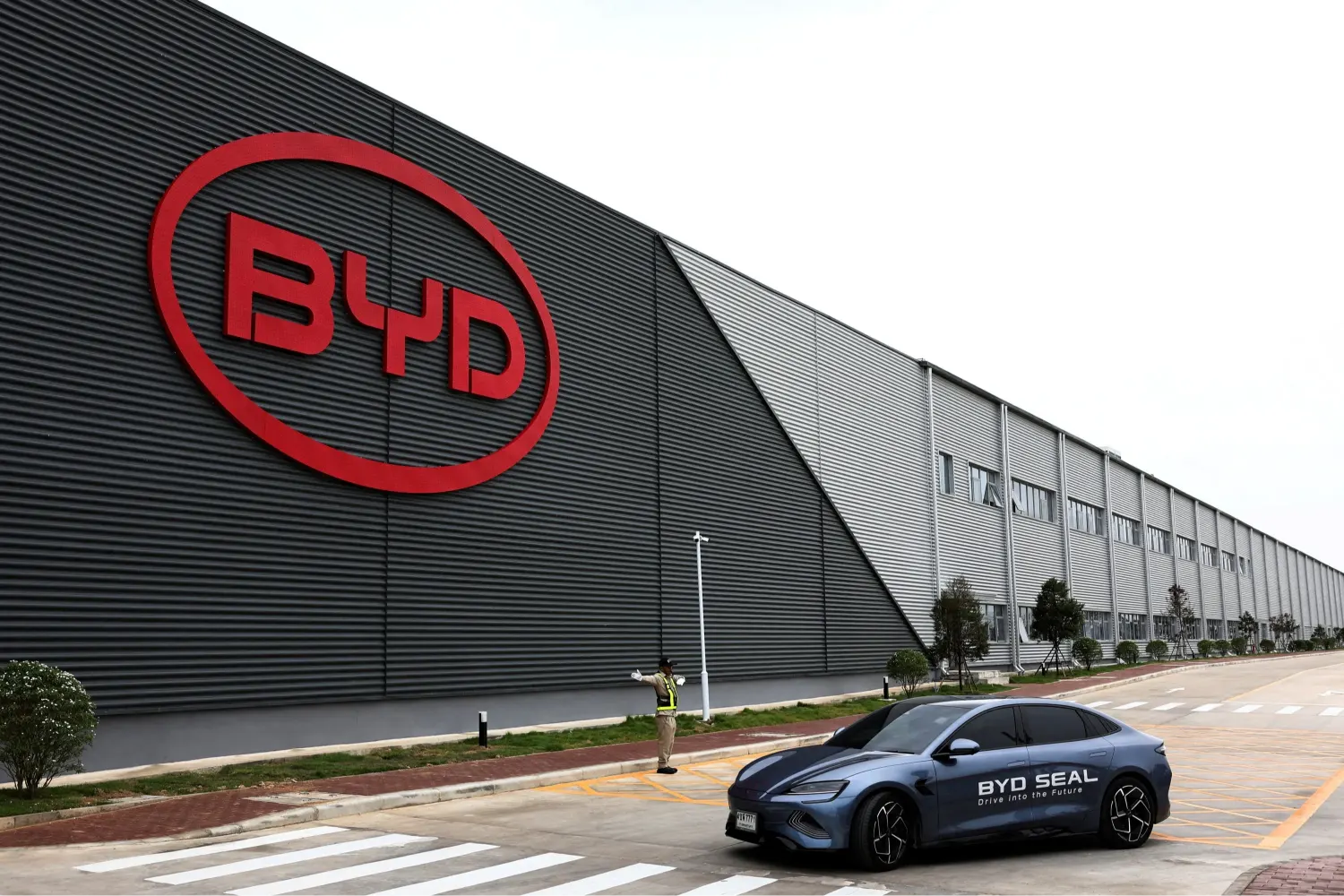
A BYD SWOT analysis looks at the strengths, weaknesses, opportunities and threats of BYD, the Chinese company that is now the world’s biggest seller of electric vehicles. In 2026, BYD’s biggest strength is its fast-growing export business. Its biggest weakness is shrinking sales at home, which, along with exchange losses, have pushed its profit down.
BYD sells more battery-electric cars than Tesla, but its sales in China fell sharply this year as a price war spread. To grow, it now builds cars in Thailand and Brazil, has started in Indonesia and is opening a plant in Hungary. Below, I cover each SWOT factor with BYD’s Q3 2026 results, compare it with Tesla and share what I think BYD should do next.
Key Takeaways
- BYD sold 762,478 passenger battery-electric vehicles in Q3 2026, beating Tesla’s 486,532 deliveries for a second straight quarter.
- BYD’s Q3 2026 net profit rose 28% to RMB 10.0 billion, but nine-month profit fell 4.2%, according to its quarterly report.
- BYD’s NEV retail sales in China fell 31.5% from January to October 2026, while overseas sales rose 93.8% to 1.51 million vehicles.
- China-built BYD electric cars pay a 17.0% EU countervailing duty on top of the standard 10% import duty.
- BYD’s share of global EV sales fell from 20.0% to 16.0% in the first nine months of 2026, according to SNE Research.
What Is BYD’s SWOT Analysis at a Glance?
Here is the full picture in two tables.
| Strengths | Weaknesses |
|---|---|
| Sells more battery-electric cars than Tesla | Nine-month profit down 4.2% |
| No. 1 in China with 22.4% of NEV retail sales (Oct) | China retail sales down 31.5% (Jan-Oct) |
| Exports up 137% in Q3 2026 | Inventories up 60% since January |
| Own Blade Batteries and Flash Charging | Battery supply bottleneck until 2027 |
| Operating cash flow up 33% | Cash down, exchange losses up |
| Opportunities | Threats |
|---|---|
| Overseas target of 2.5M+ cars in 2027 | EU tariffs, with hybrids possibly next |
| New plants in Hungary, Brazil, Indonesia | China’s price war and overcapacity |
| Fast-charging network abroad | Rivals like Geely and Leapmotor |
| Fast EV growth in Europe and Asia | Political pushback in Hungary |
| Electric trucks for Europe | Exports slowing since August |
Build a SWOT analysis for any company with our free SWOT analysis tool and guide.
How Is BYD Performing in 2026?
BYD’s results show two different stories: a strong third quarter, and a weaker year overall. Here are the figures from BYD’s Q3 2026 report filed in Hong Kong:
| Metric | Q3 2026 | First Nine Months of 2026 |
|---|---|---|
| Revenue | RMB 221.5 billion (+13.6%) | RMB 566.3 billion (flat) |
| Net profit | RMB 10.0 billion (+28.1%) | RMB 22.3 billion (-4.2%) |
| Operating cash flow | n/a | RMB 54.5 billion (+33.4%) |
| Research and development | n/a | RMB 36.3 billion (-17%) |
| Inventories (Sept 30) | RMB 221.6 billion (+60% since end-2025) | |
| Cash and cash equivalents (Sept 30) | RMB 29.8 billion (down from RMB 68.4 billion at end-2025) |
Total Q3 sales rose 18.7% to 1.32 million vehicles, Electrek reported. Exports did the heavy lifting, jumping 137% to 550,704. Domestic sales fell about 12%.
October followed the same pattern. BYD sold 490,168 vehicles, its best month since December 2024, with a record 305,743 battery-electric cars, Autonext reported. Plug-in hybrid sales fell 17.2%, and China sales fell 10.6%.
What does this show? BYD’s growth now comes from outside China. Its sales at home, once its engine, are shrinking.
What Are BYD’s Strengths?
Strengths are the internal advantages that help a company win. Our guide to SWOT strengths explains this quadrant. BYD’s come from its scale, its batteries and its export machine.
1. Outselling Tesla in Battery-Electric Cars
BYD sold 762,478 passenger battery-electric vehicles in Q3 2026, up 30.9% from a year earlier, CnEVPost reported. Tesla delivered 486,532 vehicles in the same quarter, so BYD has now led Tesla for two quarters in a row. Counting plug-in hybrids too, BYD is still the world’s No. 1 EV maker, with 2.56 million sales from January to September 2026, according to SNE Research.
2. Still No. 1 in China
Even in a falling market, BYD held 22.4% of China’s new energy vehicle (NEV) retail sales in October 2026. The figure comes from the China Passenger Car Association (CPCA) via CnEVPost. That is almost double the 11.8% of second-place Geely. Tesla dropped out of China’s top 10 in October, though that is one month, not a trend.
3. An Export Engine That Works
BYD sold 1.51 million vehicles overseas in the first ten months of 2026, up 93.8% and about 42% of its total, Yicai and Autonext reported. In 2022, it exported as few as 45,000, The Business Times reported. Overseas revenue passed domestic revenue in the first half of 2026, according to a Deutsche Bank note reported by The Business Times. BYD’s management put first-half profit at about RMB 20,000 per car sold outside China, Autonext reported. Analysts estimate the figure in China at below RMB 3,000.
Tariffs have not stopped it either. BYD more than doubled its battery-electric imports into the EU despite paying a 27% duty, according to Transport & Environment (T&E).
4. Batteries and Fast Charging
BYD makes its own Blade Batteries, so it does not rely on outside battery suppliers. Its battery scale is growing abroad too. Outside China, BYD ranked third for EV battery installations in the first nine months of 2026, according to SNE Research via electrive. Its share of that market rose from 8.0% to 10.8%. Its new Flash Charging system can charge a car from 10% to 70% in five minutes, according to BYD.
In November 2026, BYD showed a site in Abu Dhabi that combines solar power, battery storage, Flash Charging and robotic charging arms. For me, controlling batteries and charging together is a real competitive advantage.
5. Strong Cash Generation
BYD’s operating cash flow rose 33.4% to RMB 54.5 billion in the first nine months of 2026, according to its report. Even with lower profit, its core business still brings in cash.
What Are BYD’s Weaknesses?
Weaknesses are internal problems that hold a company back. Learn how to spot them in our guide to SWOT weaknesses. BYD’s center on profit, inventory and its dependence on China.
1. Falling Profit
BYD’s net profit fell 4.2% to RMB 22.3 billion in the first nine months of 2026. Its Q3 profit rose 28%, but it still missed all three analyst estimates compiled by Reuters, which ranged from RMB 11.4 billion to RMB 12.95 billion. This follows a weak 2025, when profit fell 19% to $4.7 billion, BYD’s first annual drop since 2021, CNBC reported.
2. A Shrinking Home Market
BYD’s NEV retail sales in China fell 31.5% from January to October 2026, according to the CPCA. October alone was down 15.4% from a year earlier. Chairman Wang Chuanfu described China’s car market as being in a “knockout stage,” Automotive World reported. BYD still leads, but it is selling far fewer cars at home.
3. Rising Inventory and Receivables
BYD’s inventories rose 60% to RMB 221.6 billion between the end of 2025 and September 30, 2026, according to its report. Money owed by customers (trade receivables) rose 52.6%, Reuters reported. Cash plus trading securities fell 45% to RMB 71.7 billion over the same period, Electrek calculated from the report. More cars waiting to be sold and more unpaid bills tie up cash.
4. More Bonds and Exchange Losses
BYD’s bonds payable tripled to RMB 15.0 billion in 2026 after it issued new bonds, its report shows. It also repaid about half of its short-term bank loans. Finance costs swung to an RMB 7.4 billion expense in the first nine months, from net income a year earlier, mainly because of exchange losses. Asset impairment losses also rose 67.6%, mainly from writing down the value of its larger inventory.
5. A Battery Bottleneck
In June 2026, Wang Chuanfu said BYD’s sales this year depend on how many batteries it can make, CnEVPost reported. At the time, output of second-generation Blade Batteries was rising by 20,000 to 30,000 units a month. BYD expects the constraint to be resolved by Q1 2027, The Business Times reported.
6. Lower R&D Spending
BYD spent RMB 36.3 billion on research and development in the first nine months of 2026, down 17% from a year earlier. For a company whose edge is technology, cutting R&D during a price war is a risk.
7. Losing Global Share
BYD’s share of global EV sales fell from 20.0% to 16.0% in the first nine months of 2026, SNE Research found. Its total EV sales dropped 15.4%. Its China deliveries fell 32.9% while its Europe sales rose 78.8%, SNE found. Strong exports have not fully replaced the losses in China.
What Are BYD’s Opportunities?
Opportunities are outside trends a company can use to grow. Our guide to SWOT opportunities explains this quadrant. BYD’s biggest ones are overseas.
1. Bigger Overseas Targets
BYD raised its 2026 overseas sales forecast to 1.8 million vehicles in November, up from an initial 1.3 million, Yicai reported. A September Deutsche Bank note had put BYD’s guidance higher, at 1.9 million to 2 million. For 2027, BYD is targeting more than 2.5 million overseas sales, according to the same Deutsche Bank note.
2. Factories Close to Customers
Building cars in other countries helps BYD avoid import duties and serve local buyers faster:
| Country | Plant Status in 2026 |
|---|---|
| Thailand | 100,000th car built in September; 150,000-a-year capacity |
| Brazil | Running 24 hours a day since November 9; scaling toward 300,000 a year |
| Indonesia | Production has started |
| Hungary | Trial production since January; first cars due by December; 200,000-a-year target |
Sources: CnEVPost, BYD Brasil, The Business Times, Automotive World.
Alfredo Altavilla, who advises BYD on Europe, said BYD will need three European car plants and a battery factory over the long term, Automotive World reported. Spain and France lead for the second site.
3. A Global Fast-Charging Network
BYD plans 6,000 Flash Charging stations worldwide by the end of 2027, according to BYD. The Business Times reported a wider goal of 90,000 super-fast charging stations by the end of 2028, including 6,000 outside China. For me, fast charging answers one of the biggest worries EV buyers have: waiting to charge.
4. Fast EV Growth Outside China
The whole EV market grew 32.2% in Europe and 74.7% in Asia outside China in the first nine months of 2026, SNE Research found. China fell 8.6%. BYD’s export push is aimed at exactly these markets.
5. Electric Trucks for Europe
BYD plans European deliveries of its ETT 44 electric truck from Q2 2027, Automotive World reported. Executive Stella Li also said BYD will not form a joint venture in Europe.
What Are BYD’s Threats?
Threats are outside forces that could hurt a company. BYD faces trade barriers, a brutal price war and stronger rivals.
1. EU Tariffs, and Maybe More
China-built BYD electric cars pay a 17.0% countervailing duty in the EU, on top of the standard 10% import duty, according to the European Commission. The duty started on October 30, 2024, and runs for five years. Hybrids are now in focus. Chinese brands held 13% of the EU’s plug-in hybrid market, up from 3% in 2024, T&E found.
On October 9, 2026, EU trade commissioner Maroš Šefčovič announced an understanding with Beijing on Chinese hybrids, Autonext reported. It aims to cut their exports to the EU by more than half against projected growth over four years.
A draft EU Industrial Accelerator Act could also require about 70% local content, Automotive World reported.
2. China’s Price War
Average discounts on BYD cars hit about 10% in March 2026, according to Bloomberg data reported by Automotive World. China has capacity to build about 55.5 million cars a year, but sells only about 23 million at home. China banned below-cost car sales from February 2026, but the gap between supply and demand keeps pressure on prices. For me, a price war hurts the market leader most, because it has the most cars to sell.
3. Stronger Chinese and Global Rivals
BYD still leads, but most of its biggest rivals are growing while it shrinks:
| Group | Global EV Sales, Jan-Sep 2026 | Change |
|---|---|---|
| BYD | 2.56 million | -15.4% |
| Geely | 1.59 million | +2.5% |
| Tesla | 1.32 million | +8.8% |
| SAIC | 1.03 million | +18.3% |
| Volkswagen Group | 1.02 million | +2.9% |
| Chery | 654,000 | +35.7% |
| Leapmotor | 610,000 | +66.2% |
Source: SNE Research via Battery-Tech Network. Includes battery-electric and plug-in hybrid cars.
Tesla’s growth came from the same markets BYD is targeting: its sales rose 29.7% in Europe and 75.8% in Asia, SNE found. Tesla’s China-made cars also pay a lower EU duty of 7.8%, compared with BYD’s 17.0%, according to the European Commission. See our full list of Tesla’s biggest rivals.
4. Politics Abroad
Hungary’s new government under Prime Minister Péter Magyar is reviewing the project, Automotive World reported. A police probe into contaminated soil at BYD’s plant site is also still open. BYD’s planned $1 billion plant in Manisa, Turkey (150,000 cars a year) is on hold. BYD also does not sell cars in the US.
5. Slowing Exports and Shipping Limits
BYD told investors that shipping limits held back its exports earlier in 2026, The Business Times reported. It is adding car carriers and local plants to ease them. Exports have also cooled. October exports of 170,194 were down 5.8% from September, the second monthly fall after August’s record, Autonext reported. That is below BYD’s plan of 180,000 to 200,000 a month.
How Does BYD Compare With Tesla?
Tesla is BYD’s best-known rival. Here is how the two compare:
| Factor | BYD | Tesla |
|---|---|---|
| Q3 2026 battery-electric sales | 762,478 | 486,532 |
| Global EV rank (Jan-Sep 2026) | No. 1 (2.56M, incl. hybrids) | No. 3 (1.32M) |
| 2025 revenue | $116 billion | $94.8 billion |
| 2025 net profit | $4.7 billion (-19%) | $3.79 billion |
| Forward P/E (Nov 2026) | About 15x | About 232x |
| EU duty on China-made cars | 17.0% | 7.8% |
| Sells cars in the US | No | Yes |
Sources: CnEVPost, SNE Research, CNBC, Just Auto, Motley Fool, European Commission.
For me, BYD wins on volume and price, while Tesla’s much higher P/E shows investors are paying for future growth. For Tesla’s side, read our Tesla SWOT analysis.
What Should BYD Do Next?
A SWOT analysis is most useful when you turn it into action. Here is my view, using the TOWS method:
- Strengths with opportunities (SO): Use its battery and charging lead to sell fast-charging models abroad once the Blade Battery shortage eases, expected by Q1 2027.
- Fix weaknesses with opportunities (WO): Cut inventory by shifting more output to overseas markets, where profit per car is higher.
- Strengths against threats (ST): Use the Hungary plant to avoid EU tariffs, and plants in Brazil and Thailand to ease shipping limits.
- Reduce weaknesses and threats (WT): Protect R&D spending so the price war does not erode its technology edge.
Most of these moves rely on BYD’s cost leadership, built on making its own batteries.
My Take: What Connects BYD’s SWOT?
- Exports are now the business. With China retail sales down 31.5%, overseas growth is no longer a bonus; it is what keeps BYD growing.
- The balance sheet is the warning light. Inventory up 60%, receivables up 52.6%, bonds tripled and cash plus securities down 45%. These matter more than one strong quarter.
- Local factories are the answer to tariffs. Plants outside China, especially Hungary, reduce BYD’s exposure to EU duties and shipping limits.
How Can You Use This BYD SWOT Analysis?
- For students: use BYD as a case study of a company shifting from a home-market leader to a global exporter.
- For marketers: study how BYD uses fast charging and low prices to win buyers in new markets.
- For investors: watch inventory, overseas sales and the start of Hungary production each quarter.
Bottom Line
BYD in 2026 is the world’s biggest EV seller, with a powerful export engine and its own battery technology. But its sales at home are falling fast, profit is down for the year, and inventory and receivables are piling up while cash falls.
For me, BYD’s next year depends on one question: can overseas growth outrun the decline in China? If its new plants ramp up on time and the battery shortage ends in early 2027, BYD can keep its lead. If not, the price war at home will keep squeezing it.
Educational analysis, not investment advice.
Sources: BYD Q3 2026 report (HKEX); Reuters; Electrek; Autonext; electrive; Transport & Environment; Battery-Tech Network; CnEVPost; China Passenger Car Association; SNE Research; Yicai Global; The Business Times (Deutsche Bank note); Automotive World; European Commission; BYD Media; BYD Brasil; CNBC; Motley Fool.
Frequently Asked Questions
By sales volume, yes. BYD sold 762,478 passenger battery-electric cars in Q3 2026, against Tesla’s 486,532 deliveries. BYD also earned more revenue in 2025: $116 billion versus Tesla’s $94.8 billion.
BYD’s China retail sales fell 31.5% from January to October 2026 during a price war. It also booked exchange losses and higher write-downs on inventory. Nine-month profit fell 4.2%, even though overseas sales rose.
No. BYD does not sell passenger cars in the US. It sells in Europe, Latin America, Southeast Asia and other markets, and builds cars in Thailand, Brazil and Indonesia, with Hungary starting next.
China-built BYD electric cars pay a 17.0% EU countervailing duty plus the standard 10% import duty, about 27% in total. The duty started in October 2024 and runs for five years.
BYD builds cars in Thailand and Brazil, has started production in Indonesia and plans to begin assembly in Hungary by the end of 2026. Its planned plant in Turkey is on hold.
Flash Charging is BYD’s fast-charging system. It can charge a compatible car from 10% to 70% in five minutes and to 97% in nine minutes, according to BYD. BYD plans 6,000 stations worldwide by the end of 2027.

