


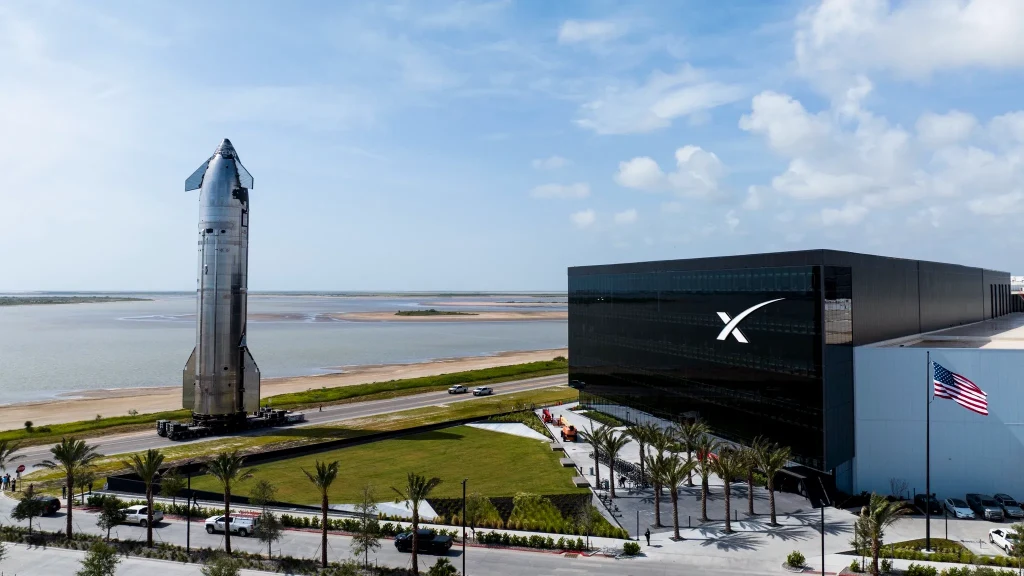
A SpaceX SWOT analysis reviews the strengths, weaknesses, opportunities and threats of Space Exploration Technologies Corp., the rocket, satellite internet and AI company led by Elon Musk. In 2026, SpaceX’s biggest strength is its control of the launch market, and its biggest weakness is how much cash its AI buildout is burning.
In 2026, SpaceX went public in the largest IPO ever, its Starship rocket reached orbit, its AI business became its biggest revenue source, and it is in talks to combine with Tesla. Below, I break down each SWOT factor with SpaceX’s own Q3 2026 numbers, compare it with rivals and share my view of what comes next.
Key Takeaways
- SpaceX’s Q3 2026 revenue jumped 161% to $14.6 billion, led by its Super Intelligence (AI) segment at $7.6 billion.
- Starlink had 13.6 million consumer subscribers and earned $2.4 billion in operating income in Q3 2026, making it SpaceX’s profit engine.
- SpaceX spent $48.1 billion on capital projects in the first nine months of 2026, against $13.1 billion of operating cash flow, and posted a $413 million net loss over that period.
- SpaceX launched fewer rockets in 2026 than in 2025: 113 in the first nine months, down from 128.
- SpaceX reported a $63 billion backlog and guided Q1 2027 revenue to $33 billion to $37 billion.
What Is SpaceX’s SWOT Analysis at a Glance?
Here is the full picture in one table.
| Strengths | Weaknesses |
|---|---|
| Almost 90% of global mass to orbit | Net loss of $413M over nine months |
| Starlink: 13.6M subscribers, $2.4B Q3 operating income | $48.1B capex vs $13.1B operating cash flow |
| Starship reached orbit; ship caught by tower | Launch count down from 128 to 113 |
| AI revenue of $7.6B in Q3 2026 | Space segment lost $1.2B in nine months |
| $63B backlog and about $89.9B in cash and securities | Starlink revenue per user fell from $83 to $69 |
| Opportunities | Threats |
|---|---|
| Starlink Mobile: 22M users, new spectrum | Amazon Leo and Blue Origin |
| Starship V3 satellites with 10x capacity | AI customers that may not renew |
| AI cloud contracts and a $100B revenue run rate goal | Starshield dispute with Ukraine |
| NASA Moon landings planned for 2028 | Space debris and collision risk |
| A possible combination with Tesla | Regulators, merger approval and execution risk |
Build a SWOT analysis for any company with our free SWOT analysis tool and guide.
How Is SpaceX Performing in 2026?
SpaceX now reports results like any public company. Here are its Q3 2026 numbers, from its Q3 2026 results release:
| Metric | Q3 2026 | Q3 2025 | Change |
|---|---|---|---|
| Total revenue | $14.6 billion | $5.6 billion | +161% |
| Operating income | $2.8 billion | Loss of $273 million | Turned positive |
| Net income | $4.4 billion | Loss of $1.1 billion | Turned positive |
| Adjusted EBITDA | $8.8 billion | $2.2 billion | +306% |
| Capital spending | $19.6 billion | $6.9 billion | Nearly 3x |
| Starlink consumer subscribers | 13.6 million | 7.2 million | +89% |
SpaceX now runs three businesses. Here is how each one performed in Q3 2026:
| Segment | Revenue | Growth | Operating Result | Capex |
|---|---|---|---|---|
| Space (rockets, launches) | $1.8 billion | +6% | Loss of $7 million | $1.6 billion |
| Connectivity (Starlink) | $5.2 billion | +69% | Profit of $2.4 billion | $1.5 billion |
| Super Intelligence (AI, formerly xAI) | $7.6 billion | +830% | Profit of $431 million | $16.4 billion |
What does this show? Starlink earns the profit, AI drives the growth, and AI also eats most of the spending. The rocket business, which made SpaceX famous, is now the smallest of the three.
What Are SpaceX’s Strengths?
Strengths are the internal advantages that help a company win. Our guide to SWOT strengths explains this quadrant. SpaceX’s strengths come from scale, reusable rockets and a business that funds itself through Starlink.
1. Dominance in Launch
Musk said on the Q3 2026 call that SpaceX carries “almost 90%” of all mass sent to orbit, with China at about 6% and the rest of the world at about 4%. In 2025, SpaceX flew a record 165 orbital launches, all on Falcon 9, nearly twice as many as China, Space.com reported. That lead comes from reusing rockets, which cuts the cost of each flight. Rivals can build rockets, but matching this launch rate takes years. It is a clear competitive advantage.
2. Starlink Is a Profit Engine
Starlink grew to 13.6 million consumer subscribers in Q3 2026, up from 7.2 million a year earlier. Its Connectivity segment earned $2.4 billion in operating income on $5.2 billion of revenue, a margin of about 45%. Enterprise and government revenue grew even faster, up 91% to $2.1 billion. More than 3,800 aircraft now carry Starlink, according to SpaceX.
3. Starship Has Reached Orbit
Starship Flight 14 was SpaceX’s first orbital Starship flight and its first paid Starship mission, deploying 26 Starlink V3 satellites. SpaceX said that one flight added about 10 times the downlink capacity of a Falcon 9 Starlink launch. On November 14, 2026, during Flight 15, SpaceX caught the returning Starship upper stage with its launch tower. CBS reported it was a first for an orbital upper stage. SpaceX’s goal is to catch both stages on future flights, which Musk has tied to rapid reuse.
4. A Fast-Growing AI Business
SpaceX’s Super Intelligence (SI) segment, built on the former xAI, earned $7.6 billion in revenue in Q3 2026, up from $813 million a year earlier. Growth came from cloud services deals, the Cursor acquisition and its Grok AI products. SpaceX had 1.7 gigawatts of computing capacity at the end of September, up from 0.6 gigawatts a year before. The CFO expects 2.5 to 3 gigawatts by the end of 2026.
5. Strong Finances and Backlog
SpaceX raised $75 billion in its June 2026 IPO, the largest in history, at a $1.77 trillion valuation, SpaceQ reported. It ended Q3 with about $89.9 billion in cash and marketable securities. The CFO said SpaceX has a $63 billion backlog, with about $42 billion expected to turn into revenue within a year. That gives it rare visibility into future sales.
6. Deep Government Ties
In Q3 2026 alone, SpaceX signed three more NASA space station crew missions and 18 National Security Space Launch missions. It also won a contract to deliver a payload to the Moon with Starship. Government work gives SpaceX steady, long-term demand.
What Are SpaceX’s Weaknesses?
Weaknesses are internal problems that hold a company back. Learn to spot them in our guide to SWOT weaknesses. SpaceX’s weaknesses center on spending, profit and its dependence on one leader.
1. Still Losing Money Over the Year
Q3 2026 was profitable, but SpaceX posted a net loss of $413 million over the first nine months of 2026. The SI segment alone lost $3.3 billion at the operating level over that period. One strong quarter does not yet prove the business can stay profitable while it spends this much.
2. Enormous Cash Burn
SpaceX spent $48.1 billion on capital projects in the first nine months of 2026, while operating cash flow was $13.1 billion. About $40 billion of that spending went to AI computing. The CFO expects Q4 2026 capex of $35 billion to $40 billion, more than any earlier quarter. SpaceX also carried about $38.8 billion in debt and finance leases at the end of Q3.
3. Fewer Launches in 2026
SpaceX completed 113 launches in the first nine months of 2026, down from 128 a year earlier. Customer launches fell from 36 to 29, and mass sent to orbit dropped from 1,627 to 1,517 metric tons.
Why does this matter? Launch leadership is SpaceX’s best-known strength. A falling launch count, even during a Starship transition, gives rivals a little room.
4. The Rocket Business Is Losing Money
SpaceX’s Space segment lost $1.2 billion at the operating level in the first nine months of 2026, as research spending on Starship rose. The business that built SpaceX’s brand now depends on Starlink and AI profits.
5. Lower Revenue Per Starlink User
Starlink’s average consumer revenue per user fell to $69 a month in Q3 2026, down from $83 a year earlier, even as subscribers nearly doubled. It did rise 5% from the previous quarter. Total consumer revenue still grew 57%, but each subscriber now brings in less money than a year ago.
6. Key-Person Risk and Complexity
Elon Musk is SpaceX’s CEO, CTO and chair, and he also runs Tesla, according to Tesla’s proxy statement. On the Q3 call, Musk called himself “a conflicted party” in the Tesla merger talks. You can see how his stakes connect in our guide on Elon Musk’s Tesla ownership. SpaceX is also now three very different businesses under one stock: rockets, satellite internet and AI. That makes it harder for investors to judge.
What Are SpaceX’s Opportunities?
Opportunities are outside trends a company can use to grow. SpaceX’s biggest ones are in mobile connectivity, AI and the Moon.
1. Starlink Mobile
Starlink Mobile, SpaceX’s mobile service, passed 22 million monthly users in Q3 2026, up 37% in one quarter, President Gwynne Shotwell said. The FCC approved SpaceX’s plan to launch 15,000 Mobile V2 satellites. SpaceX also agreed to buy 800 MHz spectrum licenses, with US mobile service targeted for early 2028. That could make Starlink a mobile carrier in the US, not just an internet provider.
2. Much More Bandwidth With Starship
Musk expects Starlink to have about 100 times its current bandwidth within about three years, using larger V3 satellites launched by Starship. Shotwell said SpaceX will attempt on-orbit refueling of Starship early next year. More capacity per launch lets SpaceX serve more users with each Starship flight.
3. Selling AI Computing
The CFO said demand is strongest in SpaceX’s cloud services business and that SpaceX is on track for $100 billion in annualized revenue by the end of 2026. Musk said SpaceX is bringing about 200,000 GB300 AI chips online per month. If outside companies keep renting this computing power, AI could become SpaceX’s largest profit source, not just its largest revenue source.
4. NASA’s Return to the Moon
NASA now plans Artemis III as an Earth-orbit test in mid-2027, with crewed Moon landings on Artemis IV and V in 2028, SpacePolicyOnline reported. SpaceX expects to test propellant transfer in early 2027 and an uncrewed lunar landing in late 2027. SpaceX’s Q3 pipeline already includes a contract to deliver a payload to the Moon with Starship.
5. A Possible Combination With Tesla
SpaceX and Tesla are discussing a merger, and a deal could be announced as soon as December 2026, Bloomberg reported. Musk said both companies’ special committees “have not reached agreement” and that Tesla would need approval from 50% of all its shares. For Tesla’s side of the story, see our Tesla SWOT analysis.
What Are SpaceX’s Threats?
Threats are outside forces that could hurt a company. SpaceX faces rivals in space and AI, political disputes and physical risks in orbit.
1. Amazon Leo and Blue Origin
Amazon Leo, Amazon’s satellite internet service, has launched nearly 400 satellites since April 2025, Data Center Dynamics reported. Blue Origin competes in rockets and Moon landers.
Both hit setbacks in November 2026. A Vulcan rocket failure on November 15 destroyed 40 Amazon Leo satellites. Blue Origin’s New Glenn return to flight slipped to January 2027 after a test explosion damaged its only launch pad, The Next Web reported. These setbacks slow SpaceX’s closest rivals, at least for now.
2. AI Customers That May Not Stay
SpaceX rents AI computing to other companies, including Anthropic. Anthropic executives reportedly told analysts they do not plan to extend the contract beyond Q2 2027, Wccftech reported. Musk replied that SpaceX “would be happy to take the compute back.” If major customers leave, SpaceX could be left with costly unused capacity. Learn more about Anthropic in our guide on who controls Anthropic.
3. The Starshield Dispute
Starshield, the military version of Starlink, has been shared with Ukraine by the US Defense Department since 2024, NPR reported. Ukrainian President Volodymyr Zelenskyy blamed restrictions on its use for hurting Ukraine’s defense, with disruptions from October 13 to 24 and again from November 12, 2026.
Musk said any limits are decided by the US military “and ultimately POTUS.” US senators have asked for an investigation. Being caught in a war-time dispute is a reputational and political risk.
4. Space Debris and Collisions
Starlink satellites made 207,152 maneuvers to avoid collisions between December 2025 and May 2026, according to SpaceX’s report to the FCC, Space.com reported. That is more than 355,000 over a full year, with more than 10,000 satellites in orbit. Experts warn that the risk adds up as orbits get more crowded. A major collision could bring tighter rules for every satellite operator.
5. Regulation and Merger Approval
SpaceX needs approval from the FAA for Starship flights and from the FCC for satellites and spectrum. A Tesla merger would need approval from 50% of all Tesla shares. Our Tesla PESTLE analysis covers the regulators that shape Musk’s companies.
6. Execution Risk
Starship is still a test program. On Flight 15, the Super Heavy booster’s engines stopped too soon and the booster exploded over the Gulf, CBS reported. At its IPO, SpaceX was valued at about 94 times its 2025 revenue, according to Morningstar, so investors expect a lot to go right.
What Should SpaceX Do Next?
A SWOT analysis is most useful when you turn it into strategy. Here is my view, using the TOWS method that pairs each factor with an action:
- Strengths with opportunities (SO): Use Starship’s capacity to launch V3 and Mobile satellites fast, before Amazon Leo recovers from its setbacks.
- Fix weaknesses with opportunities (WO): Use Starlink’s profit and the $63 billion backlog to fund AI capex, reducing the need for more debt.
- Strengths against threats (ST): Use its launch lead and NASA contracts to stay ahead in the 2028 Moon landing race.
- Reduce weaknesses and threats (WT): Sign longer AI contracts with more customers so one departure, like Anthropic’s, does not hurt.
My Take: What Connects SpaceX’s SWOT?
- Starlink pays for everything. It is the only segment earning steady profit, and it funds both Starship and the AI buildout.
- AI is the biggest bet, and the biggest risk. It is now SpaceX’s largest revenue source, but it also takes most of the $48 billion in spending and relies on customers who can leave.
- Rockets are the moat, not the money. The launch business lost money in 2026, but it is what makes Starlink and future Moon missions possible. No rival can copy that quickly.
How Can You Use This SpaceX SWOT Analysis?
- For students: Use SpaceX as a case study of a company using one profitable business (Starlink) to fund two risky ones (Starship and AI).
- For marketers: Study how Starlink grew from 7.2 million to 13.6 million subscribers in a year, and why revenue per user fell at the same time.
- For investors: Watch three numbers each quarter: AI capex, Starlink revenue per user and the launch count.
Bottom Line
SpaceX in 2026 is no longer just a rocket company. It leads the launch market, Starlink is a strong profit engine, and its AI business grew more than eightfold in a year. But it is spending far more than it earns, its launch count fell, and its newest revenue depends on AI customers who can leave.
For me, SpaceX’s future depends on whether its AI spending turns into lasting profit. If it does, the Tesla talks and Moon missions become upside; if not, Starlink carries the whole company. To compare Musk’s two companies, see our list of Tesla’s biggest rivals.
Educational analysis, not investment advice.
Sources: SpaceX Q3 2026 results release and webcast transcript (Oct 20, 2026); Tesla 2026 proxy statement; Space.com; SpaceQ; CBS; Data Center Dynamics; The Next Web; SpacePolicyOnline; NPR; Outlook India; Wccftech; Bloomberg.
Frequently Asked Questions
Yes. SpaceX went public on the Nasdaq under the ticker SPCX on June 12, 2026. It priced shares at $135 and raised $75 billion, the largest IPO in history, at a valuation of about $1.77 trillion.
Partly. SpaceX earned $4.4 billion in net income in Q3 2026, but it posted a $413 million net loss over the first nine months of 2026 because of heavy spending on AI computing and Starship.
Starlink had 13.6 million consumer subscribers at the end of September 2026, up from 7.2 million a year earlier. It also has hundreds of thousands of enterprise customers and more than 22 million monthly users on Starlink Mobile.
In satellite internet, Amazon Leo is SpaceX’s main rival. In rockets and Moon landers, Blue Origin competes with SpaceX. In AI computing, SpaceX rents capacity to outside customers such as Anthropic.
Not yet. Both companies have formed special committees to study a combination, but Musk said in October 2026 they have not agreed on terms. Any deal would need approval from 50% of all Tesla shares.
Yes. Starship Flight 14 was SpaceX’s first orbital Starship flight and deployed 26 Starlink V3 satellites. On Flight 15, in November 2026, SpaceX caught the returning Starship upper stage with its launch tower.

