



Porter’s Five Forces is a framework for analyzing how competitive an industry is and how much profit a business can realistically earn. It looks at five forces: the threat of new entrants, the bargaining power of suppliers, the bargaining power of buyers, the threat of substitutes, and rivalry among existing competitors.
Harvard Business School professor Michael E. Porter introduced the model in a 1979 Harvard Business Review article. It is now one of the most widely taught strategy tools in US business schools and a standard part of any market entry or competitive analysis.
Below, you will find each of the five forces explained in plain language, a full example using the US airline industry, a step-by-step guide to running your own analysis, and the model’s limitations.
Key Takeaways
- Porter’s Five Forces measures an industry’s competitive intensity, not a single company’s strength.
- The five forces are threat of new entrants, supplier power, buyer power, threat of substitutes, and competitive rivalry.
- When all five forces are strong, industry profits stay low. When the forces are weak, companies can earn higher returns.
- Michael Porter first published the model in the Harvard Business Review in 1979 and updated it in 2008.
- The model works best alongside a SWOT analysis, which looks inward at your company, while the Five Forces look outward at the industry.
What Are Porter’s Five Forces?
Porter’s core idea is simple. Industry structure shapes profitability more than most managers realize. Two companies with equally good products can earn very different returns because one operates in a friendly industry and the other in a brutal one.
Each of the five forces either pushes profits down or protects them. Here is what each one means.
1. What Is the Threat of New Entrants?
The threat of new entrants measures how easily new competitors can enter your market. When entry is easy, newcomers flood in, add capacity, and drive prices down.
Barriers to entry keep newcomers out. Common barriers include high startup costs, economies of scale, strong brand loyalty, patents, government licenses, and access to distribution channels. Building a new semiconductor plant costs billions of dollars, so few companies try. Opening a food truck costs far less, so new ones appear every month.
2. What Is the Bargaining Power of Suppliers?
Supplier power measures how much control your suppliers have over your prices and terms. Powerful suppliers can raise prices, cut quality, or limit supply, and that eats into your margins.
Suppliers hold more power when there are only a few of them, when their product is unique, or when switching to another supplier is expensive. Commercial aircraft are a good example. Boeing and Airbus dominate large jet manufacturing, which gives them strong leverage over every airline that buys planes.
3. What Is the Bargaining Power of Buyers?
Buyer power measures how much pressure your customers can put on your prices. Strong buyers demand lower prices, better quality, or more service for the same money.
Buyers are powerful when they purchase in large volumes, when products are standardized, and when switching costs are low. Walmart is the classic US example. Its purchasing volume gives it enormous leverage over the consumer goods brands that want space on its shelves.
4. What Is the Threat of Substitutes?
The threat of substitutes measures how easily customers can meet the same need with a different type of product. A substitute is not a direct competitor. It solves the same problem in a different way.
For movie theaters, the substitute is not another theater chain. It is Netflix, Disney+, and every other streaming service in a customer’s living room. Substitutes put a ceiling on how much you can charge, because customers will switch once your price climbs too high.
5. What Is Competitive Rivalry?
Competitive rivalry sits at the center of the model. It measures how intensely existing companies fight for market share through price cuts, advertising, and new product launches.
Rivalry is fiercest when there are many competitors of similar size, industry growth is slow, products are hard to tell apart, and exit barriers are high. The US wireless carrier market shows this clearly. Verizon, AT&T, and T-Mobile compete constantly on price plans, phone deals, and network claims.
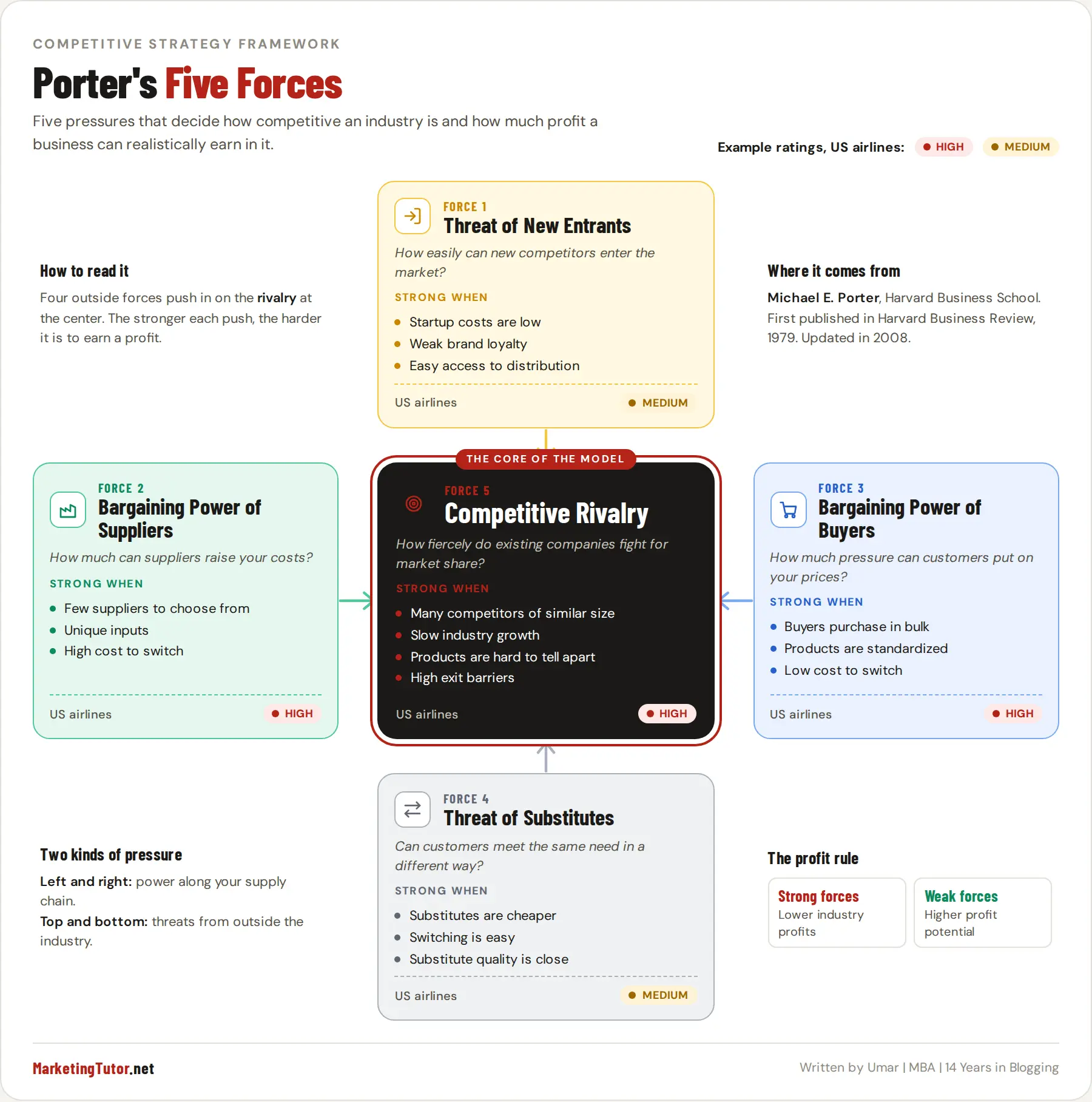
What Is an Example of Porter’s Five Forces?
The US airline industry is one of the best examples, and Porter himself used airlines to show how the forces can crush profitability. Here is how each force plays out.
| Force | Strength | Why |
|---|---|---|
| Threat of new entrants | Medium | Aircraft and airport slots are expensive, yet low-cost carriers such as Breeze Airways and Avelo Airlines still launched in 2021 |
| Supplier power | High | Boeing and Airbus control large jet supply; fuel prices and pilot unions add more pressure |
| Buyer power | High | Travelers compare fares instantly on Google Flights and Kayak, and most pick the cheapest seat |
| Threat of substitutes | Medium | Video calls replace some business trips; cars and trains compete on short routes |
| Competitive rivalry | High | Delta, United, American, and Southwest fight on price, routes, and loyalty programs |
What does this analysis tell us? Four of the five forces are strong, which explains why US airlines have a long history of thin margins and bankruptcies. The smartest carriers respond by building what the forces cannot easily attack. Loyalty programs raise switching costs for buyers. Premium cabins make the product harder to compare on price alone.
How Would a Small Business Use the Five Forces?
The model is not only for big corporations. Picture an independent coffee shop opening in a US suburb.
New entrants are a high threat because opening a café is relatively cheap. Suppliers are weak, since dozens of coffee roasters compete for business. Buyers are fairly strong because they can walk to Starbucks or Dunkin’ next door. Substitutes are high, because home brewing and gas station coffee cost less. Rivalry is intense.
That picture tells the owner to avoid a price war. The better path is differentiation: a local roaster partnership, a space people want to work in, or a signature drink the chains do not offer.
How Do You Do a Porter’s Five Forces Analysis?
A useful analysis takes a few hours, not a few weeks. Follow these five steps.
Step 1: Define the industry clearly. “Food” is too broad. “Fast-casual Mexican restaurants in Texas” is specific enough to analyze. A vague industry definition produces a vague analysis.
Step 2: Gather data on each force. Use industry reports, competitor websites, customer reviews, and public data. The US Census Bureau publishes free data on the number of businesses and total sales by industry, which helps you judge how crowded a market is.
Step 3: Rate each force as low, medium, or high. Write one or two sentences explaining each rating. The reasoning matters more than the label.
Step 4: Identify the strongest forces. These are the forces most likely to squeeze your profits. Your strategy should focus on them first.
Step 5: Turn findings into action. For every strong force, ask: “How can we reduce its impact?” A strong buyer force might lead to a loyalty program. A strong supplier force might lead you to add a second supplier.
How Is Porter’s Five Forces Different From SWOT and PESTLE?
These three tools answer different questions, and they work best together.
| Feature | Porter’s Five Forces | SWOT Analysis | PESTLE Analysis |
|---|---|---|---|
| Main question | How competitive is this industry? | Where does our company stand? | What big outside trends affect us? |
| Focus | Industry structure | Company (internal and external) | Macro environment |
| Factors | 5 competitive forces | Strengths, Weaknesses, Opportunities, Threats | Political, Economic, Social, Technological, Legal, Environmental |
| Best used for | Market entry, pricing, profit potential | Strategic planning, decision making | Long-term risk and trend scanning |
| Level of detail | Medium | Broad | Broad |
| Creator | Michael Porter (1979) | Associated with Albert Humphrey (1960s) | Developed from Francis Aguilar’s 1967 PEST model |
A practical sequence is PESTLE first for the big picture, then the Five Forces for the industry, then SWOT to decide what your company should do. The threats you find in a Five Forces analysis often feed straight into the Threats quadrant of your SWOT, and weak forces can reveal real SWOT opportunities.
What Are the Limitations of Porter’s Five Forces?
No framework is perfect, and knowing the gaps makes you a better user of this one.
- It gives a snapshot, not a movie. The model shows the industry at one point in time. Fast-changing markets, such as AI software, can shift in months.
- It ignores complementors. Economists Adam Brandenburger and Barry Nalebuff argued that companies whose products add value to yours, such as app developers for the iPhone, act as a “sixth force.” Porter’s original model leaves them out.
- Industry boundaries are blurry. Is Tesla in the car industry, the energy industry, or the software industry? Your answer changes the whole analysis.
- It focuses on competition, not cooperation. Many modern businesses grow through partnerships and ecosystems, which the model does not capture well.
- Use the Five Forces as a starting point for strategic thinking. Then combine it with tools like the BCG Matrix for portfolio decisions and the Ansoff Matrix for growth planning.
Bottom Line
In 14 years of blogging, I have watched every one of these forces reshape my own industry. AI writing tools flattened the barrier to entry overnight, and AI Overviews became the most dangerous substitute publishers have ever faced. The bloggers who survived did not ignore those forces. They built what the forces could not copy: real experience, a trusted name, and depth that a quick AI summary cannot match.
That is the real lesson of Porter’s Five Forces. Do not use it only to describe your industry. Use it to find the one force hurting you most, and then build your strategy around beating it.
Frequently Asked Questions
Porter’s Five Forces are five pressures that decide how profitable an industry can be. They are how easily new competitors can enter, how much power suppliers have, how much power customers have, how easily customers can switch to a different kind of product, and how fiercely current competitors fight. Strong forces mean lower profits. Weak forces mean a business has more room to earn healthy margins.
Michael E. Porter, a professor at Harvard Business School, created the model. He introduced it in the 1979 Harvard Business Review article “How Competitive Forces Shape Strategy” and expanded on it in his 1980 book Competitive Strategy. In 2008, he published an updated article, “The Five Competitive Forces That Shape Strategy,” which remains the standard reference for the framework today.
The model helps businesses understand why some industries are more profitable than others. It shows where competitive pressure comes from, which helps managers set prices, choose markets to enter, and decide where to invest. Investors also use it to judge whether an industry can support long-term profits. For students, it is one of the core frameworks tested in strategy and marketing courses.
The model is designed for an industry, not a single company. However, you can run it from one company’s point of view by defining that company’s specific market and then rating each force as it affects that business. Most analysts pair it with a SWOT analysis, which focuses on the individual company’s strengths and weaknesses.
Porter did not treat government as a sixth force. In his 2008 update, he explained that government affects the industry through the existing five forces. For example, licensing rules raise barriers to entry, and regulations can change buyer or supplier power. Some analysts still add government or complementors as a sixth factor, but these are later additions, not part of Porter’s original model.
Yes. The forces still explain why some industries earn high returns and others struggle. What has changed is the speed. Digital platforms and AI tools can lower barriers to entry or create new substitutes within months. The model remains useful, but analysts should update their analysis more often and pay close attention to technology-driven substitutes and new entrants.
Review it at least once a year and any time your industry faces a major shift, such as a new competitor, a price war, a new regulation, or a disruptive technology. Fast-moving industries like software or e-commerce may need a review every quarter. A Five Forces analysis that is two years old can lead to decisions based on a market that no longer exists.
Review it at least once a year and any time your industry faces a major shift, such as a new competitor, a price war, a new regulation, or a disruptive technology. Fast-moving industries like software or e-commerce may need a review every quarter. A Five Forces analysis that is two years old can lead to decisions based on a market that no longer exists.

