



What is Network Marketing?
Network marketing is a business model where independent salespeople sell a company’s products directly to customers. No storefront, no salaried staff, Just people selling to their own networks. It is also called multi-level marketing (MLM), direct selling, or referral marketing.
Here’s how it works. You sign up as a distributor for a company. You sell their products and earn a commission on every sale. But that’s only one way to earn.
You can also recruit other people to join under you. When they make sales, you earn a percentage of their earnings too. The people you recruit are called your downline and you are part of their upline.
The more your team sells, the more you earn. Nobody is on a fixed salary. Your income depends entirely on your sales and your team’s performance.
Network marketing is not the same as a pyramid scheme. Pyramid schemes have no real product. In network marketing, real products are sold to real customers. That’s the legal and functional difference.
Companies like Amway, Avon, and Herbalife have run on this model for decades. It is a legal and regulated direct selling business in the United States. [Internal link: What is Direct Selling?]
How Network Marketing Works
Network marketing works through a simple chain. A company gives independent distributors the right to sell its products. Those distributors then build their own teams by recruiting others. Everyone earns based on what they sell and what their team sells.
No fixed salary. No office. Just sales and relationships.
The company saves money on advertising and retail. Instead, it pays commissions to the people actually moving the products. That’s the core trade-off that makes this model work.
There are three main structures of this business model.
Single-Tier Network Marketing
This is the most straightforward model. You sign up, sell the company’s products directly to customers, and earn a commission on each sale. No recruiting involved.
Your entire focus is on selling and building customer relationships. The more you sell, the more you earn. Simple as that.
Avon and doTERRA are well-known examples of this model in the US market.
Two-Tier Network Marketing
Here you earn in two ways. You make money from your own direct sales. You also earn a cut from the sales made by people you recruit.
Your recruits work independently, but you get a small percentage of what they earn. So even on a slow sales day, your team keeps income coming in.
It’s a smaller and simpler structure than full MLM. You build a team, but you’re not managing multiple levels of distributors.
Multi-Level Marketing (MLM)
MLM takes the recruiting model further. It runs on multiple tiers, sometimes five or more levels deep. Every person in the chain earns from their own sales and from the sales of everyone below them.
The deeper your downline, the bigger your earning potential. This is why top MLM companies like Amway, Herbalife, and Nu Skin can pay out millions in commissions each year.
But it also means your income depends heavily on how well your team performs, not just you.
Characteristics of Network Marketing
Network marketing has some unique features that separate it from a traditional business. Here are the six main characteristics that define how this model works.
- Organizational Hierarchy. Every company runs on a structured hierarchy. You recruit someone, they work under you. They recruit someone, that person works under them. Each level earns from their own sales and from the sales of the people below them. The bigger your network, the more layers of income you can build.
- Proven Business System. You don’t build the business from scratch. The products, the compensation plan, the training, and the sales process are already in place. Your job is to follow the system and focus on selling. Most network marketing companies also provide onboarding support and mentorship to help new distributors get started.
- Low Startup Cost. Starting a traditional business is expensive. You pay for registration, office space, staff, and monthly overheads before you make a single dollar. Most people start for a few hundred dollars or less. No storefront, no employees, no massive upfront investment. That low barrier is one of the biggest reasons millions of people try it every year.
- Flexible Working Hours. You run your network business around your own schedule. Most people start part-time while keeping their day job. This gives you time to learn the business, build your downline, and grow your income before making any big financial decisions. You move at your own pace.
- Self-Accountability. No boss is tracking your hours, no manager pushing your targets and Your results depend entirely on the effort you put in. That kind of self-accountability is a skill in itself. People who thrive in MLM are the ones who treat it like a real business, not a side hobby.
- Direct Sales Model. In most businesses, a product passes through several hands before reaching the customer. Manufacturer, wholesaler, retailer, then finally the buyer. This model cuts that chain short. The distributor sells directly to the end customer and earns a commission on the spot. No middleman involved.
Pros and Cons of Network Marketing
Network marketing offers a flexible way to start a business, but it comes with significant financial risks.
Benefits
- Flexible Schedule: You work as an independent contractor. This role lets you choose your own hours and work from home.
- Low Initial Costs: Starting this business requires very little money compared to opening a traditional retail store.
- Provided Resources: Most companies give you training materials. Your recruiter also offers mentorship to help you learn sales skills.
Risks
- High Failure Rates: Data proves that most people who join these companies do not make a sustainable profit.
- Monthly Fees: You must buy a specific amount of product every month to stay eligible for your sales commissions.
- Social Tension: Mixing business with personal life often strains your relationships with friends and family members.
Differences Between Network Marketing and Pyramid Schemes
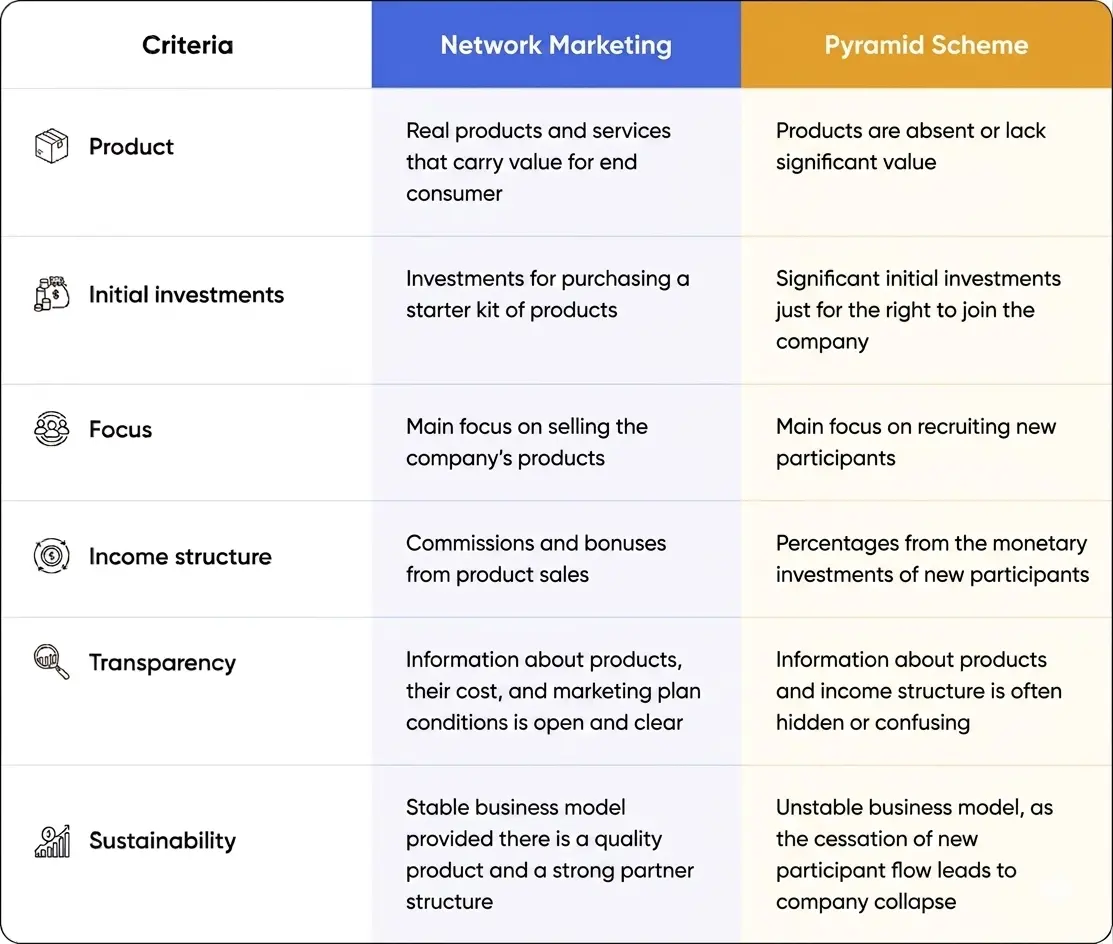
The main difference between network marketing and a pyramid scheme is how the business earns its money. Legitimate companies profit from real product sales, while illegal schemes profit from recruiting people.
Legitimate Network Marketing. It is a legal business model that focus on selling actual products or services to real everyday customers.
Pyramid Schemes. A pyramid scheme is an illegal fraud. These setups do not focus on selling actual goods. Instead, they make money by charging signup fees to new members to pay the older members.
Examples of Network Marketing
Amway
Amway is a short form of ‘American Way,’ a global American company; it’s been in the direct selling and MLM business for the past 60 years with the estimated revenue of 8.8 billion US dollars. Its products are beauty creams and cosmetics, medicines and home care. Amway hires and works with affiliated companies to conduct its operations and it’s been doing it in more than a hundred countries.
Amway calls its distributors independent business owner (IBO), these IBOs get their commission through personal sales and the retails mark up given by the company, plus performance bonuses on achieving the company’s targets. Harvard Business School calls Amway as one of the most successful direct selling and MLM companies in the world.
Avon
Avon is also a direct selling and multi-level marketing company with estimated annual revenue of 5.5 billion US dollars worldwide. It is 133 years old and it sells products in the category of personal care, beauty, and household items.
Avon recruits its sale personals and trains them for door to door direct selling; the sale members are called ‘Avon ladies’ and ‘Avon men.’ According to an estimate, Avon sales members are 500 to 600 million people across the world in more than 100 countries.
Image by Pete Linforth

