


Marketing is not just about selling but it is about understanding people, meeting their demands, and building long-term trust. Every business follows a specific marketing concept. Some focus entirely on low prices, while others focus on premium quality. The most profitable companies focus on the customer.
Philip Kotler, widely known as the Father of Modern Marketing, identified the core marketing concepts that drive how businesses operate. Understanding these models helps you build sharper strategies, avoid costly mistakes, and gain a real competitive advantage over your competition.
What is a Marketing Concept?
A marketing concept is a business philosophy that guides how a company identifies customer needs and delivers value better than its competitors. It acts as a framework for marketing decisions. Philip Kotler identified 6 core marketing concepts, each representing a different approach to how businesses think about customers.
What is Marketing?
Marketing is the art and process of building, managing and maintaining an exchange relationship, where you start by attracting customers, establishing a relationship with them, and finally maintaining it by satisfying their needs.
That customer can be other businesses or the consumers; therefore, marketing can be business-to-business or business-to-consumer depending upon the situation. The ultimate function of marketing is to establish a relationship with customers and satisfy their needs by meeting their demands.
For instance, telecommunication creates a marketing strategy that first attracts and convinces people to use their calls, messaging, and internet packages. Once people start using it, they ask them to rate their service by giving them stars.
What are the Marketing Concepts?
The marketing concept is a process by which a company plans and implements to maximize profit by increasing sales, satisfying customers’ needs and beating competitors. The purpose is to create a situation that benefits both parties: the customer and the company.
The idea of the marketing concept is to anticipate and satisfy the needs and wants of customers better than competitors, which requires understanding consumer behavior and creating effective demand generation strategies. The 5 marketing concepts were developed by Philip Kotler and outlined in his book Marketing Management (1967). Kotler is widely recognized as the Father of Modern Marketing.
“To fully understand the marketing concept, we first need to understand needs, wants, and demands.
- Needs — basic requirements for survival and daily life, including food, shelter, security, social belonging, self-esteem, and respect.
- Wants — our personal wishes and desires, shaped by culture, social setup, and lifestyle.
- Demands — wants that are backed by the ability to pay. When you can afford what you want, it becomes a demand.”
5 Marketing Concepts
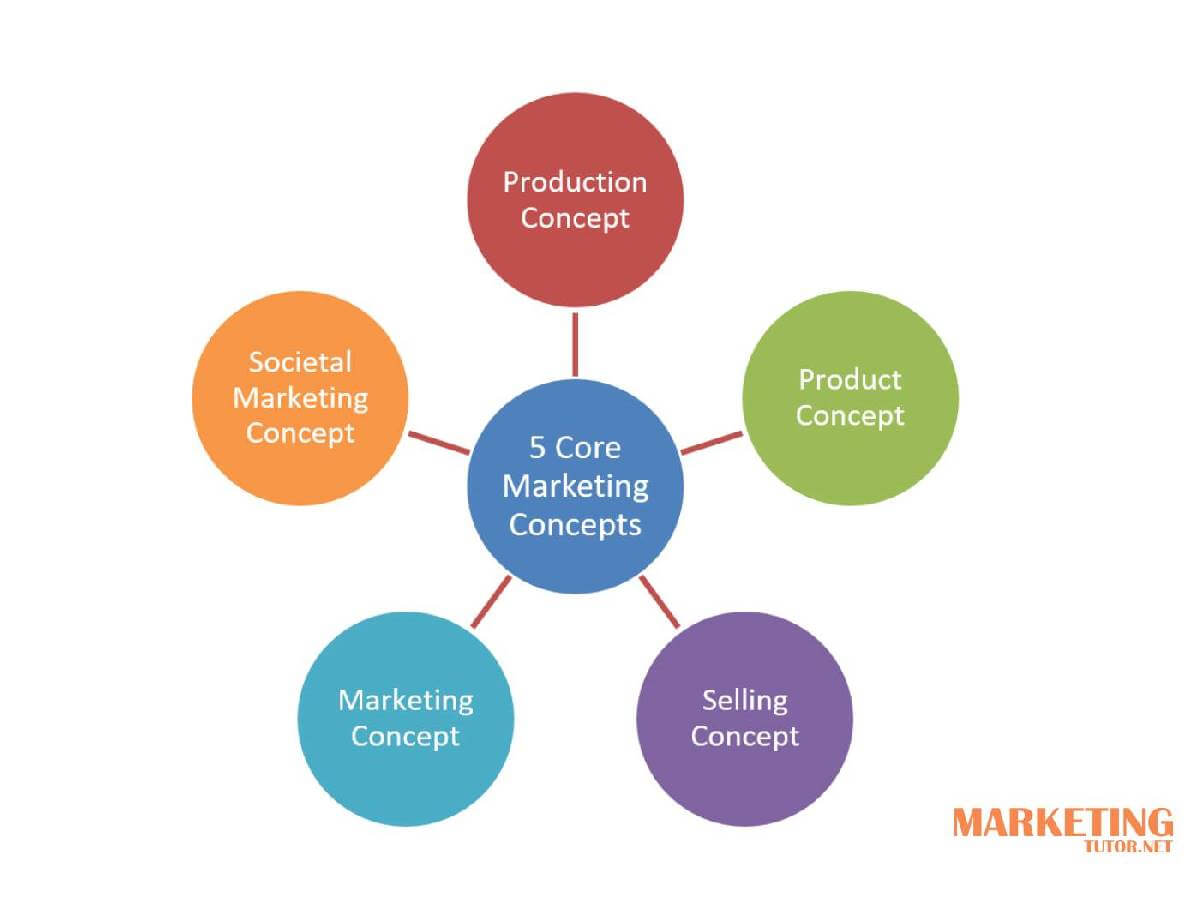
Philip Kotler identified 5 core marketing management philosophies in his book Marketing Management (1967). These are:
- Production Concept
- Product Concept
- Selling Concept
- Marketing Concept
- Societal Marketing Concept
In later editions, Kotler added a 6th concept: - Holistic Marketing Concept
Comparison of Core Marketing Philosophies
| Concept | Focus | Orientation | Goal | Era | Example |
| Production Concept | Low cost and availability | Production efficiency | Mass supply | 1800s to early 1900s | Generic medicine, fuel |
| Product Concept | Quality and features | Product improvement | Best product | Early 1900s | Apple iPhone |
| Selling Concept | Aggressive promotion | Sales volume | Close the transaction | 1950s to 1960s | Insurance, door to door sales |
| Marketing Concept | Customer needs | Customer satisfaction | Long term profit | 1960s onwards | Amazon, Coca Cola |
| Societal Marketing Concept | Society and customer welfare | Social responsibility | Sustainable growth | 1970s onwards | Patagonia, Body Shop |
| Holistic Marketing Concept | Entire business system | Integration and alignment | Unified brand experience | 2000s onwards | Apple, Nike |
Production Concept
The production concept is one of the earliest marketing concepts, where the company focuses on the efficiency of its production processes. It is to produce the products cheaper to make it available to the mass population. It focuses on the quantity, not the quality of the products.
The production concept is the oldest marketing philosophy, dating back to the Industrial Revolution era of the 1800s and early 1900s, and it follows Say’s Law. It states that supply creates its own demand in the market. According to this law, when a business manufactures a product, it does not need to advertise. The product sells itself.
This idea made sense at the time. There was no mass media, no advertising, and people rarely traveled far to shop. Local shopkeepers were the only sellers. Manufacturers were few and competition was almost zero. Whatever came to market, people bought it. There was no other choice.
Today, the production philosophy still applies in industries like generic medicine and fuel, where availability and low price matter more than branding. The entire focus was on profit maximization through lower costs and wider distribution.
Product Concept
The product concept is based on the idea that customers will choose products that offer the best quality and performance. Companies following this concept focus on continuous product improvement and innovation.
Companies following this concept believe a better product will naturally attract more customers. This thinking sometimes leads to marketing myopia. They get so focused on the product that they ignore what customers actually want.
A good example is the early smartphone industry. Companies raced to add better cameras, faster processors, and more features. They believed the best product would win. In most cases, it did. The risk with this philosophy is tunnel vision. Companies get so focused on building a better product that they forget to check if customers actually need it. Kotler called this marketing myopia.
Apple is the most cited example of the product concept. They constantly improve their products, adding better chips, better displays, and better cameras. Customers wait in line for the newest iPhone not because they need it, but because Apple convinced them it is the best.
Selling Concept
The selling concept focuses on pushing products through large scale marketing and promotional activities. It does not matter whether the product fulfills customer needs or not. Management following this concept believes their job is done once the sale is complete. They focus on closing the sale rather than building a long term relationship with the customer.
Unlike the marketing concept, the selling concept skips identifying the target market first. It simply pushes the product to anyone willing to buy. Marketers using this approach assume customers will forget a bad experience and come back anyway.
Blood donations and insurance policies fall under this marketing philosophy, where the marketer thinks their job is done after completing the transaction.
Marketing Concept
The marketing concept is customer-oriented. It puts customers in the middle of the marketing process, finding out customers’ needs and wants, then satisfying those needs better than the competitors.
In this approach, the marketer says that the customer is always right and his needs and wants should come first. The marketing strategy focuses on making a profit by meeting the needs and wants of customers.
Marketers following this philosophy do not look for the right customers for their product. They produce the right product for their customers. The marketing concept and the selling concept are complete opposites. One starts with the product. The other starts with the customer.
Societal Marketing Concept
The societal marketing concept goes one step beyond the marketing concept. It questions whether giving customers what they want is always good for society. What customers want does not always mean it would be good for them in the long term. What you want, and what is good for you and society as a whole, are two completely different things.
For instance, we all like sweet, spicy and fast foods. We all want the same things whenever we go out, but it does not mean that it is good for our health, and the health of the whole society. The main purpose is to make companies realize they have a social and environmental responsibility much bigger than their short term sales and profit goals.
Companies are part of society. They should operate with a sustainable future in mind, not just quarterly profits. This approach represents the highest form of market orientation, balancing customer needs with long term social responsibility.
Holistic Marketing Concept
The holistic marketing concept means every part of your business is doing marketing, whether you planned it or not. Salespeople, customer service reps, and product designers all change how people view your brand. If these departments don’t work together, your brand image breaks quickly.
Philip Kotler introduced this idea to explain that modern businesses are too complex to keep departments separate. This strategy focuses on four core areas to keep everything connected.
- Relationship marketing shifts the focus away from quick, one time sales. Instead, you build long-term loyalty so customers keep coming back for years.
- Integrated marketing ensures your ads, emails, and social media posts all say the same thing. The customer gets a matching experience everywhere.
- Internal marketing focuses on your own workers. You train employees so they understand company values and represent the brand well.
- Performance marketing measures more than just revenue. It tracks customer trust, brand reputation, and your impact on society.
Apple is the clearest example. The product, packaging, store layout, website, and staff all feel the same. That is not a coincidence. It is a strategy. When all departments work together, businesses build stronger brand loyalty and improve customer retention over time.
Evolution of Marketing Concepts
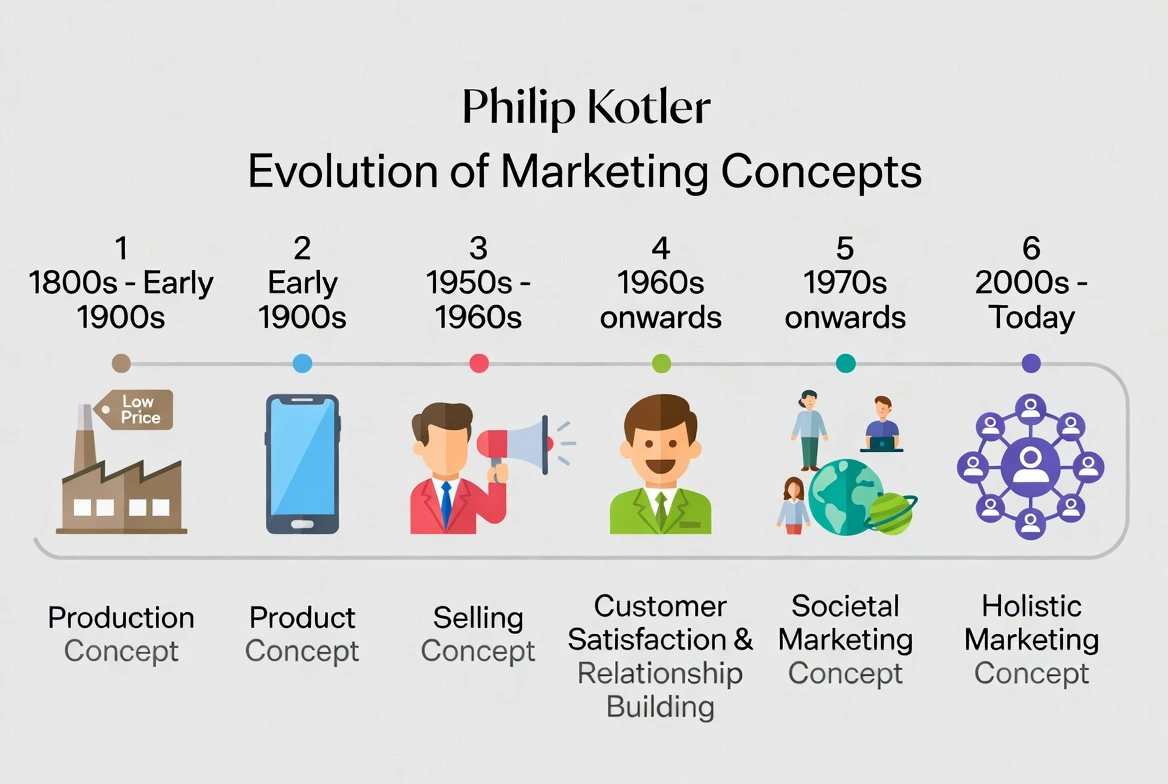
- 1800s – Production era. Make it cheap. Sell to everyone.
- Early 1900s – Product era. Focus on quality and features.
- 1950s – Selling era. Push products through aggressive advertising.
- 1960s – Philip Kotler shifts focus to the customer.
- 1970s -Societal marketing adds social responsibility.
- 2000s – Holistic marketing connects every part of the business.
- Today – AI and data make marketing deeply personal.
Marketing Concept Examples in Real Life
The best way to understand any marketing philosophy is to see it in action. Here are real brands that follow each concept today.
Amazon is the best example of the marketing concept. Everything they build starts around the customer. One-click buying, same-day delivery, and personalized recommendations all exist because Amazon studied what customers actually wanted.
Apple follows the product concept. They obsess over design, performance, and features. Customers do not just buy an iPhone but pay for the idea that Apple makes the best product on the market.
Insurance companies like MetLife follow the selling concept. Nobody wakes up wanting to buy insurance. Agents push hard, follow up repeatedly, and close the sale through aggressive promotion.
Patagonia is the clearest example of the societal marketing concept. They actively tell customers to buy less. Their “Don’t Buy This Jacket” campaign asked people to think before purchasing. They put environmental responsibility above short term sales.
Nike practices holistic marketing. Their ads, stores, app, website, and athlete partnerships all deliver the same message. Just Do It is not just a tagline. It runs through every part of the business.
Generic medicine brands follow the production concept. Such brands do not rely on advertising or premium packaging, they focus on wide availability and low price.
Conclusion
Marketing shifted from old mass production lines to smart, customer-first strategies. What worked decades ago will fail today.
Most successful businesses now prioritize real customer needs and long-term community impact. They use customer-centric thinking to build trust.
The ultimate strategy for our current digital landscape is holistic marketing. Every worker, sales channel, and department builds your brand image together. Modern AI tools and social platforms have changed consumer habits. Shoppers now test dozens of digital touchpoints before making a purchase.
Brands that coordinate all these moving parts win the market. Companies that stay divided lose customers fast.
Frequently Asked Questions
The 5 core marketing concepts are production, product, selling, marketing, and societal marketing. Philip Kotler outlined these philosophies in his 1967 book, Marketing Management. Newer editions include a 6th model called holistic marketing.
The selling concept starts with an existing item inside a factory. The business pushes that item onto people using aggressive advertising and promotional activities.
The marketing concept does the exact opposite. It starts by studying the target market. You build the product to fit what buyers already want. One targets a single transaction while the other builds a long relationship.
No single philosophy wins every time. Your choice depends on your specific industry and corporate goals.
Most successful modern teams choose the marketing concept or holistic marketing. These models prioritize consumer satisfaction and deliver a consistent brand message across all channels.
Apple mixes the product concept with holistic marketing strategies. They spend massive amounts of energy building premium hardware chips and beautiful screens. At the same time, their clean website design and store layout offer the exact same premium feeling.
Marketing myopia is a term used by Theodore Levitt to warn business owners. It describes a company that looks too closely at its own product and ignores changing market trends.
Old companies kept updating typewriters while ignoring the fact that consumers wanted faster, easier ways to create and share documents.
The production concept focuses on mass distribution and low manufacturing costs to make goods highly affordable.
The product concept ignores low prices. It prioritizes premium engineering, quality, and advanced features. One competes entirely on cheap pricing, while the other competes on superior quality.

