



Business markets are growing faster than ever. Companies now invest more money in buying from other businesses than they spend on reaching everyday consumers.
Take Microsoft as a clear example. Their Azure cloud platform sells directly to thousands of businesses worldwide. Those businesses use it to run their operations, store data, and serve their own customers.
That is a business market transaction. One company selling to another. No end consumer is involved.
What are Business Markets?
A business market is where companies sell products or services to other businesses. Those products are either used as raw materials to manufacture something new, or bought and resold to other buyers.
This is different from selling to everyday consumers. In a business market, the buyer is always another company, not a person.
A steel company selling metal sheets to a car manufacturer is a classic example. The car manufacturer uses that steel to build vehicles. That is a B2B transaction in a business market.
Business Markets Vs Consumer Markets
A business market works differently. Companies buy products from other businesses to manufacture new goods or resell them. The buyer is always another company, not an individual.
A consumer market is where businesses sell products and services directly to end consumers. It is highly competitive with many sellers targeting the same audience.
One key difference is the supply chain. In business markets, one company’s purchase depends on another company’s sales. If the final product stops selling, the business stops buying. This is called derived demand.
Consumer markets focus on demographics like age, gender, and social status. Business markets focus on industry type, company size, and purchasing power.
Business market relationships are long term and stable. Both sides invest heavily in making the partnership work. A failed relationship directly impacts production and revenue for both companies.
| Consumer Market | Business Market | |
| Buyer | Individual consumer | Another business |
| Purchase purpose | Personal use | Production or resale |
| Number of buyers | Millions | Fewer but larger |
| Relationship | Short term | Long term |
| Decision process | Simple and quick | Complex and formal |
| Demand type | Direct demand | Derived demand |
| Focus | Demographics | Industry and company size |
Characteristics of Business Markets
Market Structure and Demand
Business markets contain fewer but larger buyers. A single business client can place an order worth millions. That one order equals what thousands of individual consumers might spend combined.
Business buyers are more geographically concentrated. Unlike retail shops that exist in every neighborhood, business buyers operate from specific industrial zones, corporate offices, and manufacturing hubs. In 2026, many of these relationships run entirely through digital procurement platforms like SAP Ariba and Amazon Business.
Business buyer demand is derived from final consumer demand. A tyre manufacturer only buys rubber when car sales are strong. If car demand drops, rubber orders stop. This is called derived demand and it runs through every level of the supply chain.
Demand in business markets is more inelastic. Price changes do not immediately affect purchasing decisions. A factory cannot stop buying steel just because prices rise slightly. Production must continue.
Demand in business markets fluctuates quickly. When consumer spending drops, businesses cut orders fast. A small shift in retail sales can trigger large swings in B2B marketing activity and purchasing volumes across entire industries.
Professional Buyers and the Buying Center
Business buying involves a professional purchasing effort. The procurement process is highly structured and detail oriented. Companies use dedicated purchasing teams, vendor evaluation systems, and formal approval chains before signing any contract.
This is called organizational buying. Multiple people across different departments evaluate the supplier before a final decision is made. In 2026, most large companies use AI powered procurement tools to shortlist vendors and compare pricing automatically.
Kind of Decisions and the Decision Process
Business buyers face complex buying decisions. Unlike consumer purchases, business deals are long term commitments. Companies research suppliers carefully, check backgrounds, and verify track records before signing any contract.
The business buying process is highly formalized. Every purchase follows a strict chain of command. Multiple departments review the decision before final approval. Nothing moves forward without proper authorization.
Buyers and sellers work closely together. Once both sides agree, they build a working relationship based on trust and performance. In 2026, most companies use digital vendor management systems to track supplier performance in real time.
The 4 Main Types of Business Markets
Every business market falls into one of four categories. The difference comes down to who the buyer is and what they do with the product.
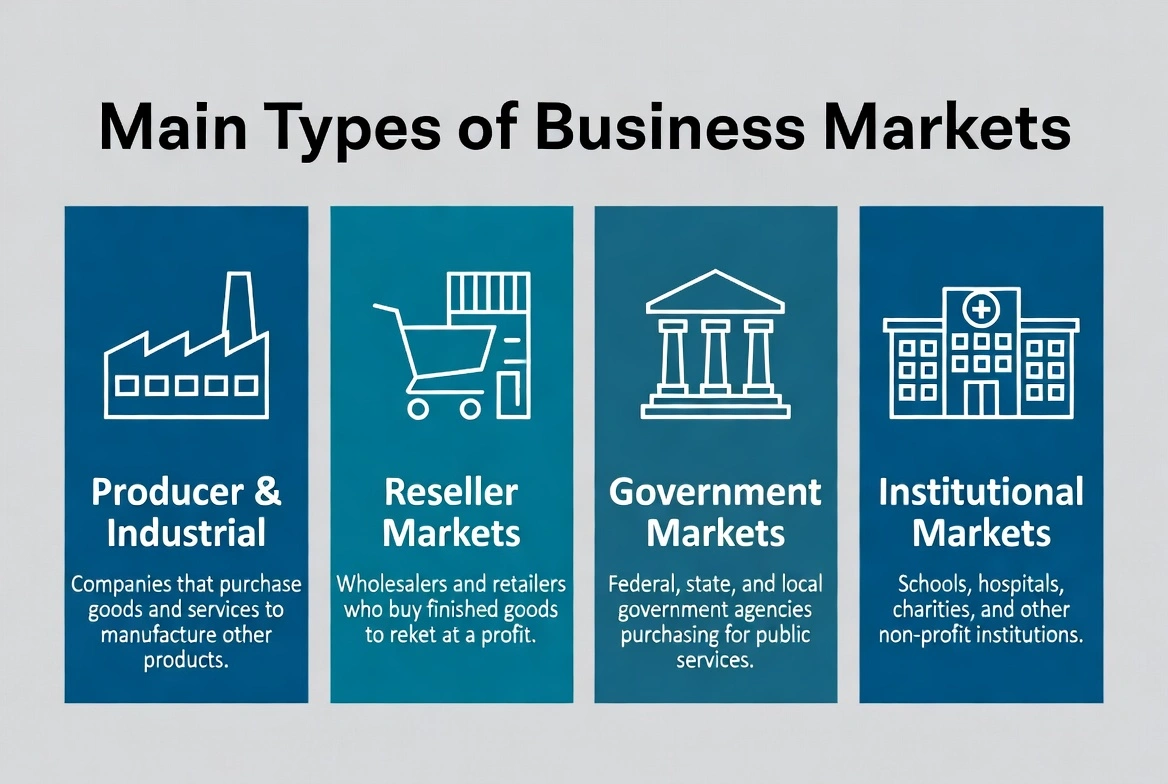
1. Producer and Industrial Markets
The producer market consists of companies that buy products and raw materials to manufacture something new. They do not resell what they buy. They transform it into a finished product.
This is the largest and most active type of business market. The entire supply chain runs through it.
Examples of Producer Market Transactions
Boeing buys aluminium, titanium, and electronic components from hundreds of suppliers to build aircraft. Tesla buys lithium, steel, and semiconductor chips to manufacture electric vehicles. In 2026, AI chip manufacturers like NVIDIA supply processors directly to cloud companies like Google and Microsoft for data centre production.
2. Reseller Markets
The reseller market includes wholesalers and retailers who buy finished products and resell them without changing them. They add no manufacturing value. Their business model is purely distribution.
This market type drives a massive portion of global B2B marketing activity. Brands spend heavily to get shelf space and distribution agreements.
Examples of Reseller Market Distribution Channels
Amazon’s wholesale division buys products from brands like Samsung and resells them directly to consumers. Carrefour and Walmart buy finished goods from thousands of manufacturers and distribute them through their retail networks. In 2026, online reseller platforms like Noon and Alibaba have become major reseller market channels across GCC and Asian markets.
3. Government Markets
The government market includes federal, state, and local government units that purchase products and services to deliver public services. Governments are among the largest single buyers in any economy.
The procurement process in government markets is highly regulated. Suppliers must go through formal bidding and tender processes before winning any contract.
Examples of Government Procurement
Lockheed Martin sells defence systems directly to the US Department of Defence. The US Department of Homeland Security purchases cybersecurity software from companies like Palo Alto Networks and CrowdStrike through formal government contracts. In the GCC, Saudi Aramco runs one of the largest government procurement operations in the world, buying billions in equipment and services annually.
4. Institutional Markets
The institutional market includes non-profit organizations, hospitals, universities, and charities. These buyers purchase products and services to serve their communities, not to make a profit.
Institutional buyers face strict budget limitations. They look for low cost suppliers who can deliver consistently at scale.
Examples of Institutional Purchasing
Johns Hopkins Hospital purchases medical equipment, medicines, and surgical supplies from healthcare suppliers. Harvard University buys educational technology, campus furniture, and facility management services through formal organizational buying processes. In 2026, many institutions use group purchasing organisations to combine buying power and negotiate better supplier rates.
Understanding the Business Buying Behavior Process
Business purchases do not happen overnight. Every company follows a structured buying process before committing to a supplier. Understanding this process helps B2B marketers position their products at the right time.
The 3 Main B2B Buying Situations
Not every business purchase is the same. The complexity of the decision depends on what is being bought and how familiar the buyer is with the supplier.
1. Straight Rebuy
A straight rebuy happens when a company reorders the same product from the same supplier without any changes. No new evaluation. No price negotiation. The order goes through automatically.
This is the most common buying situation in business markets. Office supplies, raw materials, and maintenance products are typical straight rebuy purchases. In 2026, most straight rebuys happen through automated procurement process systems like SAP Ariba and Oracle Procurement Cloud.
2. Modified Rebuy
A modified rebuy happens when a company wants to change something about an existing order. The buyer may negotiate a better price, switch suppliers, or upgrade product specifications.
This situation requires more evaluation than a straight rebuy. Sales teams at competing suppliers see modified rebuys as their best opportunity to win new business.
3. New Task Buying
A new task buying situation happens when a company purchases a product or service for the first time. This is the most complex buying situation of all three.
The company has no prior experience with the product or supplier. The organisational buying process involves extensive research, multiple supplier evaluations, and formal approval from senior management. In 2026, companies increasingly use AI powered vendor comparison tools to shortlist suppliers during new task buying situations.
Members of the Organizational Buying Center
The buying center is the group of people inside a company who influence and make purchasing decisions. It is also called the Decision Making Unit or DMU.
Most people assume one person makes the buying decision. In business markets, that is rarely true. A typical buying center has six key roles:
- Users – the employees who will actually use the product. They often initiate the purchase request.
- Influencers – technical experts and consultants who shape the product specifications.
- Buyers – the purchasing department that handles supplier negotiations and contract management.
- Deciders – senior managers or executives who give final approval on the purchase.
- Gatekeepers – assistants and procurement staff who control the flow of information between suppliers and the buying center.
- Initiators – the person or department that first identifies the need for a product or service.
Understanding the buying center is critical for any B2B marketer. Targeting only one person in the DMU is a common mistake. Successful B2B marketing reaches every member of the buying centre with the right message at the right time.
Why Business Markets Matter for B2B Marketers
Understanding business markets is not optional for any serious marketer. It directly affects how you position your product, approach buyers, and close deals.
Business market transactions are larger, longer, and more complex than consumer purchases. One lost client can cost a company millions in annual revenue. One strong relationship can sustain a business for decades.
Here is why B2B marketing knowledge gives you a real competitive advantage:
- Smarter targeting. Business markets have fewer but larger buyers. Knowing exactly who sits inside the buying center helps you reach the right people with the right message.
- Better timing. Understanding the three buying situations tells you when a prospect is most likely to switch suppliers or place a new order. Timing your outreach correctly increases conversion rates significantly.
- Stronger relationships. Business markets run on trust and long term contracts. Marketers who understand organizational buying build deeper supplier relationships that are hard for competitors to break.
- Higher revenue per client. A single business buyer spends more than thousands of individual consumers combined. Winning one corporate account can transform your entire revenue pipeline.
- In 2026, B2B marketing has become more data driven than ever. AI tools now map entire buying centers, track procurement cycles, and predict when companies are ready to buy. Marketers who understand business markets will always have an edge.
Conclusion
Business markets are more complex than consumer markets. The buyers are fewer, the orders are larger, and the relationships last much longer.
Understanding the 4 types of markets (producer, reseller, government, and institutional) gives any marketer a clear picture of how B2B transactions work in the real world.
The buying center changes everything. Decisions in business markets rarely come from one person. Reaching every member of the DMU with the right message at the right time is what separates average B2B marketers from great ones.
In 2026, B2B marketing is faster, more data driven, and more competitive than ever. Companies that understand business market structures, buying behavior, and procurement processes will always have an edge over those that do not.
Frequently Asked Questions
A business market is where companies sell products or services to other businesses. The buyer uses those products as raw materials, incorporates them into new products, or resells them.
The 4 types are producer markets, reseller markets, government markets, and institutional markets. Each type differs based on who the buyer is and what they do with the purchase.
A consumer market sells to individual people for personal use. A business market sells to companies for production, resale, or operational use. Business purchases are larger, more complex, and involve multiple decision makers.
The buying center is the group of people inside a company who influence and approve purchasing decisions. It includes users, influencers, buyers, deciders, gatekeepers, and initiators.
Derived demand means business purchases depend on consumer demand. If consumers stop buying cars, manufacturers stop buying steel. One market directly drives the other.
Boeing buying aluminium from suppliers, Amazon wholesaling products from Samsung, and hospitals purchasing medical equipment from healthcare companies are all real examples of business markets in action.

