


A product is anything a business offers to satisfy a need or want. It can be physical, like a phone; intangible, like a service; or digital, like an app. Products are the foundation of every market transaction.
Think about what you bought last time, maybe a Starbucks coffee, a Netflix subscription, a pair of Adidas shoes or a FIFA World Cup ticket. All of these are products. American consumers spent over $21 trillion on goods and services in 2026 (FRED), and every dollar of that went toward some product. A product is anything a business puts out in the market for people to buy, use, or experience. It doesn’t have to be something you can touch. Services and digital downloads count too.
Definition of a Product
Kotler, Wong, Saunders, and Armstrong, in their widely used textbook Principles of Marketing, defined a product as:
“Anything that can be offered to a market for attention, acquisition, use or consumption that might satisfy a want or need. It includes physical objects, services, persons, places, organizations and ideas.”
Kotler, Wong, Saunders, Armstrong
That’s a broad definition. And honestly, it should be. A product isn’t just a physical thing sitting on a store shelf. It’s any offering that delivers value to a buyer.
According to the American Marketing Association, “a bundle of attributes (features, functions, benefits, and uses) capable of exchange or use, usually a mix of tangible and intangible forms.”
In simple terms: if someone will pay for it because it solves a problem or fulfills a desire, it’s a product.
What Does a Product Include?
Products come in many forms. Most people picture physical goods, but that’s only part of the picture.
A product can be tangible (something you can hold, like a laptop or a book) or intangible (something you can’t touch, like a legal consultation or a software subscription).
It can also be:
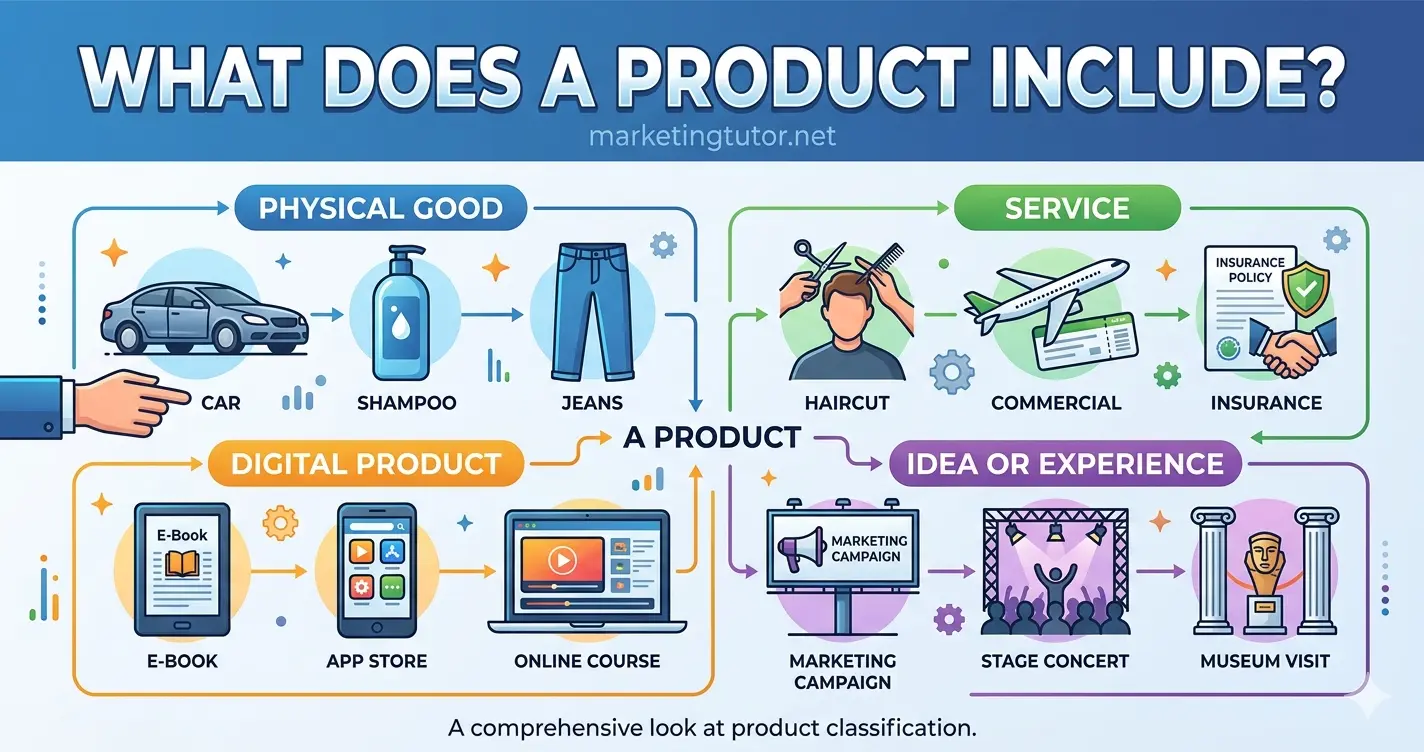
- A physical good is a car, a bottle of shampoo, a pair of jeans
- A service is a haircut, a plane ticket, an insurance policy
- A digital product can be an e-book, a mobile app, an online course
- An idea or experience may be a marketing campaign, a concert, a museum visit
The common thread? Each one is offered to a market to satisfy a specific need or want.
Three Levels of a Product
Marketers do not just think about what a product is. They think in three layers. Each layer adds more value for the customer. Understanding these levels helps businesses build better products and market them more effectively.
1. Core Product
A core product is the fundamental benefit the buyer actually wants. Not the product itself, but the problem it solves.
For example, Revlon doesn’t sell lipstick, it sells confidence and beauty. Coca-Cola doesn’t sell a fizzy drink but sells refreshment and a moment of happiness. The core product is always about the why, not the what.
Read more: What is a Core Product?
2. Actual Product
An actual product is the physical or tangible form of the core benefit. It includes the brand name, features, design, packaging, and quality level.
Take an iPhone as an example, the core product is communication and connectivity. The actual product is the device itself. Its slim design, Face ID, iOS software, and Apple branding are all part of the actual product.
3. Augmented Product
An augmented product means everything extra that comes with the actual product. Warranties, customer support, free delivery, installation services, loyalty programs.
When Samsung sells a TV, they often include free installation, a warranty, and a customer service hotline. That bundle of extras is the augmented product. It’s often the reason customers choose one brand over another.
Read more: What is an Augmented Product?
Characteristics of a Product
Not everything qualifies as a product in the marketing sense. A well-defined product usually has several key traits.
| Characteristic | What It Means | Example |
| Utility | It solves a problem or fulfills a need | Pain reliever removes a headache |
| Features | Unique qualities that separate it from competitors | AirPods’ noise cancellation |
| Quality | Meets or exceeds customer expectations | Toyota’s reliability ratings |
| Branding | A name, logo, or symbol that creates identity | Apple’s logo |
| Packaging | Protects the product and attracts buyers | iPhone’s minimalist box |
| Pricing | Set at a level the market accepts | Competitive pricing vs premium pricing |
| Availability | Accessible when and where buyers need it | Amazon’s 2-day shipping |
| Design | Improves function or visual appeal | Tesla’s interior layout |
| Warranty | Provides post-purchase assurance | Dell’s 1-year hardware warranty |
Types of Products
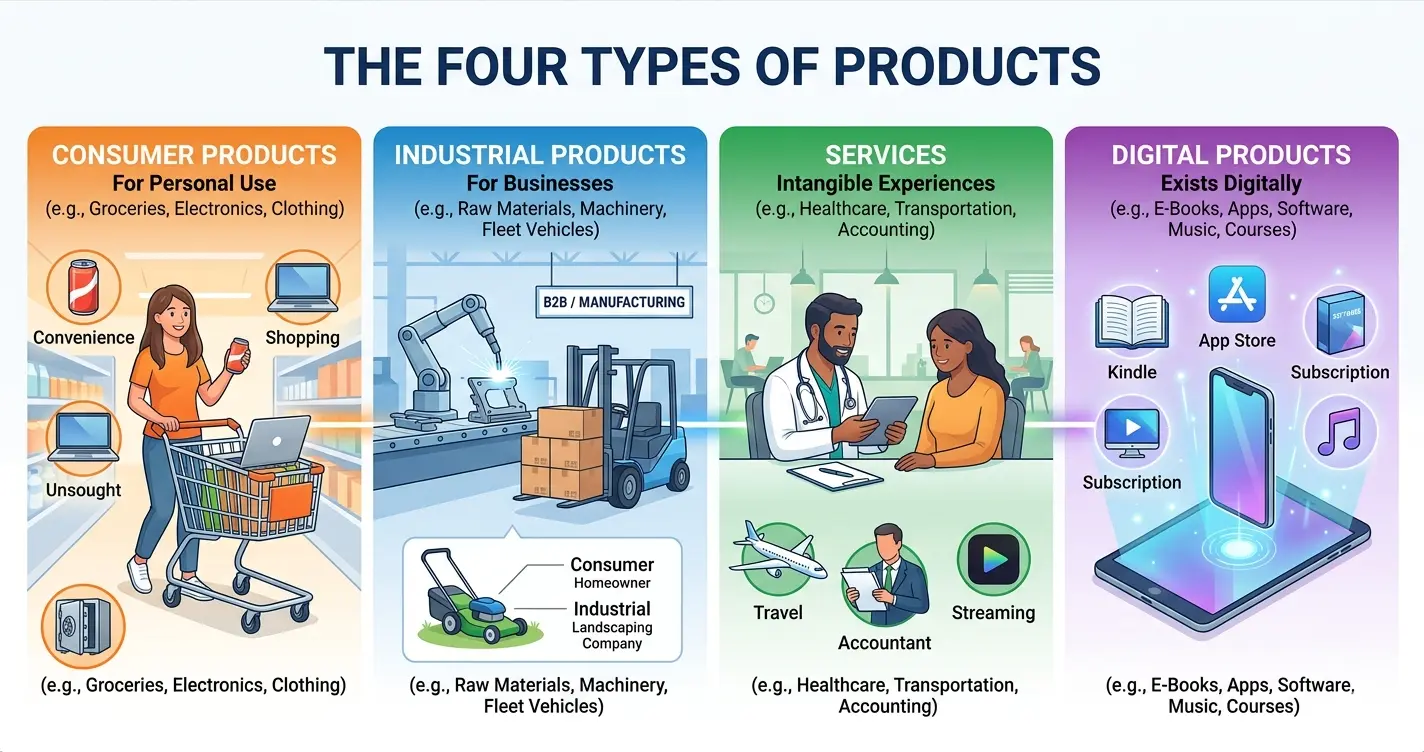
When you walk into any store or open any app, and you’ll find hundreds of different products. Marketers organize them into four main categories.
Consumer Products
Consumer products are finished goods bought by everyday people for personal use, i.e., groceries, clothing, electronics, and household items.
Consumer products break down further into convenience products (bought often and quickly, like a can of Pepsi), shopping products (compared before buying, like a laptop), specialty products (unique items people will seek out, like a Rolex), and unsought products (things people don’t actively look for, like life insurance). According to the data from the U.S. Census Bureau, retail sales alone top $7 trillion annually, most of it driven by consumer products.
Read more: Types of Consumer Products
Industrial Products
These products go to businesses, not consumers. They’re used in manufacturing, operations, or resale.
A steel company buys iron ore as a raw material. A printing shop buys industrial printers. A restaurant buys commercial-grade kitchen equipment. The same lawnmower sold to a homeowner is a consumer product. Sold to a landscaping company, it’s an industrial product. The buyer and purpose determine the category.
Services
A service is intangible. You can’t store it, touch it, or return it once it’s performed.
Doctors, lawyers, accountants, airlines, hotels, and streaming platforms all sell services. According to Statista, the U.S. service sector accounts for over 77% of GDP, making services the largest product category in the American economy.
Read more: What is a Service?
Digital Products
Digital products exist only in digital form. No physical delivery needed.
E-books, mobile apps, software licenses, online courses, templates, music files, and stock photos are all digital products. The U.S. is the world’s largest digital products market. If you’ve ever bought a Kindle book on Amazon, subscribed to Adobe Creative Cloud, or downloaded a Spotify playlist, you’ve bought a digital product.
Read more: What is a Digital Product?
Tangible vs Intangible Products
One of the most basic ways to classify products is by whether you can physically touch them.
| Tangible Product | Intangible Product | |
| Can you touch it? | Yes | No |
| Can you store it? | Yes | Usually no |
| Ownership | Transferred to buyer | Often licensed or experienced |
| Examples | Laptop, car, clothing | Software, haircut, consulting |
| Quality check | Before purchase | Only after experience |
Product vs Service: Key Difference
People mix these up all the time. Here’s a clean comparison.
| Factor | Product | Service |
| Form | Tangible or digital | Intangible |
| Ownership | Buyer owns it | Buyer experiences it |
| Storage | Can be stored | Cannot be stored |
| Consistency | Standardized | Varies by provider |
| Return policy | Usually returnable | Usually non-refundable |
| Example | iPhone, book, car | Haircut, legal advice, flight |
Honestly, the line between product and service keeps blurring. A car (product) now comes with connected services, OTA software updates, and subscription features. Most modern businesses sell both.
Real-Life Product Examples (USA Brands)
Sometimes the simplest way to understand a concept is through examples you already know.
| Product Type | Brand | What They Sell |
| Physical Good | Nike | Athletic shoes, apparel |
| Service | Delta Airlines | Air travel experience |
| Digital Product | Adobe | Creative software subscriptions |
| Industrial Product | Caterpillar | Construction equipment |
| Consumer Good (food) | Coca-Cola | Beverages |
| Subscription Service | Netflix | Streaming content |
Conclusion
Every business in America, from a food truck in Austin to Apple in Cupertino, starts with the same question: what product do we offer?
A product isn’t just a thing. It’s a promise. It’s a solution to someone’s problem, packaged in a way people are willing to pay for. Whether it’s a physical good, a digital file, or a 30-minute consulting call, the product is always at the center of the marketing conversation.
Understanding what a product is, and the layers around it, gives you a clearer view of how businesses create value and how marketing actually works.
FAQs About Products
In marketing, a product is anything a business offers to satisfy a customer’s need or want. It is not only physical goods. Marketing weighs a product as total value packages, including the brand, packaging, service, and post-purchase experience. Kotler’s definition covers physical objects, services, ideas, places, and even people (think personal branding). Marketers use the three levels model (core, actual, augmented) to build and position products strategically.
The four main types are consumer products, industrial products, services, and digital products. Consumer products go to everyday buyers for personal use. Industrial products go to businesses for operations or manufacturing. Services are intangible actions like consulting or repairs. Digital products exist only online, like software or e-books. Most companies sell more than one type, and the lines often overlap.
A product is usually something you can own, store, or resell. A service is an action or experience that can’t be stored or returned once delivered. When you buy a laptop, you own it. When you buy a haircut, you experience it. That’s the core difference. In today’s economy, most businesses sell a blend of both, like a phone (product) with a data plan (service).
The three levels include core product, actual product, and augmented product. The core product is the basic benefit or problem the buyer wants solved. The actual product is the physical form it takes, including its features, brand, and design. The augmented product includes everything extra, like warranties, customer service, and delivery. Each level adds value and helps businesses compete on more than just price.
Philip Kotler defined a product as: “Anything that can be offered to a market for attention, acquisition, use or consumption that might satisfy a want or need.” This definition is intentionally broad. It includes physical goods, services, ideas, places, organizations, and people. Kotler’s definition shaped how modern marketers think about products, moving beyond just physical items to anything that delivers value to a buyer.
A tangible product is something you can physically touch, hold, and own. Cars, books, clothing, food, and electronics are all tangible products. They can be inspected before purchase, stored in a warehouse, and returned if faulty. Most tangible products also come with intangible layers, like a brand reputation or a warranty.

