


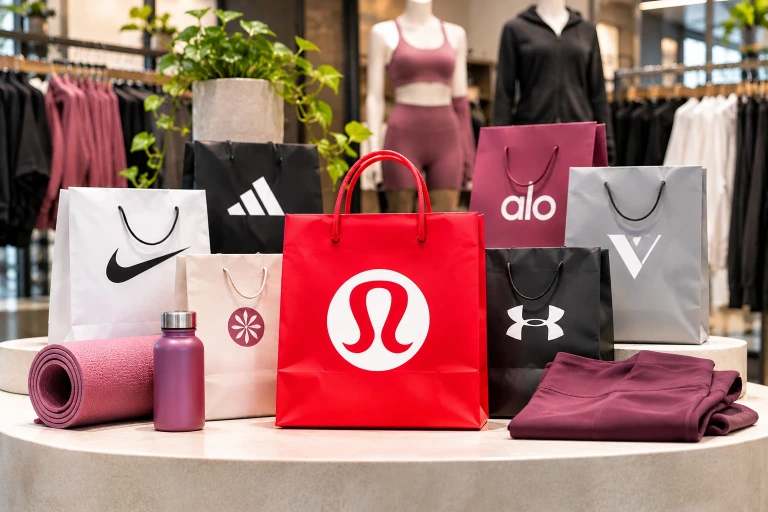
Lululemon’s biggest competitors are Alo Yoga and Vuori, two fast-growing athleisure brands that sell to the same shoppers. By size, Nike is the largest rival. Other main Lululemon competitors include Athleta, Adidas, Under Armour, Puma, Gymshark, Fabletics, and Sweaty Betty.
I first wrote about Lululemon’s rivals in 2019. A lot has changed since then. Lululemon’s sales are falling in the US, new brands are opening stores fast, and a new CEO took over in September 2026. This updated list uses the latest sales data for every brand.
Key Takeaways
- Alo Yoga and Vuori are Lululemon’s closest rivals. Reuters named both as the upstarts competing with it in the US in June 2026.
- Nike is the biggest rival by size, with $46.4 billion in fiscal 2026 revenue, about four times Lululemon’s $11.1 billion in 2025.
- Lululemon’s revenue fell 4% in the quarter ended August 2, 2026, and sales in the Americas fell 8%.
- Not every rival is winning. Athleta, Under Armour, and Puma all reported falling sales in 2026.
- In China, Lululemon also faces local brands like Maia Active and Xexymix.
Who Are Lululemon’s Main Competitors?
Here are the 10 main Lululemon competitors at a glance.
| # | Competitor | Owner | Latest sales | Type |
|---|---|---|---|---|
| 1 | Alo Yoga | Color Image Apparel (private) | Parent near $2B (Forbes estimate, 2025) | Direct |
| 2 | Vuori | Private (founder Joe Kudla) | About $1B (analyst estimate, 2024) | Direct |
| 3 | Athleta | Gap Inc. | $264M in Q2 2026 (down 12%) | Direct |
| 4 | Nike | Public (NKE) | $46.4B in fiscal 2026 (flat) | Indirect |
| 5 | Adidas | Public (Germany) | €24.8B in 2025 (up 13%*) | Indirect |
| 6 | Under Armour | Public (UAA) | $4.97B in fiscal 2026 (down 4%) | Indirect |
| 7 | Puma | Public (Germany) | €7.3B in 2025 (down 8%*) | Indirect |
| 8 | Gymshark | Private (founder-led) | £646M in fiscal 2025 (up) | Direct |
| 9 | Fabletics | TechStyle Fashion Group | Over $1B in 2025 (up 18%) | Direct |
| 10 | Sweaty Betty | Wolverine World Wide | Up 4.6% in Q4 2025 | Direct |
*Currency-neutral or currency-adjusted change. Sources: company reports and news coverage listed at the end.
Who Is Lululemon’s Biggest Competitor?
It depends on how you measure it.
By overlap, Alo Yoga and Vuori lead. A 2024 Earnest Analytics study found that 63% of Alo Yoga shoppers and 52% of Vuori shoppers also buy from Lululemon, as reported by Retail Dive. Each brand gained about 1% market share in a year.
By size, Nike leads. Nike’s fiscal 2026 revenue was $46.4 billion. That is about four times Lululemon’s 2025 revenue of $11.1 billion.
For me, Alo Yoga and Vuori are the bigger threat. Nike is far larger, but Alo and Vuori share far more of Lululemon’s own customers.
1. Alo Yoga
Alo Yoga is a yoga and athleisure brand founded in 2007 in Los Angeles by Danny Harris and Marco DeGeorge. It is based in Beverly Hills and owned by its parent company, Color Image Apparel.
- Size: Forbes estimated in April 2025 that Color Image Apparel’s revenue was approaching $2 billion.
- Stores: Alo had fewer than a dozen stores in early 2023 and more than 150 worldwide by June 2026, according to SGI Europe.
- Why it matters: 63% of Alo shoppers also buy from Lululemon, the highest overlap in the 2024 Earnest Analytics study.
Is Alo Yoga better than Lululemon? Neither is better for every shopper. Alo is smaller and growing fast, while Lululemon is much larger and more established. The right choice depends on fit, style, and what you use the clothes for.
2. Vuori
Vuori launched in 2015 in Encinitas, California. Founder Joe Kudla started it with men’s activewear.
- Value: Vuori raised $825 million in November 2024 at a $5.5 billion valuation, in a round led by General Atlantic and Stripes.
- Sales: Analysts estimated its revenue at around $1 billion in 2024. The company says it has been profitable since 2017.
- Stores: Vuori was on a path to more than 100 stores worldwide by the end of 2025, according to Retail Dive.
The strongest data point here comes from GlobalData. The share of Lululemon customers who also shopped at Vuori rose from 1.2% in 2018 to 7.8% by late 2024, as reported by CNBC.
3. Athleta
Athleta is a women’s athletic apparel brand founded in 1998. Gap Inc. bought it in 2008 for about $150 million.
Athleta competes with Lululemon for women shoppers, but it is having a hard year. In the quarter ended August 1, 2026, Athleta’s net sales fell 12% to $264 million, according to Gap Inc.’s second-quarter report. That makes it a direct rival that is losing ground, not gaining it.
4. Nike
Nike is the largest Lululemon competitor by revenue. It reported $46.4 billion in fiscal 2026 revenue, flat from the year before and down 2% on a currency-neutral basis.
Nike’s business is much wider than Lululemon’s, so the two overlap in only part of what they sell. There is also a new link between the two: Lululemon’s CEO, Heidi O’Neill, spent more than 25 years at Nike before joining in September 2026. You can read the full story in our guide on who owns Lululemon, and see Nike’s own rivals in our list of Nike competitors.
5. Adidas
Adidas is a German sportswear company led by CEO Bjorn Gulden. It reported record 2025 revenue of €24.8 billion, up 13% on a currency-neutral basis.
Like Nike, Adidas is a much broader business than Lululemon. Of the four big sportswear companies on this list, Adidas has the strongest recent growth. See how it compares in our Nike vs Adidas breakdown and our list of Adidas competitors.
6. Under Armour
Under Armour is a US performance sportswear brand. Its revenue fell 4% to about $4.97 billion in the fiscal year ended March 31, 2026. North America, its biggest region, fell 8% to $2.86 billion.
It is now less than half Lululemon’s size by revenue. For more, see our list of Under Armour competitors.
7. Puma
Puma is a German sportswear brand led by CEO Arthur Hoeld. Its 2025 sales fell 8.1% on a currency-adjusted basis to €7.3 billion, and it posted a loss from continuing operations of €643.6 million. Puma calls 2026 a transition year.
Like Under Armour, Puma is a shrinking rival right now, focused on fixing its own business.
8. Gymshark
Gymshark is a British fitness clothing brand founded in 2012 by Ben Francis and Lewis Morgan. It is based in Solihull, England.
- Sales: Revenue rose to £646 million (about $871 million) in the year ended July 31, 2025, its 13th straight year of sales growth.
- US push: Gymshark opened its first permanent US store at Roosevelt Field on Long Island and a flagship on Bond Street in Manhattan.
- Investors: General Atlantic bought a 21% stake in 2020, valuing the company at £1.25 billion.
Its new US stores put it in more direct competition with Lululemon on its home ground.
9. Fabletics
Fabletics is an activewear brand founded in 2013 by Adam Goldenberg, Don Ressler, and Ginger Ressler. It is part of TechStyle Fashion Group and based in El Segundo, California.
Fabletics uses a membership model. Its VIP Membership Program costs $59.95 a month. Revenue passed $1 billion for the first time in 2025, up more than 18%, and it had 135 stores and 2.7 million VIP members, according to Modaes. It added menswear in 2020, with Kevin Hart as the face of the line.
10. Sweaty Betty
Sweaty Betty is a British women’s activewear brand. Wolverine World Wide bought it in 2021 for about $410 million. At the time, it had about 60 stores in the UK.
Sweaty Betty’s revenue grew 4.6% in the fourth quarter of 2025. It is a smaller rival, but one of the few on this list with growing sales.
What Is the Difference Between Direct and Indirect Competitors?
Direct competitors sell almost the same products to the same shoppers. Indirect competitors overlap in some products but have a different main business.
| Direct competitors | Indirect competitors | |
|---|---|---|
| Brands | Alo Yoga, Vuori, Athleta, Gymshark, Fabletics, Sweaty Betty | Nike, Adidas, Under Armour, Puma |
| Main focus | Activewear and athleisure | Sportswear across many sports |
| Overlap with Lululemon | Most of what they sell | Only part of what they sell |
Which Brands Are Like Lululemon?
If you want a Lululemon alternative, the best match depends on who you are shopping for.
| If you want… | Look at | Why |
|---|---|---|
| Yoga and lifestyle wear | Alo Yoga | Shares the most shoppers with Lululemon |
| Men’s activewear | Vuori | The brand started with men’s clothing |
| Women’s athletic wear | Athleta, Sweaty Betty | Both focus on women shoppers |
| Gym and training clothes | Gymshark | A fitness clothing brand now opening US stores |
| A membership model | Fabletics | VIP members pay $59.95 a month |
Why Is Lululemon Losing Ground to Competitors?
Lululemon’s numbers show the pressure. In the quarter ended August 2, 2026, its revenue fell 4% to $2.4 billion and comparable sales dropped 9%, according to its second-quarter report. Sales in the Americas fell 8%, while China grew 4%.
The US is Lululemon’s biggest market, and that is where its rivals are growing. In June 2026, Reuters reported that Lululemon faced tough US competition from Alo Yoga and Vuori as they grow their store networks. Lululemon now expects full-year 2026 revenue of $10.35 billion to $10.5 billion, below its $11.1 billion in 2025.
Who are Lululemon’s competitors in China? Reuters named Maia Active and Xexymix as rivals in China. Lululemon’s China sales are still growing, unlike in the Americas.
To see the full picture of these pressures, read our Lululemon SWOT analysis. To see who Lululemon sells to, see our guide to Lululemon’s target market.
Bottom Line
Lululemon still earns more than most of its rivals, but the brands that worry me for Lululemon are not the biggest ones. For me, Alo Yoga and Vuori are the real competitors: they share many of the same shoppers, and they keep opening stores while Lululemon’s US sales fall. Nike, Adidas, Under Armour, and Puma matter, but they are fighting on a wider field. The next year under its new CEO will show whether Lululemon can win its core shoppers back.
Frequently Asked Questions
By shopper overlap, Alo Yoga and Vuori are Lululemon’s biggest competitors. A 2024 study found 63% of Alo shoppers and 52% of Vuori shoppers also buy Lululemon. By revenue, Nike is the largest rival, with $46.4 billion in fiscal 2026.
Yes. Athleta is a direct competitor that sells women’s athletic wear to many of the same shoppers. Gap Inc. owns it. Athleta’s sales fell 12% to $264 million in the quarter ended August 1, 2026.
No. Vuori is a separate private company led by its founder, Joe Kudla, who started it in 2015. Investors valued it at $5.5 billion in 2024, and it competes with Lululemon, starting out in men’s activewear.
Lululemon is bigger. It made $11.1 billion in revenue in 2025, while Under Armour made about $4.97 billion in its fiscal year ended March 31, 2026. Under Armour’s sales fell 4% that year, and its North America sales fell 8%.
Yes. Gymshark is a British fitness clothing brand that competes in gym and training wear. Its revenue rose to £646 million in the year ended July 31, 2025, and it has opened its first permanent stores in the US.

