



A market positioning statement, also called a positioning statement, is a short internal statement that defines who your product is for, what category it competes in, what makes it different, and why customers should believe you. It keeps your marketing, sales, and product teams telling the same story.
A positioning statement is not a slogan, and customers usually never see it. It is a guide for every decision about how you present your brand. In this guide, you will get a fill-in template, a step-by-step method, and real brand examples.
Key Takeaways
- A positioning statement has five parts: target market, frame of reference, point of differentiation, key benefit, and reason to believe.
- It is an internal tool, not an ad or a tagline.
- The most common template is: For [target market], [brand] is the [point of differentiation] among all [frame of reference] because [reason to believe].
- Keep it to one or two sentences.
- Most companies publish a mission statement, not a positioning statement. Do not confuse the two.
What Is a Market Positioning Statement?
A market positioning statement explains the place you want your brand to hold in your customers’ minds. Doug Stayman, writing for Cornell’s eCornell, describes it as “an internal tool,” even though it may sound like promotional copy.
It answers four questions in one or two sentences:
- Who is the product for?
- What category does it compete in?
- How is it different from rivals?
- What proof backs that up?
A positioning statement is one part of a larger market positioning strategy. The strategy decides where you want to stand in the market. The statement puts that decision into words.
Positioning Statement Structure
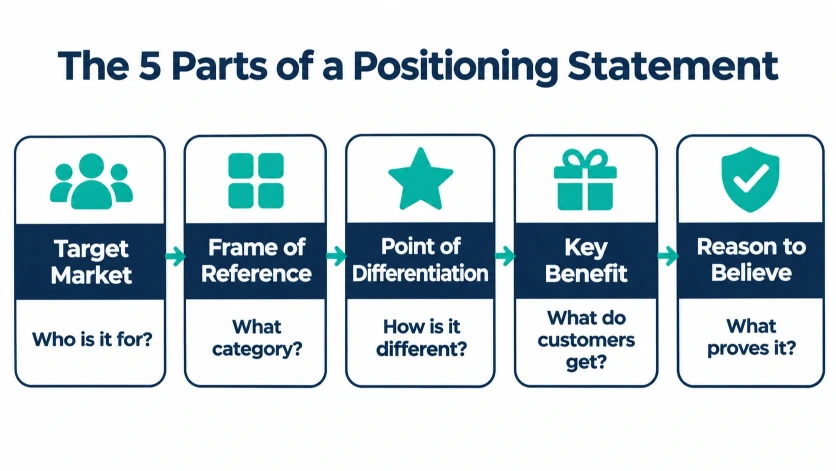
Every strong positioning statement includes the same five elements:
| Element | What it answers | Example (Volvo, our wording) |
|---|---|---|
| Target market | Who is it for? | Families who put safety first |
| Frame of reference | What category does it compete in? | Cars |
| Point of differentiation | How is it different? | Built around safety |
| Key benefit | What does the customer get? | Peace of mind on the road |
| Reason to believe | What proves it? | Volvo introduced the three-point safety belt in 1959 |
The reason to believe is the part most people skip. Without proof, your point of difference is only a claim. Learn how to pick the right customer group in our guide to target market.
Positioning Statement Template
Here are two templates. Copy one and fill in the brackets.
Template 1: The classic formula
This version comes from Cornell’s eCornell:
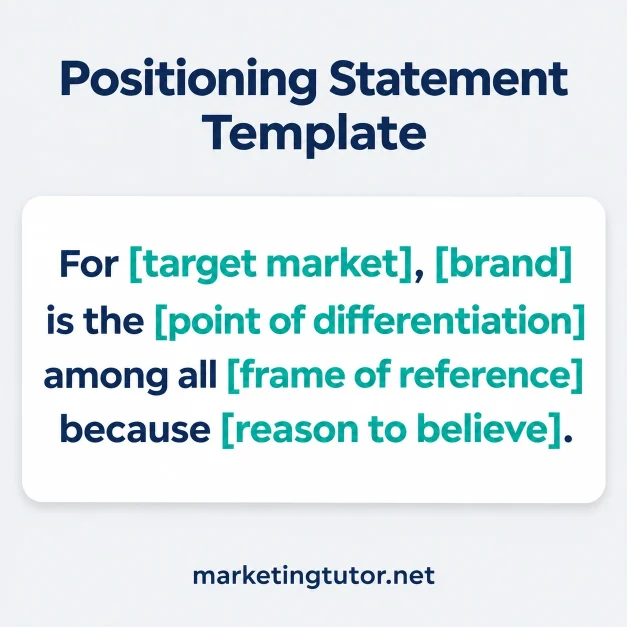
For [target market], [brand] is the [point of differentiation] among all [frame of reference] because [reason to believe].
Template 2: The problem-and-alternative formula
This version builds on the questions Geoffrey Moore lists in his book Crossing the Chasm: who the customer is, their reason to buy, and the alternative you replace.
For [target customer] who [need or problem], [brand] is a [category] that [key benefit]. Unlike [main alternative], [brand] [point of differentiation].
Use Template 1 for a whole brand. Use Template 2 for a single product, or when you are clearly replacing an existing option.
How to Write a Market Positioning Statement
Follow these five steps:
- Define your target market. Be specific. “Busy parents in the US who cook at home” is better than “everyone.” Our guide to market segmentation shows how to split a market into groups.
- Name your frame of reference. Decide which category customers compare you with. A meal kit may compete with grocery stores, not just other meal kits.
- Find your point of differentiation. Pick the one thing you do better than rivals that customers care about. This is your competitive advantage.
- Add a reason to believe. Use facts: a number, a record, a patent, or a customer result.
- Test it. Cornell’s guidelines say a good statement is easy to recall, sets you apart, is believable, is a position you can own alone, helps judge marketing decisions, and leaves room to grow.
What is a good positioning statement? One that a new employee could read and then make the right call on an ad, a price, or a product feature without asking anyone.
Brand vs Product Positioning Statement
A brand positioning statement covers the whole company. A product positioning statement covers one product inside it.
| Brand positioning statement | Product positioning statement | |
|---|---|---|
| Scope | The entire brand | One product or product line |
| Changes | Rarely | When the product or market changes |
| Example use | Brand ads, store design, hiring | Launch plans, product pages, sales scripts |
A brand can have one brand positioning statement and several product positioning statements. Each product statement should fit inside the brand statement.
Positioning Statement Examples
Most companies never publish their positioning statements, because they are internal. What companies do publish is a mission or vision. Below, each example shows the brand’s published statement first, then a positioning statement we wrote from public facts. The written statements are our examples, not the companies’ own.
1. Volvo
Published (Volvo’s safety vision): “Our aim is that no one should be killed or seriously injured in a new Volvo.”
Our example: For families who put safety first, Volvo is the car brand built around protecting the people inside, because it introduced the three-point safety belt in 1959, which Volvo estimates has saved more than one million lives.
2. Nike
Published (Nike’s mission): “Bring inspiration and innovation to every athlete* in the world.” The footnote reads: “*If you have a body, you are an athlete.”
Our example: For anyone who moves, because Nike counts every person with a body as an athlete, Nike is the sportswear brand that brings inspiration and innovation to everyday sport, backed by $46.4 billion in fiscal 2026 sales.
Nike’s footnote is a smart positioning move. It widens the target market from athletes to everyone. Read more in our Nike SWOT analysis.
3. Starbucks
Published (mission, updated in 2025): “To be the premier purveyor of the finest coffee in the world, inspiring and nurturing the human spirit, one person, one cup and one neighborhood at a time.”
Our example: For coffee lovers who want a place to connect, Starbucks is the coffeehouse that pairs the finest coffee with a welcoming space to gather, because 35.8 million active US members use its Rewards program.
4. Costco
Published (annual report): “We do not focus in the short-term on maximizing prices charged.”
Our example: For shoppers who buy in bulk to save money, Costco is the membership warehouse that keeps prices low by carrying fewer than 4,000 items per warehouse, which is why 92.3% of its US and Canadian members renew.
5. A small business
This one is fully made up, to show the template for a local business.
Our example: For busy parents in Austin who want healthy school lunches, FreshBox is the meal-prep service that delivers kid-approved lunches every Sunday, because every menu is planned by a registered dietitian.
The small business wins by narrowing its target market. This is a focus strategy, and it lets a small brand beat bigger rivals in one niche.
Positioning Statement vs Value Proposition vs Mission Statement
These four statements are often mixed up. Here is how they differ:
| Statement | Who reads it | What it does | Example |
|---|---|---|---|
| Positioning statement | Your team | Defines your place in the market | See examples above |
| Value proposition | Customers | Tells customers the benefit they get | Website headlines and sales copy |
| Mission statement | Everyone | States the company’s purpose | McDonald’s: “make delicious feel-good moments easy for everyone” |
| Tagline | Customers | A short, catchy public line | Ad slogans |
Mission statements can change a lot. Tesla’s master plan page now says its mission is “to build a world of amazing abundance.” A positioning statement is narrower: it is about one market and one point of difference.
Common Positioning Statement Mistakes
- Targeting everyone. If your target market is “all consumers,” you have no position.
- Skipping the proof. A point of difference without a reason to believe is only a claim.
- Writing an ad. A positioning statement guides the team. It does not need to sound catchy.
- Claiming what rivals also offer. “High quality” or “great service” does not set you apart if competitors say the same thing.
- Picking a position you cannot own. Cornell’s guidelines say the brand should be able to own the position alone.
Bottom Line
For me, the positioning statement is the most useful sentence a small business can write, and the most often skipped. It takes little time to write, and it keeps every message consistent. Start with Template 1, fill in all five parts, and back your point of difference with one hard fact. If you cannot find that fact, your position is not ready yet. For the bigger picture, read our guide to market targeting.
Frequently Asked Questions
McDonald’s has not published an official positioning statement. Its published mission is “to make delicious feel-good moments easy for everyone,” and its listed values are serve, inclusion, integrity, community, and family. So treat any McDonald’s “positioning statement” online that does not link to McDonald’s as someone’s own example.
A positioning statement is internal. Cornell’s eCornell calls it “an internal tool” for guiding marketing decisions. Customers see the result in your ads, prices, and products, but rarely see the statement itself.
Keep it to one or two sentences. It should include all five parts: target market, frame of reference, point of differentiation, key benefit, and reason to believe. If it runs longer, you are probably adding ad copy.
Most do not. Because the statement is an internal tool, companies usually publish a mission or vision instead, like Nike’s mission or Volvo’s safety vision. Treat any “official” positioning statement online with caution unless it links to the company.
Marketing, sales, and product teams use it most. It acts as a shared guide, so every ad, sales pitch, and product decision tells the same story about who the brand serves and why it is different.

