



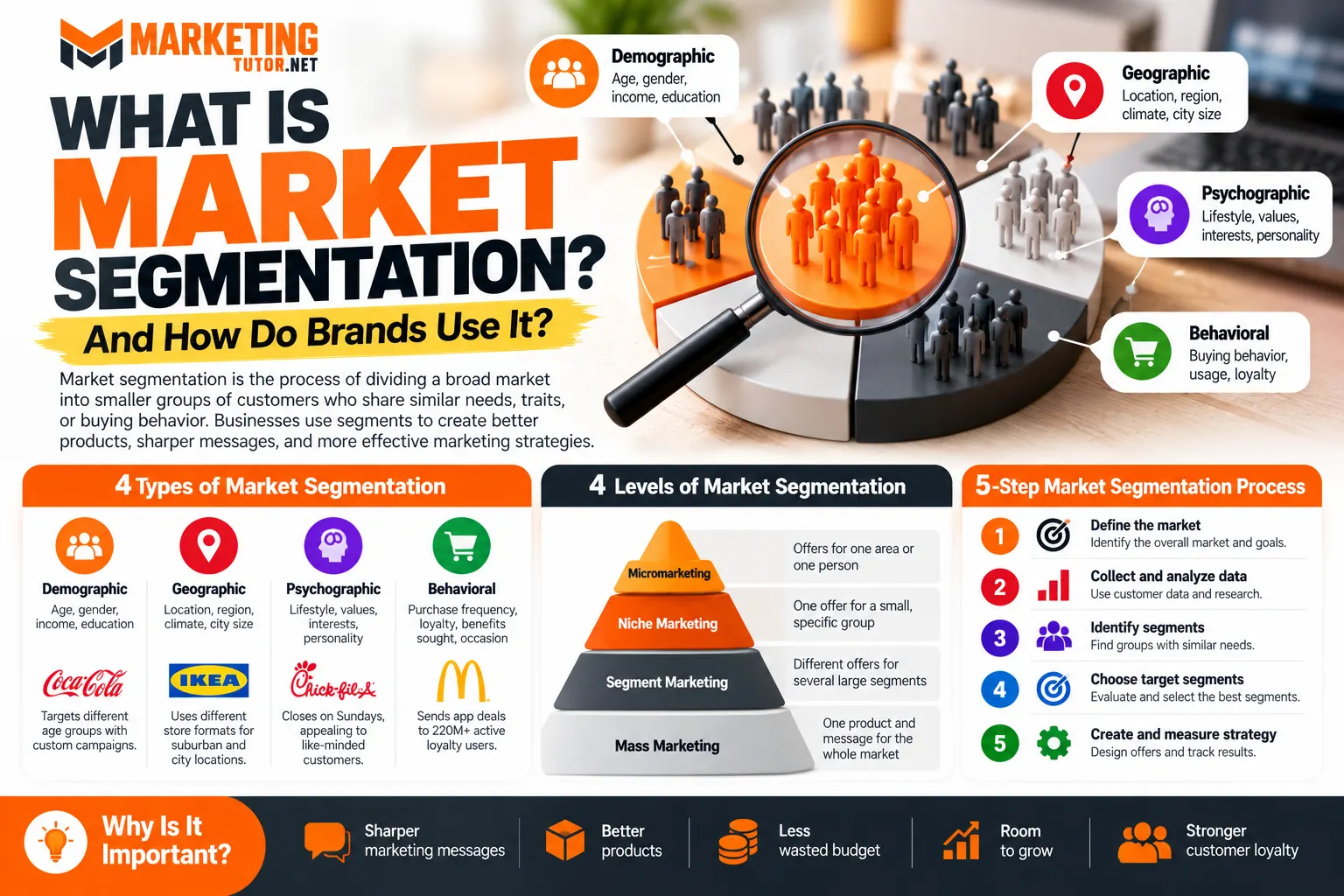
Market segmentation is the process of dividing a broad market into smaller groups of customers who share similar needs, traits, or buying behavior. Each group is called a market segment, and businesses use segments to decide who to sell to and how to reach them.
Segmentation is the first step of the segmentation, targeting, and positioning (STP) model. Every brand from Coca-Cola to a local gym uses it, whether it calls it segmentation or not. This guide covers the four types, the levels of segmentation, what makes a segment worth targeting, and a five-step process, with real examples from US brands.
Key Takeaways
- Market segmentation divides a market into groups of customers with shared needs, traits, or behavior, so a business can target the right people.
- The four main types are demographic, geographic, psychographic, and behavioral segmentation; B2B companies add firmographic segmentation.
- The four levels of segmentation run from mass marketing (one offer for all) to micromarketing (offers for one city or one person).
- A useful segment is measurable, accessible, substantial, differentiable, and actionable.
- Segmentation has limits: it costs time and money, and segments built on poor data lead to poor decisions.
What Is a Market Segment?
A market segment is one group of customers inside a larger market who respond in a similar way to a product, price, or message. “Budget-minded parents in the suburbs” is a segment. “All parents” is a market.
What is the difference between a market segment and market segmentation? A segment is the group. Segmentation is the process of finding and defining those groups. One segmentation study usually produces several segments.
The idea goes back to Wendell Smith, who described market segmentation in a 1956 Journal of Marketing article. He argued that businesses could succeed by adjusting products to fit different groups of buyers, instead of trying to make every buyer want the same product.
Why Is Market Segmentation Important?
Segmentation helps a business spend its money where it is most likely to pay off. Its main benefits are:
- Sharper marketing messages: an ad written for new parents speaks to them more directly than an ad written for everyone.
- Better products: knowing what a segment needs helps you design the right features, sizes, and prices.
- Less wasted budget: you stop paying to reach people who will never buy.
- Room to grow: new segments show where to expand next.
- Stronger customer loyalty: customers stay longer when offers fit what they want.
What is segmentation in marketing used for? It shapes nearly every marketing decision: which products to make, what to charge, where to sell, and which channels and messages to use. It is the starting point for choosing a target market.
What Are the 4 Types of Market Segmentation?
The four main types of market segmentation are demographic, geographic, psychographic, and behavioral. Most businesses combine two or more.
| Type | Groups Customers By | Common Variables | Real Example |
|---|---|---|---|
| Demographic | Who they are | Age, gender, income, education, family size | Young adults are 41% of people considering IKEA in the US, versus 29% of all adults (YouGov) |
| Geographic | Where they are | Country, region, city size, climate, urban or rural | IKEA runs big suburban stores and smaller city-center formats |
| Psychographic | How they think and live | Values, interests, personality, lifestyle | Chick-fil-A closes on Sundays, which appeals to customers who share its values |
| Behavioral | How they buy | Purchase frequency, loyalty, benefits sought, occasion | McDonald’s sends app deals to about 220 million active loyalty users |
What is firmographic segmentation? Firmographic segmentation is the B2B version of demographic segmentation. It groups business customers by industry, company size, revenue, location, and buying process. A software company might sell one plan to small businesses with under 50 employees and another to large enterprises.
Are there 5 or 6 types of market segmentation? Some sources list more than four because they count firmographic, needs-based, or technographic (technology used) segmentation separately. These are variations of the four main types, not different methods.
For a closer look at how businesses group the people who already buy from them, see our guide to customer segmentation.
What Are the Levels of Market Segmentation?
The levels of market segmentation describe how finely a business splits its market. Philip Kotler and Gary Armstrong describe four levels, from no segmentation at all to segments of one.
| Level | What It Means | Who It Suits | Example |
|---|---|---|---|
| Mass marketing | One product and message for the whole market | Basic products most people buy the same way | A store-brand table salt sold to every shopper |
| Segment marketing | Different offers for several large segments | Companies with many products or brands | Marriott runs Ritz-Carlton for luxury travelers, Courtyard for business travelers, and Fairfield for value-minded travelers |
| Niche marketing | One offer for a small, specific group | Small businesses and specialist brands | Lululemon started by selling yoga apparel to women before expanding |
| Micromarketing | Offers for one area (local marketing) or one person (individual marketing) | Brands with strong customer data | McDonald’s personalized app deals; IKEA’s small city-center stores |
Which level of market segmentation is best? It depends on your product, budget, and competition. A small business usually does best with niche marketing, because it can serve one group better than a large competitor can. Our guide to the advantages and disadvantages of niche marketing covers the trade-offs. A large brand with many products often uses segment marketing, the way Coca-Cola sells 32 brands that each make more than $1 billion a year.
Is mass marketing still used? Yes, but rarely on its own. Most mass-market brands now use segmentation inside their mass market. McDonald’s serves almost everyone, but about 36% of its US visitors come from areas with median household incomes under $50,000, according to Placer.ai, which is why value deals are central to its strategy.
What Makes a Market Segment Useful?
Not every group you can define is worth targeting. Kotler and Armstrong list five characteristics of an effective segment:
| Characteristic | Question to Ask | Example of a Fail |
|---|---|---|
| Measurable | Can we estimate its size and buying power? | “People who love quality” is hard to count |
| Accessible | Can we reach it through channels we can afford? | A segment that uses no online or local media you can buy |
| Substantial | Is it large or profitable enough to serve? | A group of 50 buyers for a product that needs 5,000 |
| Differentiable | Does it respond differently from other segments? | Two “segments” that want the same thing at the same price |
| Actionable | Can we build a marketing program for it? | A segment that needs a product you cannot make |
These characteristics turn segmentation from a guessing game into a decision tool. If a segment fails two or more tests, merge it with another or drop it.
How Do You Do Market Segmentation?
You can segment a market in five steps. The example follows a hypothetical fitness studio in Denver.
- Define the market and the goal. Decide which market you are studying and what decision the segmentation should support. Example: The studio wants to fill its empty early-morning and midday class slots.
- Collect customer data. Use your own sales records, website and social analytics, and short customer surveys. For local demographics, the Census Bureau offers free data tools on population, age, and income by area. Our guide to types of market research explains which methods fit each need. Example: The studio reviews member sign-up forms, class attendance, and a five-question survey.
- Choose your segmentation bases and build segments. Pick the variables that best explain differences in buying behavior, then group customers. Start with two or three variables, not ten. Example: Using schedule and life stage, the studio finds four groups: office workers, new parents, college students, and retirees.
- Evaluate each segment. Score each segment against the five characteristics above, plus your competition and your own strengths. Example: Office workers are large, nearby, and willing to pay for early classes. College students are price-sensitive and already served by a campus gym.
- Target, act, and measure. Choose your target segments, build offers for them, and track results by segment, such as sign-ups, revenue, and retention. Example: The studio launches 6 a.m. classes for office workers and checks attendance after 30 and 90 days.
How often should you redo market segmentation? Review your segments at least once a year, and sooner if sales patterns change, a new competitor arrives, or you launch a new product.
How Do Real Brands Use Market Segmentation?
Large US brands combine several types of segmentation. Here is how five of them do it:
| Brand | Main Segments | Types Used |
|---|---|---|
| Coca-Cola | Separate brands by age, sugar preference, and occasion; 51% of Gen Z would consider buying Coca-Cola, versus 35% of all Americans (YouGov) | Demographic, behavioral |
| IKEA | First apartments, young families, and budget-minded homeowners; IKEA Family members bring in 56% of US sales | Demographic, geographic, behavioral |
| McDonald’s | Families, value seekers, commuters, and app users | Demographic, behavioral |
| Nike | Performance athletes, everyday fitness buyers, sneaker fans, women, and kids | All four |
| Chick-fil-A | Suburban families, teens, and working adults; teens’ favorite restaurant in Piper Sandler’s fall 2025 survey | Demographic, psychographic |
What is Coca-Cola’s market segmentation? Coca-Cola splits its market by age, sugar preference, and drinking occasion, then gives each segment its own brand. Coke Zero Sugar targets people who want Coke taste without sugar, and it grew 14% in 2025.
For more cases across industries, including B2B and service businesses, see our full list of market segmentation examples.
What Is the Difference Between Market Segmentation, Customer Segmentation, and a Target Market?
These three terms are linked but not the same:
| Term | What It Is | Focus | Example |
|---|---|---|---|
| Market segmentation | Splitting a whole market, including people who have never bought from you | Finding new opportunities | All US coffee drinkers split by habit and budget |
| Customer segmentation | Splitting your existing customers | Keeping and growing current buyers | A coffee shop’s loyalty members split by visit frequency |
| Target market | The segment or segments you choose to serve | Deciding where to focus | Office workers who buy coffee before 9 a.m. |
Segmentation comes first, then you choose a target market, then you decide how to position your brand for it. Our market positioning guide covers that last step.
What Are the Limits of Market Segmentation?
Segmentation works only when it is done with care. Watch for these problems:
- Cost: research, separate products, and separate campaigns all cost more than one offer for everyone.
- Over-segmentation: splitting a market into too many tiny groups spreads your budget too thin.
- Poor data: segments based on guesses or a small, unrepresentative sample lead to wrong decisions.
- Stereotyping: demographic labels can miss real differences inside a group. Not every 25-year-old shops the same way.
- Privacy rules: collecting customer data brings legal duties. California’s CCPA, for example, gives consumers the right to know and delete the personal information businesses collect.
- Segments change: habits shift over time, so segments need regular review.
Bottom Line
Market segmentation is the step that turns “everyone” into customers you can actually reach. For me, the best segmentation is simple: two or three variables that clearly change how people buy, checked against real sales data. Start with one segment you can serve better than anyone else, measure the results, and add segments only when the first one is working.
Frequently Asked Questions
Market segmentation is sometimes called customer segmentation, consumer segmentation, or audience segmentation. Strictly, customer segmentation splits your existing buyers, while market segmentation splits the whole market, including people who have not bought from you yet.
A clothing brand that sells separate lines for children, teens, and adults is using demographic segmentation by age. A car maker that offers four-wheel-drive models in snowy states and smaller cars in big cities is using geographic segmentation.
Yes. A small business can segment its customers using sales records, simple surveys, and free Census Bureau data. Most small businesses do best by focusing on one segment they can serve better than larger competitors.
Market segmentation divides the market into groups of similar customers. Targeting comes next and decides which of those groups a business will actually serve. A business can identify five segments but choose to target only one or two of them.
B2B market segmentation groups business customers instead of individual consumers. Common variables include industry, company size, annual revenue, location, and how the company makes buying decisions. This approach is often called firmographic segmentation.
You need data on who your customers are, where they live, how they buy, and what they value. Good sources include your own sales and website data, customer surveys and interviews, and public data from the Census Bureau.

